- As climate change leads to more electricity blackouts and brownouts, the reliability of every day refrigeration is at risk.
- A new IEC Standard, together with solar innovations in Africa and Asia, demonstrate how cooling can continue when power grids falter.
Recognising this, the IEC has finalized IEC 63437, a standard for domestic and light commercial fridges designed for weak and unreliable or intermittent electricity supplies as well as for off-grid fridges designed to be directly powered by photovoltaic (PV) solar panels.
Patrick Beks, Director and Co-owner of the Dutch firm Re/Gent BV, has led much of the work on the document within IEC TC 59, the technical committee which prepares standards for the performance of household appliances. His company grew out of Philips’ former refrigeration R&D labs. “There are a lot of areas in Sub-Saharan Africa and other parts of the world where reliable refrigeration does not exist,” Beks explains.
IEC 63437 introduces simple classifications. Supply classes show how long a fridge can keep cooling during outages – for instance, four hours on and 20 hours off. Voltage classes indicate the range of fluctuations an appliance can survive, from as low as 30% to as high as 200% of nominal supply. The standard also prescribes solar classes, representing various supply signals generated by a solar panel.
“It presents information on the power outage a fridge can withstand while still cooling, and the voltage fluctuation it can tolerate. With that label, people can select the right fridge for their region,” says Beks.
The standard also defines test procedures: how quickly a fridge cools down, how long it holds temperature during blackouts, and how it copes with voltage stress. Importantly, it doesn’t prescribe how to build a fridge, only how performance and energy consumption should be measured.
“If you have a generator, how long do you need to run it each day for the fridge to stay cold for 24 hours? Those are the kinds of questions this standard helps answer,” says Duncan Kerridge, a senior R&D engineer, formerly with SureChill, who is now contributing to IEC work.
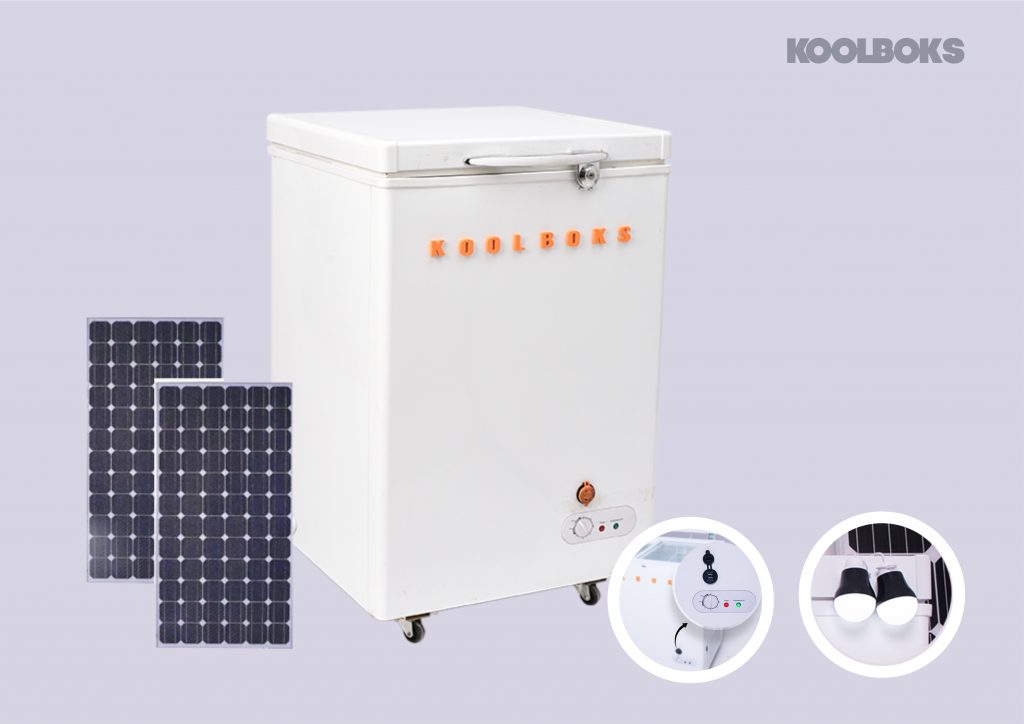
Alongside the standards, researchers are testing new technologies to make fridges more resilient under weak-grid and off-grid conditions. One promising approach is solar direct drive cooling, which powers refrigeration directly from PV panels without relying on external batteries. Instead, thermal storage inside the cabinet maintains cold temperatures at night or during cloudy spells.
Ivan Katic, a senior specialist at the Danish Technological Institute (DTI), leads a Danish-funded initiative exploring how this approach can move beyond vaccine fridges into the wider food cold chain. Scaling up has required new hardware. While the alternating current (AC) market has plenty of large compressors, adapting them for direct current (DC) solar power is difficult. Katic’s team worked with a Danish manufacturer of frequency converters and compressors to develop a variable converter that can run a standard compressor directly from solar panels.
Specialized software then adjusts power consumption depending on how much sunlight is available. “We’ve proved it’s possible,” says Katic. “The converter can adapt automatically, so the fridge keeps running even as supply fluctuates.”
Examples in Kenya and the Philippines
To prove the concept, the project is building demonstration units: freezers for fishing communities in Kenya and fridges for a dairy producer in the Philippines. In Kenya, the challenge is particularly acute: freezing fish requires large amounts of energy, and outages risk wasting the catch. The solution is to integrate saltwater-based thermal storage inside the freezers, maintaining sub-zero temperatures overnight. “The idea is that the content stays cold even when the power dips. That way the fish is preserved, and losses are reduced,” says Katic.
The project, run in cooperation with the WWF, will test whether the technology can strengthen local fisheries and cut waste. In the Philippines, the aim is to help dairies keep milk cold in rural areas where the grid power is unreliable. Both pilots will provide field data on performance and costs – essential for scaling up.
But commercialisation remains difficult. Cabinets with integrated phase-change material (PCM) storage are expensive, and sophisticated converters and software add further costs. At the same time, competition from battery-backed solar systems may undercut the appeal of stand-alone units. “For distributed small-scale systems it has a promising future, but for larger commercial industrial systems it may be more cost effective to introduce a local grid that you can rely on,” Katic says. He remains optimistic: “If fridges upscale and costs reduce, it will be a good technology.”
IEC Standards could help as well on the solar thermal tech: IEC TC 117 prepares standards for solar thermal energy plants and is increasingly looking at standardizing solar thermal applications for industry. (For more on this read: https://etech.iec.ch/issue/2024-05/concentrating-solar-power-for-cheap-energy-storage).
Author: Bryan Groenendaal