- Large scale data shows a minority of solar panels fail far faster than expected.
- Accelerated degradation linked to manufacturing and design issues rather than climate.
- Findings raise financial and risk management concerns for utility scale solar projects.
A new study by researchers from the University of New South Wales has shed light on why some solar panels degrade much faster than industry models predict, posing potential financial risks for large solar installations.
The research analysed a global dataset originally compiled by Dr Dirk Jordan of the US Department of Energy’s National Renewable Energy Laboratory. The dataset draws on annual production and maintenance records from tens of thousands of photovoltaic systems worldwide, offering one of the most comprehensive views of real world solar panel performance.
While most panels show a smooth and predictable decline in output over time, the UNSW team identified a significant minority that deteriorate at an unusually rapid rate. When plotted statistically, these outliers form what researchers describe as a long tail of extreme degradation.
“Most solar systems are designed to last around 25 years, based on their warranty period,” said Yang Tang, one of the authors of a paper on the subject published in IEEE, opens in a new window. ”For the entire dataset, we observed that system performance typically declines by around 0.9% per year. However, our findings show extreme degradation rates in some of the systems. At least one in five systems degrade at least 1.5 times faster than this typical rate, and roughly one in 12 degrade twice as fast. This means that for some systems, their useful life could be closer to just 11 years. Or, in other words, they could lose about 45% of their output by the 25-year mark.”
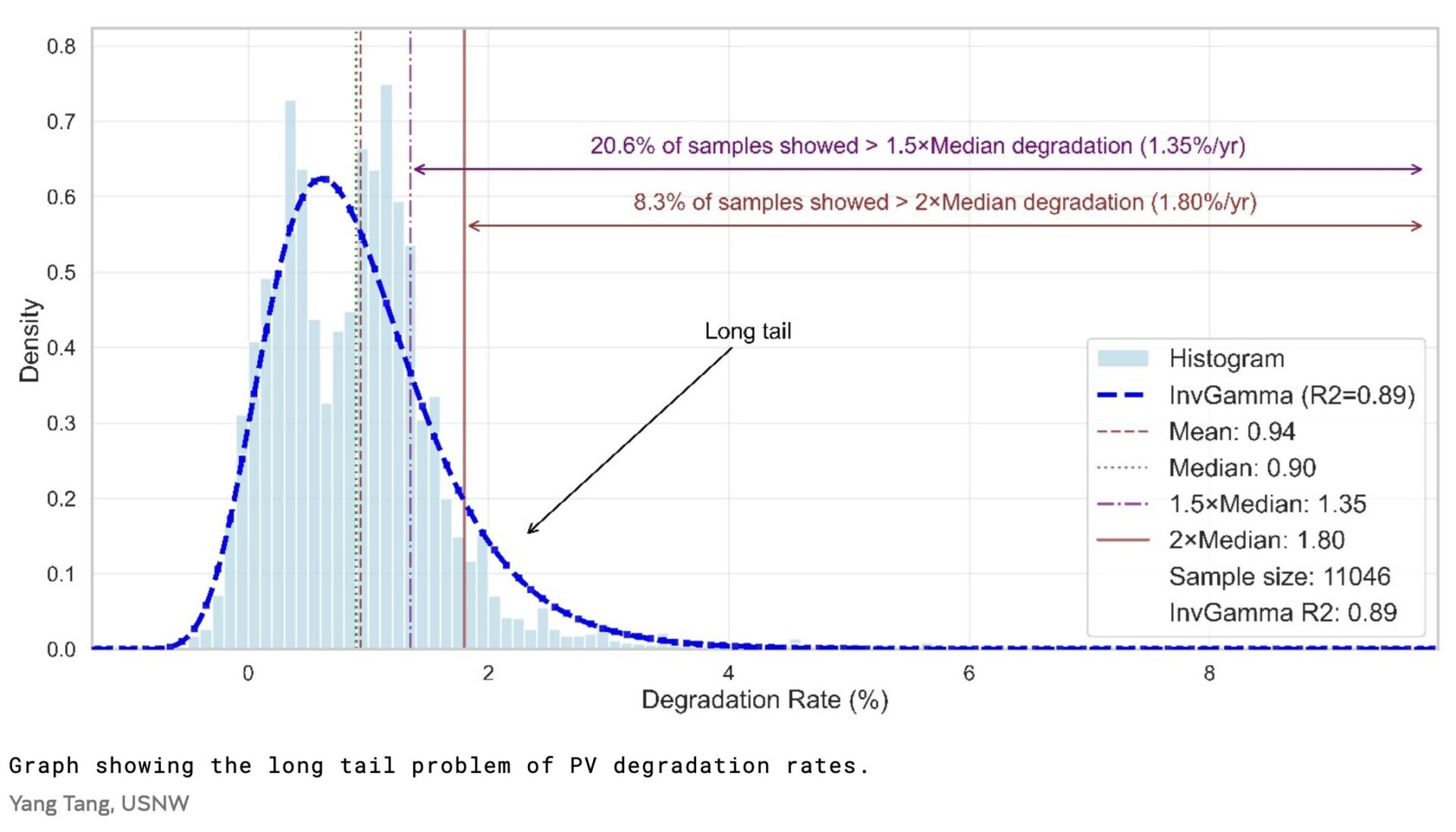
According to the study, this long tail is not simply a statistical curiosity. In large solar farms, where hundreds of thousands of modules are installed, even a small proportion of early failures can translate into substantial unexpected costs. Lower energy yield, increased maintenance and premature replacements all threaten the financial assumptions behind major solar investments.
Crucially, the researchers found that climate is not the driving factor behind these extreme failure rates. Panels installed in moderate environments exhibited similar degradation patterns to those in harsher regions, ruling out the idea that extreme heat or location alone explains the problem.
Instead, the study identifies three primary causes. The first is interconnected failures, where one fault triggers a cascade of others within the same module. Damage to a backsheet, for example, can allow moisture ingress, leading to junction box failure, corrosion or cracked cells. These combined effects accelerate degradation far beyond initial expectations.
The second factor is early life failure, often referred to as infant mortality. Some panels experience rapid degradation soon after installation due to hidden manufacturing defects or material flaws that escape standard quality checks. Although performance may stabilise later, these early losses can be severe and sometimes occur within just a few years.
The third cause involves minor defects that remain dormant for long periods before suddenly triggering major performance loss. Small cracks in cells or slightly imperfect soldering may go unnoticed until they lead to abrupt failure.
Dr Poddar, a co author of the study, said the long tail pattern persists even when data from very hot regions is removed from the analysis. This indicates the issue is consistent across different climates and operating conditions.
He noted that current testing standards focus on isolated stress factors such as mechanical load, temperature extremes, ultraviolet exposure and humidity. However, real world operation exposes modules to many interacting stresses at once, increasing the likelihood of cascading failures.
The findings carry important implications for manufacturers, project developers and investors across the solar value chain. Financial models that assume uniform and predictable degradation may underestimate operational risks, particularly for large scale projects with tight margins.
The researchers hope the study will encourage wider data sharing from utility scale solar farms, support the development of early detection systems, and inform new testing standards that better reflect real operating conditions. By improving design robustness and testing methods, the industry could reduce unexpected failures and strengthen confidence in long term solar investments across global markets, including Africa.
Link to the full paper HERE
Author: Bryan Groenendaal