


Opinion
- Large smelters have delayed clean energy investment while securing massive electricity discounts, shifting cost burdens onto the public.
- Eskom’s 62 c/kWh ferrochrome tariff and long term aluminium deals undermine cost recovery during a tightening winter supply environment.
- Political pressure linked to jobs and labour relations is distorting energy policy and delaying industrial decarbonisation.
South Africa’s energy intensive smelting sector is once again being framed as a victim of high electricity prices. The reality is less sympathetic. For more than a decade, major operators including South32 and other ferrochrome producers have failed to modernise their assets or invest meaningfully in clean, self-generation capacity. Instead, they are leveraging Eskom’s financial vulnerability and political pressure points to secure deeply discounted electricity.
The latest negotiated tariff of 62 c/kWh for ferrochrome producers Glencore-Merafe Chrome Venture and Samancor Chrome, highlights the scale of the distortion. This price sits far below Eskom’s average cost of supply, effectively locking in a loss making position for the utility.
The justification offered is job preservation. Yet this argument is increasingly tenuous. These industries have had years of warning on rising electricity costs and global decarbonisation trends. Rather than investing in modern, energy efficient smelting technologies or developing renewable energy supply at scale, most have deferred capital expenditure and relied on legacy coal based power agreements.
South32’s position is particularly instructive. In Mozambique, where government refused to concede on power pricing, the company placed the Mozal smelter on care and maintenance after failing to secure a favourable tariff. In South Africa, however, it continues to benefit from a heavily discounted electricity agreement at its Hillside smelter, with analysis indicating potential savings of about R92 billion over ten years. The contrast is stark. Where firm governance exists, production stops. Where political and institutional weakness persists, concessions follow. Read more
This raises uncomfortable questions about the nature of the proposed “transition” now being advanced. South32 and Eskom have announced a joint working group to explore renewable energy integration for Hillside, with a framework only targeted for 2031. In effect, the utility is being asked to facilitate the decarbonisation of a private industrial asset, while the operator continues to benefit from discounted grid electricity in the interim.
The sequencing is telling. Instead of leading with capital investment into on site renewables, storage, or efficiency upgrades, the approach relies on Eskom to restructure supply first. This reverses the basic principle of industrial transition, where high energy users are expected to internalise decarbonisation costs over time.
Meanwhile, Eskom’s own data shows that the system cannot comfortably absorb additional smelter demand, particularly during winter peaks. Maintaining these discounted supply arrangements increases reliance on ageing coal infrastructure and expensive emergency generation, further eroding the utility’s financial position. Read more
The political economy underpinning these decisions is difficult to ignore. Electricity pricing is being used as a tool to maintain relations with organised labour and to avoid near term job losses, particularly in regions heavily dependent on smelting activity. However, this comes at a broader cost to the economy. Subsidised tariffs distort market signals, discourage efficiency, and delay the inevitable restructuring of energy intensive industries.
There is also a growing fiscal dimension. Eskom recently recorded R359.6 billion loss and relies on a R254 billion government bailout funded by the taxpayer to keep afloat. Read more
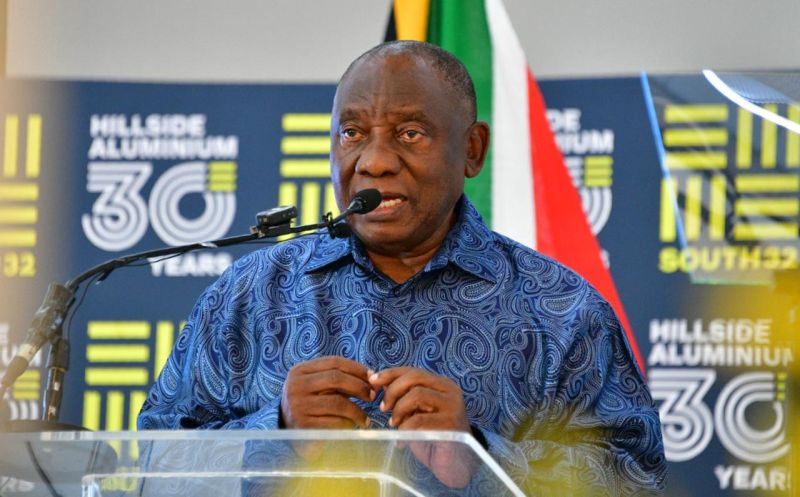
The irony was on full display at Hillside’s 30 year celebration, attended by senior political leadership. The smelter was rightly recognised for its historical contribution to industrial development and employment. Yet the event also underscored a deeper contradiction. A legacy asset built on abundant, low cost coal power is now being sustained through continued preferential pricing, rather than being transformed into a competitive, low carbon operation.
South Africa’s ferrochrome sector tells a similar story. Despite holding 72% of global chrome reserves, the country’s share of ferrochrome production has fallen to about 19%, down from over 50% historically. This decline is often attributed solely to electricity pricing. In reality, it also reflects a failure to invest in modern, energy efficient processing capacity and to adapt to a changing global energy landscape.
A credible path forward would look very different. Any tariff support should be strictly conditional on measurable progress in energy efficiency, self-generation capacity, and emissions reduction. Time bound incentives could play a role, but only if they accelerate transition rather than entrench dependence.
Without this shift, South Africa risks locking itself into a cycle where public resources are used to sustain outdated industrial models, while the transition to a competitive, low carbon economy is repeatedly deferred. In the meantime, companies that have avoided difficult investment decisions continue to benefit, quite literally, from power that the system can no longer afford to provide.
Author: Bryan Groenendaa
Disclaimer: The articles and videos expressed in this publication are those of the authors. They do not purport to reflect the opinions or views of Green Building Africa, our staff or our advertisers. The designations employed in this publication and the presentation of material therein do not imply the expression of any opinion whatsoever on the part Green Building Africa concerning the legal status of any country, area or territory or of its authorities.


