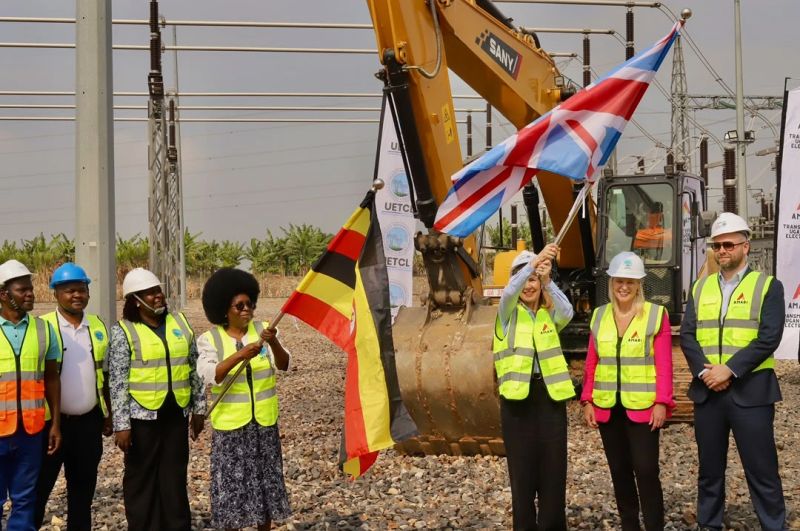
- The US$50 million Amari Power Transmission Project has broken ground in Mbarara, marking a major milestone for Uganda’s power sector and the first independent power transmission project to reach this stage.
- The project will upgrade four substations and add 700 MVA of transformation capacity, helping to improve grid reliability, attract industrial investment, and support Uganda’s Tenfold Growth Strategy.
- The initiative is being developed with the Government of Uganda, UETCL, and Gridworks, with support from the United Kingdom and other partners.
Uganda has broken ground on the Amari Power Transmission Project in Mbarara City, a landmark infrastructure scheme and the first independent power transmission project to reach financial close.
The ceremony was officiated by Hon. Dr. Monica Musenero, Minister of Energy and Mineral Development, and attended by Baroness Chapman, the United Kingdom Minister for Development, H.E. Lisa Chesney, the British High Commissioner to Uganda, government officials, investors, and energy sector leaders.
The project will involve an investment of about US$50 million and will upgrade four key substations, Tororo, Nkenda, Mbarara North, and Mbarara South. It is expected to increase Uganda’s electricity transformation capacity by 700 MVA, lifting it from 7,170 MVA to 7,870 MVA.
Officials say the project will strengthen grid reliability, improve power quality, unlock new industrial investment, and support the country’s Tenfold Growth Strategy by ensuring transmission capacity keeps pace with demand. In her remarks, Dr. Musenero said transmission infrastructure is not only an engineering priority but also an economic one, creating room for new industries, business expansion, competitiveness, investment, and jobs.
Baroness Chapman said the project is a landmark for Uganda and for Africa, adding that the UK is shifting its role from donor to investor in support of strategic infrastructure. As Uganda expands generation and industrialisation, the need for stronger transmission networks is becoming more urgent, especially to ensure electricity reaches industries, businesses, and communities reliably.
Author: Bryan Groenendaal