


- Natural earthquake cluster linked to deep fault system beneath proposed shale gas zones.
- Evidence suggests critically stressed structures could increase induced seismic risk.
- Findings highlight need for tighter monitoring and cautious project planning.
A new scientific study titled ‘An Intraplate Seismic Swarm in the Karoo Basin, South Africa, Highlights the Presence of Critically Stressed Faults in an Area of Proposed Shale Gas Exploration,’ has identified a previously underexamined seismic risk in South Africa’s Karoo Basin, where interest in shale gas development continues despite ongoing uncertainty over resource viability.
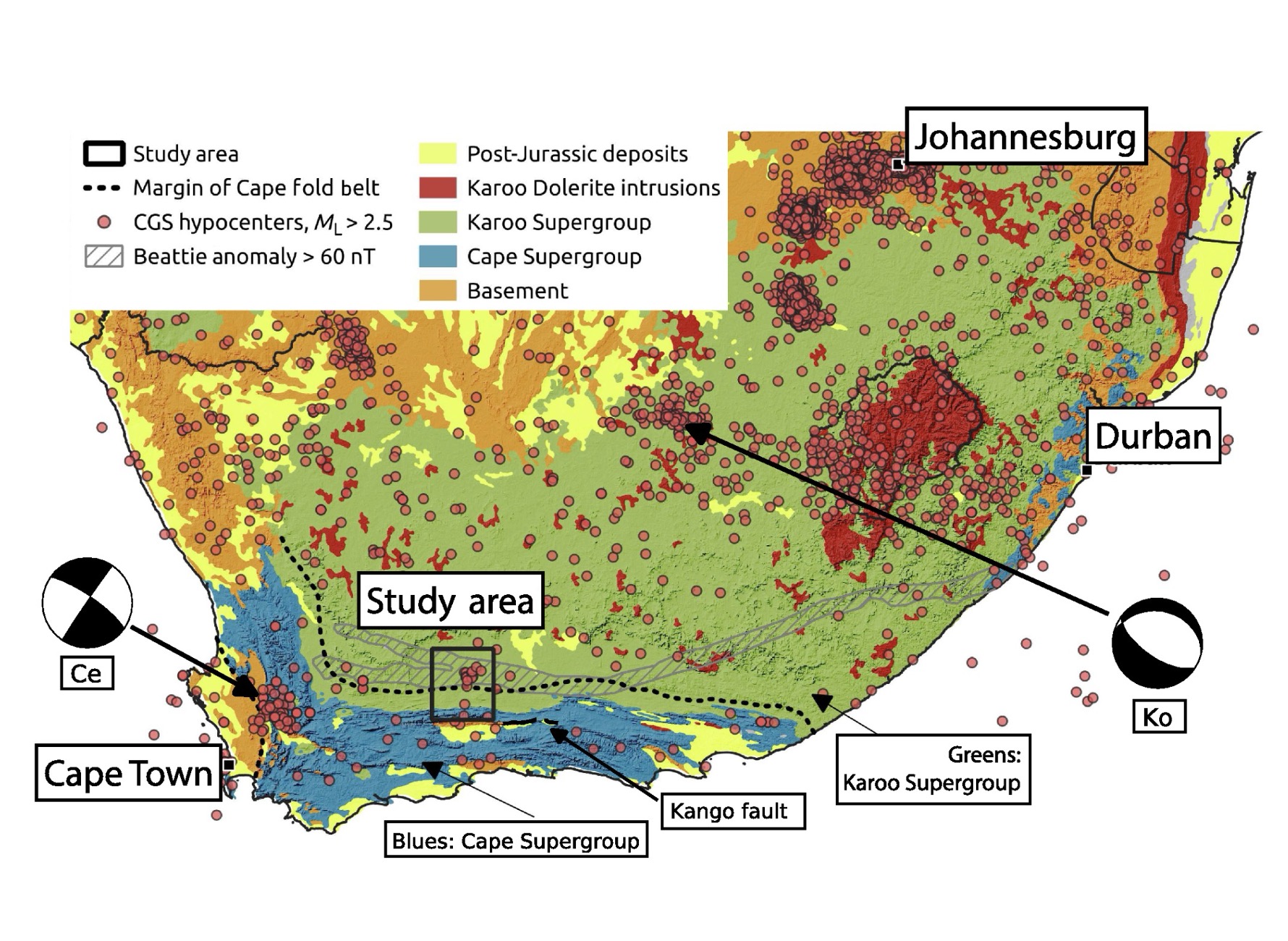
Researchers analysed an earthquake cluster near Leeu Gamka and found that seismic activity is closely tied to a deep seated geological structure aligned with a major magnetic anomaly that stretches across the region. Although the area is considered tectonically stable, the study shows that hidden faults within the crust can still generate earthquakes, including events of moderate magnitude such as the recorded 4.8.
The seismic swarm began abruptly in 2007 in a region with little prior activity. Using a temporary network of geophones and ambient noise imaging, the researchers mapped a fault system trending west northwest to east southeast. This structure extends from sedimentary layers targeted for shale gas exploration down into the crystalline basement, indicating a continuous pathway through which stress and fluid pressure could move.
The analysis shows that earthquakes in the cluster are consistent with left lateral strike slip motion, similar to the mechanism behind the destructive 6.3 Ceres Tulbagh earthquake in 1969. Subsurface imaging also revealed a clear change in rock properties along the same الاتجاه as the seismic activity, reinforcing the presence of a significant geological boundary.
While South Africa experiences low overall strain rates compared to active plate boundaries, the study notes that large earthquakes can still occur in such settings. Historical examples globally and locally demonstrate that infrequent but damaging events are possible, particularly where ancient faults are reactivated.
The Karoo Basin, long considered for shale gas extraction, has already attracted exploration interest, with earlier estimates suggesting large gas resources, though later reassessments reduced these figures. Even so, the presence of potentially viable reserves continues to drive attention to the region.
The study draws parallels with international cases in the United States, United Kingdom and Canada, where shale gas operations and wastewater injection have been linked to increased seismic activity. In those settings, earthquakes were more likely where fluid pressure interacted with pre existing basement faults that were already close to failure.
In the Karoo, the identified fault system appears to meet similar conditions. The research indicates that critically stressed faults extend through both sedimentary and basement layers, meaning that even modest changes in subsurface pressure could trigger seismic events.
Importantly, the findings challenge earlier assessments that considered damaging earthquakes in the region unlikely. While not dismissing shale gas development outright, the authors stress that the geological conditions required for induced seismicity are present.
They recommend expanded seismic monitoring and careful spatial planning, including avoiding development near identified fault zones and populated areas until risks are better understood. The study also calls for further investigation along the broader magnetic anomaly, which may host similar hidden structures.
For energy developers and policymakers, the message is clear: even in stable continental regions, subsurface conditions can create material seismic risk, and these factors must be fully integrated into project planning and regulatory frameworks.
Author: Bryan Groenendaal





1 Comment
How about you read the room, all
you greedy people and not ruin the Karoo with fracturing it.