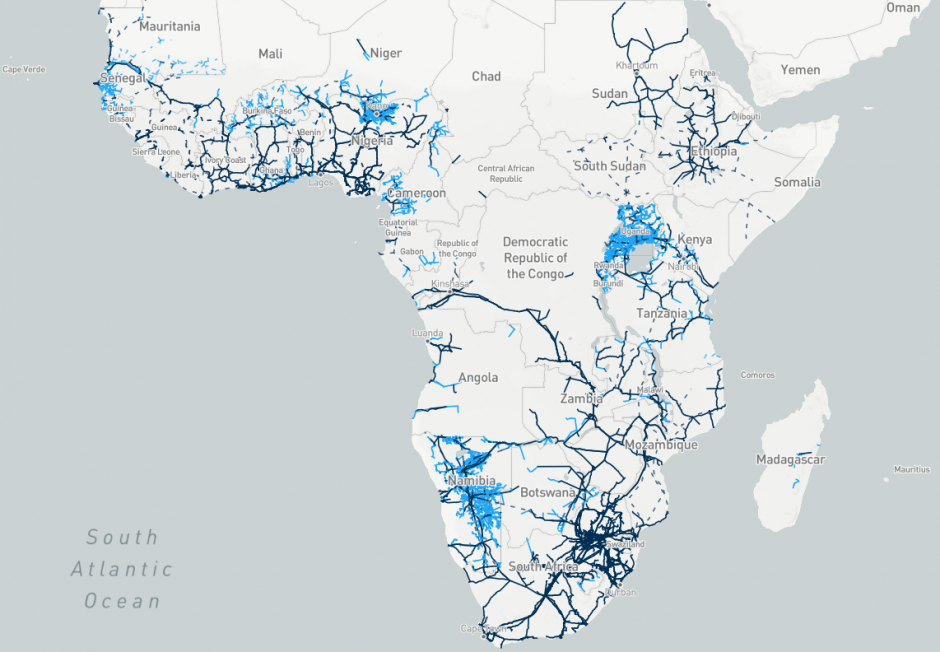

- The rate of electrification in Sub-Saharan Africa is stagnating, the International Energy Agency has said.
The agency’s latest analysis reveals there were 730 million people worldwide that still lacked access to electricity in 2024, a decline of only 11 million compared to 2023, with Sub-Saharan Africa accounting for eight of every ten people now living without electricity.
IEA says that progress on electrification in Sub-Saharan Africa is concentrated in a handful of countries such as Côte d’Ivoire, Kenya and Mozambique. A total of 27 countries in the region recorded slower progress last year than that recorded in the last pre-pandemic years. Some countries in the region are experiencing population growth that outpaces electrification, meaning there are currently around 685 million without electricity access in Sub-Saharan Africa, compared to 681 million in 2010.
Last year saw 6.8 million new electricity connections in sub-Saharan Africa, a 2% increase from 2023, but the IEA adds that population growth in areas without access offset much of this progress, reducing the total number of people without electricity by 4 million.
Grid expansions combined with mini-grids drove nearly 90% of new connections in 2024, with annual grid connections rising more than 11% year-on-year. IEA pointed out that Nigeria, the Democratic Republic of the Congo and Uganda as countries that posted notable gains under this metric.
While the sale of solar home systems (SHS) grew by 4% last year globally, according to figures posted by off-grid solar association Gogla, Sub-Saharan Africa recorded a 26% increase in new primary users. But IEA’s analysis points out that the majority of these are very small systems, up to 10 W in capacity, and therefore fall short of its definition of access. Excluding these sales means SHS connections were down from their 2022 peak.
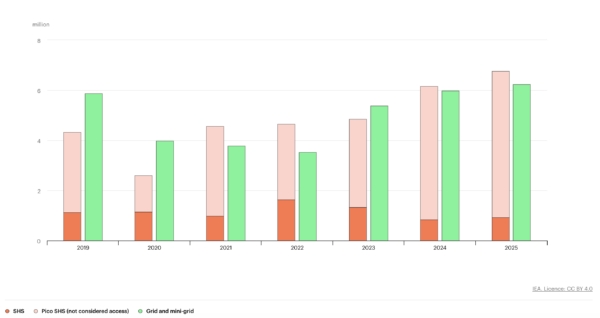
IEA says that early data for 2025 suggests the rate of progress on new connections in Sub-Saharan Africa will remain broadly flat this year, despite movement in the sector, including a record number of solar imports from China, due to persistent high debt burdens, elevated borrowing costs and falling levels of development finance.
But the agency adds that policy momentum is growing, with around 60% of people without access living in countries that advanced electricity access measures over the last year through either tax and consumer incentives, electrification programmes, national strategies or other targeted actions.
Away from Sub-Saharan Africa, Latin America is moving closer to universal access, with 98% of the population connected by the end of 2024. IEA expects the last percentages to be the hardest to reach, with remote areas in the Andean Highlands and the Amazon expected to take 15 years to reach full access under the current pace of electrification. Haiti has the lowest electrification rate in the region, with around half the population lacking electricity.
The access rate among developing Asian countries also reached 98% last year. With India and Indonesia reaching the universal access milestone, most of the remaining gap is located in Pakistan, Afghanistan, Mongolia, Myanmar and North Korea. Together, these countries account for 83% of the region’s population still without electricity.
Author: Patrick Jowett
This article was originally published in pv magazine and is republished with permission.