- At its 2022 annual general meeting (AGM), 99.7% of Standard Bank’s shareholders voted in favour of a resolution co-filed by shareholders Just Share and Aeon Investment Management, for staggered disclosure relating to the bank’s oil and gas exposure over a period of three years.
The bank has failed, in its 2024 integrated reporting suite, to comply with the terms of this resolution, although its content and timeframes were negotiated and agreed with the bank. In its latest disclosures, Standard Bank does not acknowledge that it has not met the terms of the resolution which it had agreed were feasible, and provides no explanation for this failure.
Related news: StopEACOP campaign targets Chinese government
Following an extensive engagement with the co-filers, the bank had agreed to table a non-binding advisory resolution at its 31 May 2022 AGM, which required it, by 31 March 2025, to update its March 2022 Climate Policy to include short-, medium-, and long-term targets for its financed greenhouse gas emissions from oil and gas. These targets were to be aligned with the Paris Agreement goal of limiting the global temperature increase to 1.5 degrees Celsius above pre-industrial levels (the Paris 1.5 degree goal).
In other words, the bank was required to disclose:
- short-term,
- medium-term, and
- long-term
emission reduction targets:
- for its financed emissions;
- from its oil and gas exposure;
- that are aligned with the Paris 1.5 degree goal.
The resolution was overwhelmingly endorsed by shareholders at the bank’s 2022 AGM, making it clear that investors expect greater disclosure from the bank.
Related news: Union investment pulls investment in TotalEnergies over human rights abuse in EACOP oil project in Uganda
The bank has failed, in material respects, to comply with this resolution, as is set out below.
- Standard Bank has not disclosed its most material oil and gas exposure:
- The bank has focused on disclosure of its upstream oil and gas assets (which it has also not comprehensively disclosed). It has not provided a timeline for setting targets for mid and downstream exposure.
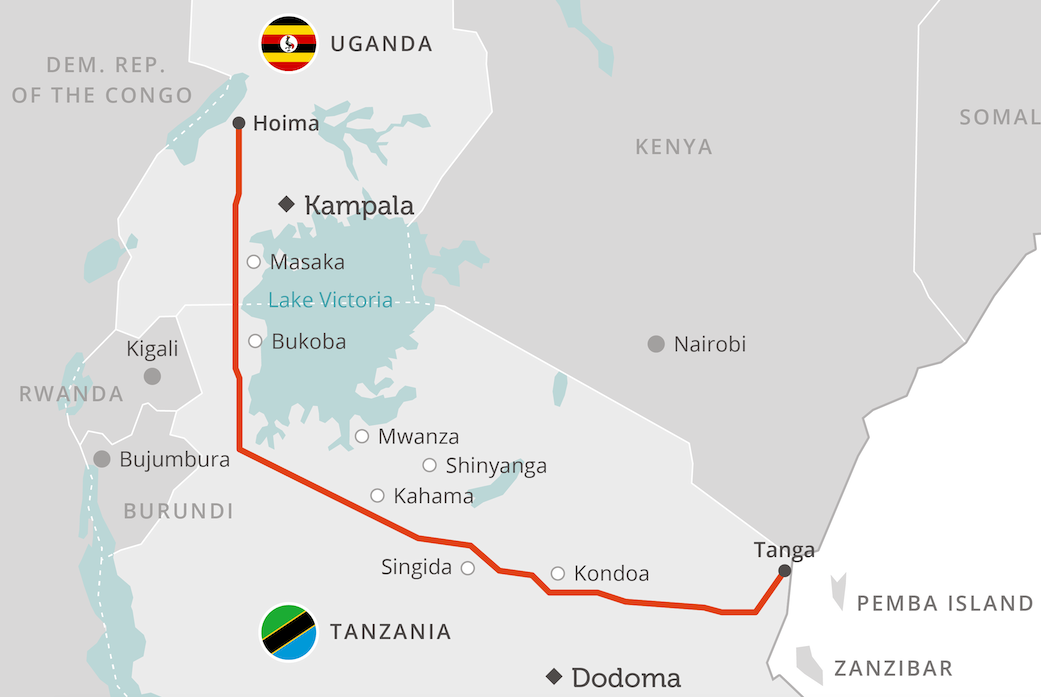
East African Crude Oil Pipeline map. Image credit: EACOP
This is an incomplete picture of Standard Bank’s oil and gas exposure. It allows the bank to downplay the significant impact that its involvement in midstream projects such as the East African Crude Oil Pipeline will have on its oil and gas exposure and financed emissions.
The 2025 Climate Policy only provides a short-term 2030 oil and gas target (consisting of an average physical intensity target “combined with” a target to limit exposure).
No medium-term target or interim milestones are disclosed to achieve the bank’s target to be net-zero by 2050, nor does the bank give any indication of its timeframe for doing so.
The bank’s targets are not aligned with the Paris 1.5 degree goal.
The targets are weaker than those contained in the bank’s 2022 Climate Policy and allow the bank to significantly increase its exposure to oil and gas.
In addition, the bank’s disclosures do not allow for clear analysis of its exposure to oil and gas, nor for its progress in reducing this exposure. It has conflated exposure metrics, used ambiguous targets, and shifted the goalposts.
Investors should call on Standard Bank to explain this non-compliance and to commit to an urgent timeframe within which it will update its 2025 Climate Policy to include:
- Short-, medium-, and long-term absolute emission reduction targets aligned with the Paris 1.5 degree goal.
- Strategies to achieve all its targets.
- Midstream and downstream oil and gas exposure targets.
To demonstrate climate leadership, banks must hold firm to their existing commitments to climate action and prioritise the strengthening of these commitments. Investors need to hold banks accountable, not only to their own commitments, but to the level of ambition that is increasingly required to prevent and limit and worst impacts of the climate crisis.
Source: JustShare