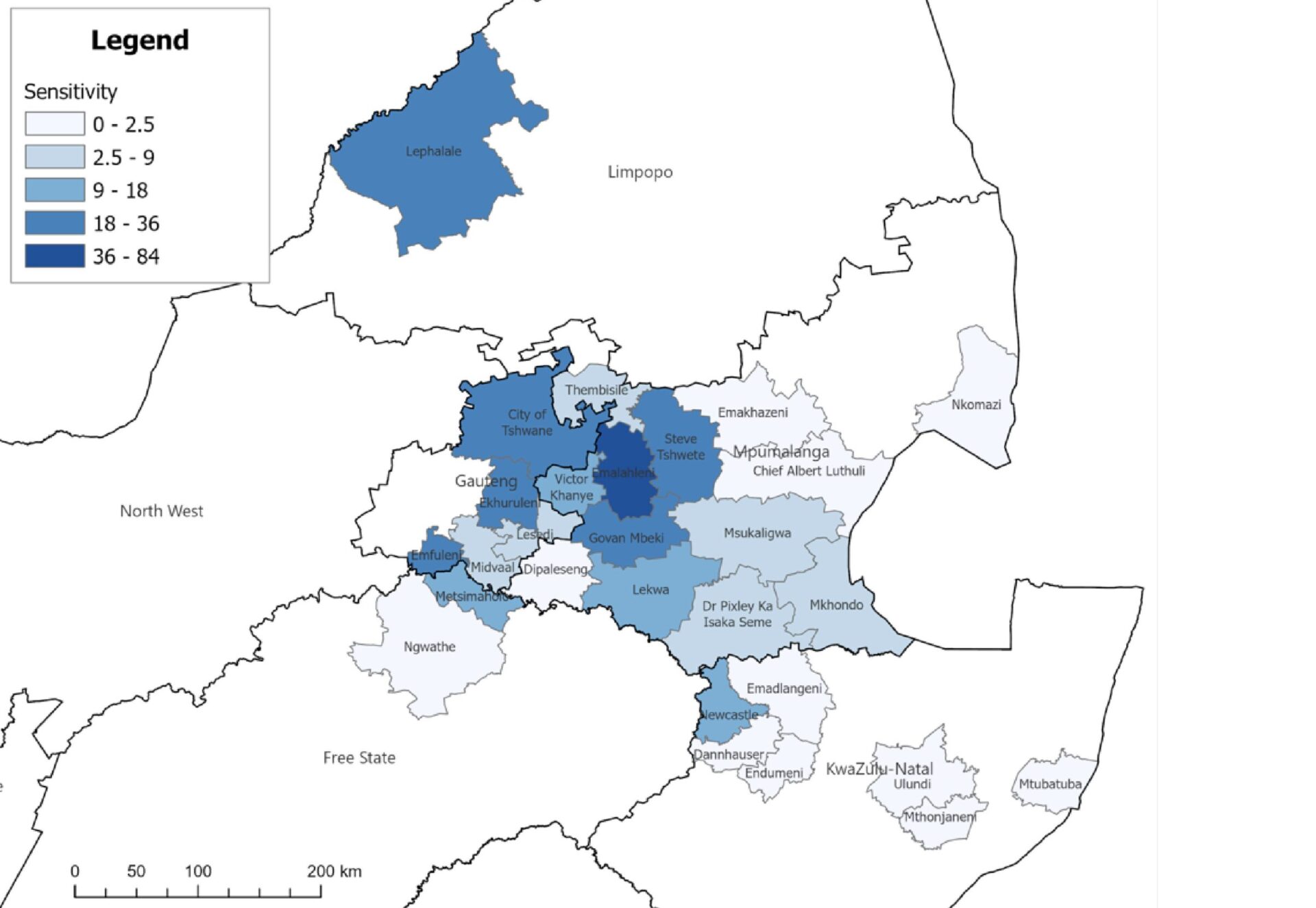
Map of Sensitivity to coal phase-down for all coal municipalities. Image created by study authors and used under Creative Commons 4.0 International License
- A new analysis has revealed stark differences in how South African coal-dependent regions are likely to be affected by the global transition to cleaner energy, raising urgent questions about how the country will protect vulnerable workers and communities.
Researchers have developed a Coal Transition Vulnerability Index (CTVI) for South Africa that measures how 29 coal-reliant municipalities may fare as mines and power plants close over the coming decades. The index assesses vulnerability through three components namely; exposure, sensitivity and adaptive capacity and uses 19 socioeconomic and infrastructural indicators.
The study finds that Mpumalanga, South Africa’s coal heartland, contains several of the country’s most at-risk communities. Municipalities such as Emalahleni and Steve Tshwete rank highest in vulnerability due to their heavy dependence on coal employment and revenue. Mining contributes roughly 40% and 31% of Gross Value Added (GVA) respectively in these municipalities.
While the province’s larger cities possess relatively strong adaptive capacity, better infrastructure, more diversified economies and stronger governance, many nearby towns and villages are far less prepared for the economic shock of coal decline. Some communities were established specifically to support mining operations that have operated for more than 150 years.
Related news: Coal and renewables – no reason they cant be friends
The findings highlight that South Africa’s coal transition is deeply unequal, mirroring broader spatial inequalities in income, services and employment across the country. With unemployment rates already high, the loss of mainly low- and semi-skilled jobs in the coal sector is expected to worsen socioeconomic instability unless targeted interventions are implemented.
Despite these challenges, the study notes that the transition will unfold gradually. South Africa’s 90 coal mines and 14 power plants are expected to close sequentially over the next five decades, creating a window for careful planning. Researchers say this period must be used to strengthen local governance, diversify local economies and improve basic service delivery, especially in municipalities where audit outcomes and financial performance are currently weak.
Policy experts recommend embedding the CTVI into strategic planning tools such as municipal Integrated Development Plans (IDPs), the District Development Model, and the national Just Energy Transition Partnership (JETP) frameworks. Mining companies’ existing Social and Labour Plans, which fund skills development and local economic projects, could also serve as a foundation for future just-transition programmes.
The study further warns that municipal-level assessments mask significant inequalities within communities themselves. Women, young people, informal workers and black communities affected by historical land injustices all face unique and heightened risks during the transition. Researchers argue that policies must be tailored accordingly. For example, by improving gender-responsive planning, expanding education pathways for youth, and ensuring meaningful community participation in mine rehabilitation and land-use decisions.
While the vulnerability framework primarily highlights risks, it also identifies opportunities. Municipalities that combine high exposure with relatively strong adaptive capacity may be well positioned to develop new economic activities linked to renewable energy, mine rehabilitation and emerging industries, provided that investments begin now.
As South Africa accelerates its shift away from coal, the CTVI offers one of the clearest tools yet for identifying which communities stand to lose the most, and which policy actions will be essential to ensuring a just and equitable transition.
Link to the full paper – A coal transition vulnerability index for South Africa
Author: Bryan Groenendaal