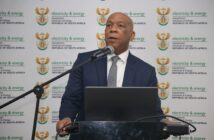
Watch the video: Minister of Electricity and Energy, briefs media on South Africa’s Integrated Resource Plan
- South Africa has unveiled a bold new Integrated Resource Plan (IRP 2025) that aims to end the country’s electricity crisis, stimulate economic growth, and transition the power sector toward cleaner energy sources.
Electricity and Energy Minister Dr Kgosientsho Ramokgopa announced that government would invest R2.2-trillion—about 30% of South Africa’s gross domestic product—in an ambitious energy transformation programme. The plan, approved by Cabinet and to be Gazetted by October 24, outlines a major shift in the country’s generation mix, long-term infrastructure development, and industrial revival.
“As a result of the lights being off, the South African economy has not been able to grow,” Ramokgopa said during a Sunday briefing. “Now that we have turned the corner on load shedding, we are addressing the future. Energy now ceases to be a crisis—electricity is going to be a catalyst for growth.”
Related news: Special promotion: Buy 10 get 1 FREE from GoodWe
The IRP 2025 targets an average 3% GDP growth rate by 2030, with energy security and affordability at its core. The Minister said the plan was “not just an electricity programme, but a response to an economic question,” aimed at driving industrialisation, job creation, and new skills development.
Massive Generation Expansion and Cleaner Energy Mix
Key allocations in the plan leading up to 2030 include:
- 11 270 MW of solar PV.
- 7 340 MW of wind energy.
- 6 000 MW of gas-to-power.
- 5 200 MW of new nuclear capacity.
By 2039, South Africa aims to add 105 000MW of new generation capacity—effectively building Eskom “two and a half times” its current size. This includes:
- 25 000 MW of utility-scale solar PV.
- 16 000 MW of distributed (mostly solar rooftop) generation.
- 34 000 MW of onshore wind.
- 8 500 MW of battery storage.
- 16 000 MW of gas-to-power.
- 5 200 MW of new nuclear capacity, which could include small modular reactors and grow to 10000MW.
Currently, about 58% of installed capacity comes from coal, but the IRP marks the first time in history that renewables and low-carbon sources—solar, wind, hydro, nuclear, and gas—are expected to surpass coal in the national mix.
The plan also commits to cutting carbon emissions to 160 million tonnes of CO₂ equivalent by 2030, declining further to 142 million tonnes by 2035.
Gas-to-Power and Industrial Development
A key policy shift in IRP 2025 involves raising the minimum load factor for initial gas-to-power plants to 50%, from the previously modelled flexible range of 25%–65%. While 6 000 MW of gas-to-power capacity is targeted for 2030, Ramokgopa conceded that achieving this would be “difficult” due to the lack of gas import, regasification, and pipeline infrastructure.
Government plans to convert Eskom’s existing diesel-fired turbines to gas and use the new gas plants to “anchor” domestic demand, helping justify the import of liquefied natural gas (LNG) and avert a looming “gas cliff” as supplies from Mozambique’s Pande and Temane fields decline later this decade.
By 2039, the IRP allocates 16 000 MW of gas-to-power capacity, underpinned by industrial gas demand.
Nuclear, Clean Coal and Technology Development
The plan also reaffirms government’s intention to demonstrate clean-coal technologies and expand nuclear generation, potentially rising to 10 000 MW by 2039 under a new “nuclear industrialisation plan.”
Ramokgopa confirmed that the pebble bed modular reactor (PBMR) project—currently under care and maintenance at Eskom—will be transferred to the South African Nuclear Energy Corporation (Necsa) to revitalise local nuclear innovation and test its competitiveness against emerging global SMR designs.
State-Led Rollout and Energy Security
Ramokgopa stressed that the generation build-out would be state-led, saying that “an over-reliance on the market” had previously failed to ensure security of supply. The state will therefore continue to run large-scale procurement bid windows even as work progresses on establishing a Wholesale Electricity Market in line with new energy legislation.
The Minister acknowledged two key constraints—limited engineering skills and a weakened construction industry—but said government remained committed to rebuilding both sectors as part of its broader economic stimulus.
Eskom’s performance has already improved, he noted, with the energy availability factor rising from 48% at the height of load shedding to about 70% currently, providing a stronger foundation for implementation.
“We’re talking about growth, industrialisation, new skills, and resuscitating collapsed industries,” Ramokgopa said. “For as long as the lights are off, we will undermine our potential. This plan constructs a story about how we’re going to get the South African economy back on its feet.”
Author: Bryan Groenendaal