
- First full scale system level deflagration test conducted globally by UL under UL 9540A 2025 proposal framework.
- Real lithium ion cells driven into thermal runaway under highly demanding conditions.
- Structural integrity and pressure relief systems performed in line with engineering design expectations.
As large scale energy storage deployments accelerate globally, safety validation is shifting from component certification toward full system performance under worst case conditions. Developers and asset owners are increasingly asking not only whether a system is certified, but how it behaves when subjected to extreme failure scenarios and whether associated risks remain controllable.
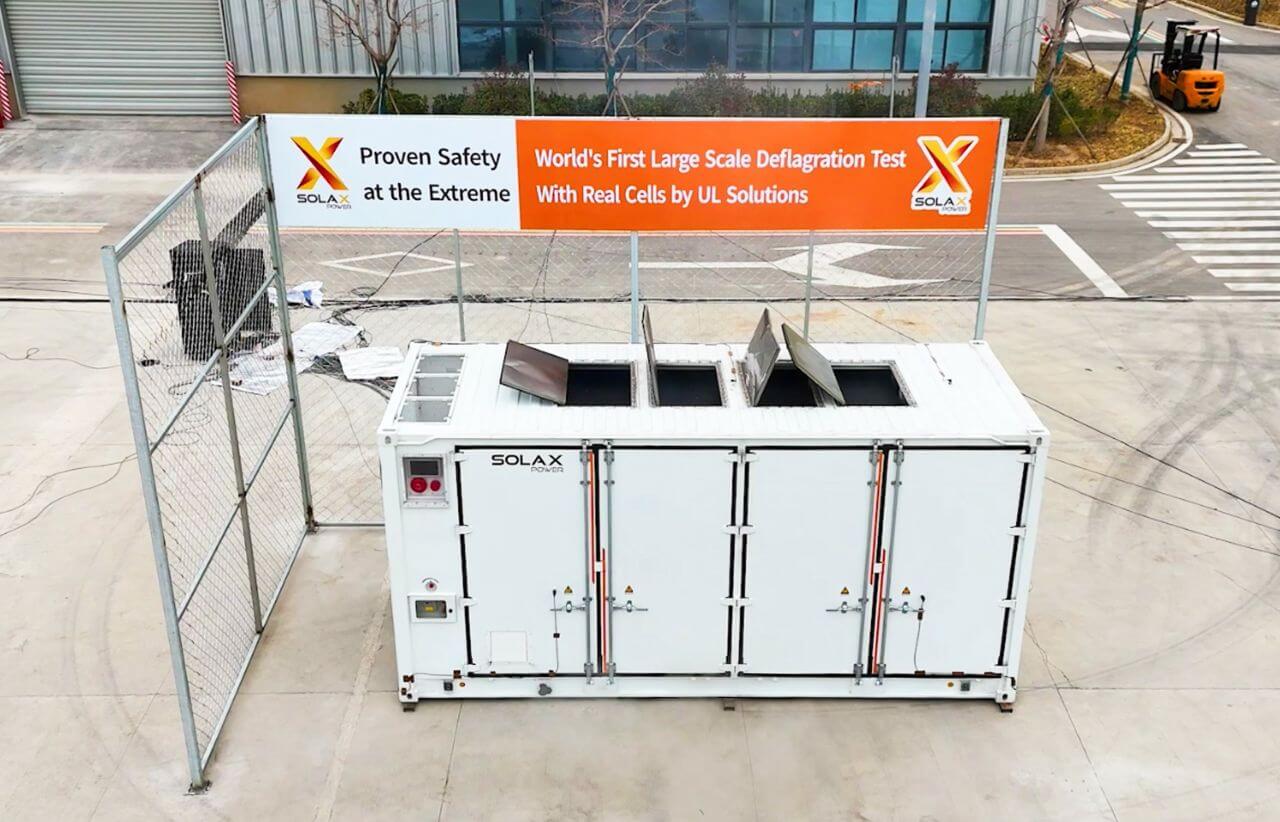
SolaX has announced that its ORI 5MWh large scale energy storage system has successfully completed a full scale system level deflagration test under the proposed UL 9540A 2025 framework. The test was conducted with direct involvement from UL Solutions in the design, execution and engineering assessment. According to the company, this marks the first system level deflagration test carried out globally by UL under the proposed 2025 framework.
Related news: SolaX Power wins TÜV Rheinland “All Quality Matters” award for excellence in utility string inverters
The test was performed on a fully integrated ORI 5MWh system using real lithium ion battery cells. Under controlled conditions, cells were intentionally driven into thermal runaway while the emergency ventilation system remained closed. The system subsequently underwent the complete sequence of flammable gas release, accumulation and deflagration, replicating the critical risk chain considered in system level safety assessments.
UL Solutions developed the test site configuration and operating parameters based on simulation modelling to represent an intentionally severe scenario. The ignition trigger point was positioned in an area more prone to pressure wave amplification and flame turbulence, increasing the stress placed on structural integrity and pressure relief pathways.
During the deflagration event, observations confirmed that the pressure relief structure activated as designed. Container doors remained closed with no significant deformation. The container structure showed no rupture and no components or structural fragments were ejected. No additional risks to surrounding personnel or the environment were identified.
An engineer from UL Solutions involved in the assessment stated that the scenario was designed to optimise both severity and realism. The use of real lithium ion battery cells introduces inherent uncertainties linked to thermal runaway behaviour and free gas dispersion. To address this, the test incorporated redundant ignition sources, carefully defined the thermal runaway initiation mode of the trigger cell and positioned the trigger cell to maximise deflagration potential while evaluating whether the system responded in accordance with its engineering logic once deflagration occurred.
The engineer noted that the applied test conditions represented a high level of challenge for both structural integrity and integrated safety functions, providing valuable reference data for understanding system level safety boundaries.
From a development perspective, SolaX R&D representatives emphasised that safety is treated as a baseline rather than a compliance milestone. They stated that once deployed, operational risk is ultimately borne by the customer, and that early identification of potential issues combined with clearly defined safety limits through rigorous testing forms a core engineering responsibility.
SolaX will continue working with UL Solutions and other internationally recognised organisations to advance system level safety validation, supporting the reliable and long term integration of energy storage into global energy infrastructure.
Author: Bryan Groenendaal
For enquiries on the African continent, contact SolaX Power South Africa: kendall.xu@solaxpower.com