- Four-hour battery storage costs fall 27% year on year to US$78 per MWh, a record low.
- Solar, onshore wind and offshore wind benchmark costs rise amid supply chain and financing pressures.
- Clean energy LCOE projected to decline by up to 30% by 2035 despite short term headwinds.
Clean power markets delivered mixed signals in 2025, with battery storage costs plunging to record lows even as most other renewable technologies became more expensive, according to the latest Levelized Cost of Electricity 2026 report from BloombergNEF.
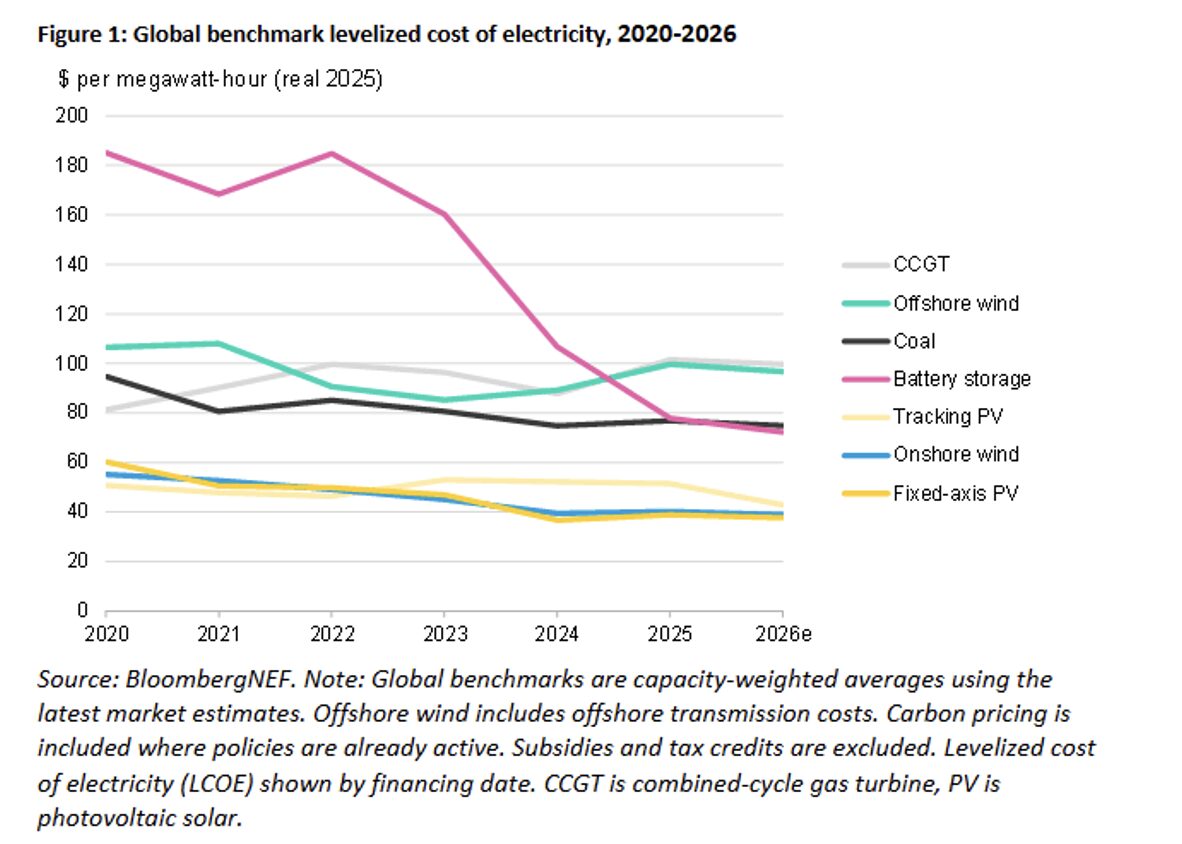
The report shows that the global benchmark levelized cost of electricity for a four-hour battery project dropped 27% year on year to US$78 per MWh in 2025. This marks the lowest level recorded since BloombergNEF began tracking costs in 2009. Falling battery pack prices, rising competition among manufacturers and improved system designs drove the decline.
Lower storage costs are accelerating the rollout of co located renewable energy projects. In 2025 alone, developers added 87 GW of combined solar and storage capacity, delivering electricity at an average cost of US$57 per MWh.
In contrast, benchmark costs for other clean technologies increased. The cost of a typical fixed axis solar farm rose 6% to US$39 per MWh, while onshore wind reached US$40 per MWh. Offshore wind climbed to US$100 per MWh globally, reflecting supply chain constraints, weaker resource availability in some markets and the impact of market reforms in mainland China.
Despite rising global protectionism, supply chain challenges and higher financing costs, BloombergNEF expects technology innovation and competitive pressure to resume driving cost reductions over the medium term. By 2035, the firm forecasts LCOE reductions of 30% for solar, 25% for battery storage, 23% for onshore wind and 20% for offshore wind.
Amar Vasdev, lead author of the report and senior energy economics associate at BloombergNEF, said manufacturing overcapacity linked to the electric vehicle market and improved system design are transforming the economics of large-scale storage. The LCOE for a four-hour battery system is now below US$100 per MWh in six markets. As costs continue to decline, battery storage is expected to strengthen solar project revenues, support wider renewable deployment and accelerate the shift toward storage led system balancing instead of fossil fuel peaking capacity.
Thermal generation also faced upward cost pressure in 2025. New build gas and coal plants recorded rising equipment prices, pushing the global LCOE for combined cycle gas turbines up 16% to US$102 per MWh, the highest level on record. Strong demand for gas turbines, driven in part by rapid data centre expansion, has doubled US turbine capital expenditure in just two years and lifted costs well above global averages.
Wind markets showed diverging regional trends. Mainland China retained a cost advantage, although projects built in lower wind speed areas pushed the global onshore benchmark up 2%. Outside mainland China, onshore wind costs declined 4% in 2025. Offshore wind supply chains remained tight in most major markets, driving a 12% global cost increase. In the UK, the cost of recently financed offshore wind projects is now 69% higher than five years ago, with elevated pricing expected to persist until at least 2030.
In the US, wind power regained its position as the cheapest source of new electricity generation, overtaking gas fired power for the first time since 2023. Surging gas turbine demand linked to data centre growth has significantly inflated project costs, strengthening the competitive position of renewables.
Constraints in gas turbine supply chains and grid connection queues are also creating opportunities for fast to deploy clean technologies. Co located solar and four-hour battery systems can meet a substantial share of data centre electricity demand at lower cost than gas in regions such as California and parts of Texas, where solar output is expanding and storage prices continue to fall.
According to BloombergNEF, renewables are already outcompeting the operating costs of existing fossil fuel plants in several key markets. New solar projects undercut new coal and gas generation across almost all Asia Pacific markets, while wind has displaced gas as the cheapest source of new build generation in the US and Canada. Solar consistently outperforms fossil fuel alternatives in Southern Europe, while wind leads in Northern Europe.
Now in its 17th year, BloombergNEF’s annual Levelized Cost of Electricity report remains a global benchmark for power generation costs. The analysis covers more than 800 recently financed projects across 28 technologies in over 50 markets. The 2026 edition expands coverage of the Middle East and Africa, deepens its analysis of battery storage economics and renewables plus storage assets, and provides updated data across both mature and emerging technologies.
Author: Bryan Groenendaal