- New IRENA report finds firm renewable electricity costs as low as US$54 per MWh in leading solar and wind markets.
- Battery storage costs have fallen 93% since 2010, accelerating the competitiveness of hybrid renewable systems.
- Firm renewable energy systems are increasingly suited for data centres, AI infrastructure and clean fuel production.
Solar and wind energy combined with battery storage can now provide reliable and cost effective round the clock electricity at prices below fossil fuel generation, according to a new report by the International Renewable Energy Agency.
The report, titled 24/7 renewables: The economics of firm solar and wind, found that hybrid renewable systems paired with battery storage are already delivering continuous power supply in prime solar and wind regions at lower costs than coal and gas generation.
IRENA said firm levelised costs of electricity for solar plus storage currently range between US$54 and US$82 per MWh in high quality renewable resource regions. This compares with US$70 to US$85 per MWh for new coal power projects in China and more than US$100 per MWh for new gas fired power globally.
António Guterres said the global energy crisis had exposed the risks of dependence on fossil fuels.
“The worst energy crisis in decades has exposed the true cost of fossil fuel dependence. But another path is now possible. Renewable power is increasingly the most affordable, reliable and secure option,” said Guterres.
He called for accelerated investment in energy infrastructure and stronger international cooperation to expand access to clean energy.
IRENA Director General Francesco La Camera said the long standing argument that renewable energy lacks reliability no longer applies.
“Today, renewables can deliver reliable, round the clock power,” said La Camera. “The economics of the entire energy system have shifted. The battery revolution has driven down costs while accelerating advances in storage.”
He added that renewable systems also improve resilience and energy security as oil and gas markets remain vulnerable to geopolitical disruptions, including instability around the Strait of Hormuz.
According to the report, renewable hybrid systems optimise constrained grid infrastructure, shift electricity generation to periods of higher market value and reduce exposure to fuel price volatility. The systems are increasingly positioned to support high demand users such as AI facilities and data centres that require uninterrupted electricity supply.
IRENA said the declining costs of solar PV, wind generation and battery storage have been the main drivers behind the growing competitiveness of firm renewable energy systems.
Since 2010, installed costs have declined by 87% for solar PV and 55% for onshore wind projects. Battery storage costs recorded the steepest decline at 93%.
Construction timelines for renewable energy projects have also shortened significantly, with most projects completed within one to two years after securing permits and grid access. This is substantially faster than new gas fired generation projects in most markets.
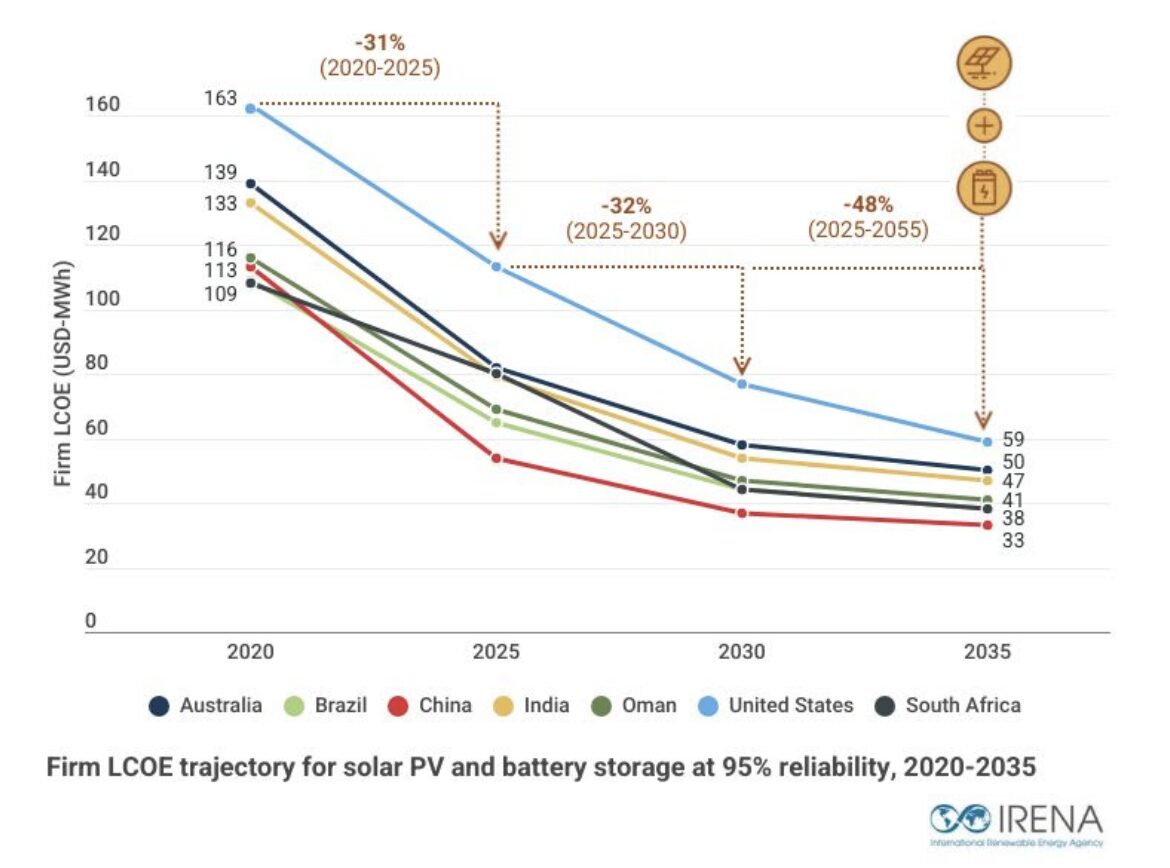
The report found that firm renewable electricity costs have fallen sharply since 2020. Solar plus battery systems that previously exceeded US$100 per MWh are now delivering electricity at around US$54 to US$82 per MWh in high irradiation solar markets and strong wind corridors by 2025.
IRENA projects further cost reductions of approximately 30% by 2030 and around 40% by 2035, potentially lowering firm renewable electricity costs below US$50 per MWh at leading project sites.
The Al Dhafra Solar PV project in the United Arab Emirates was highlighted as an example of the commercial viability of hybrid renewable systems. The facility combines solar PV with battery storage to deliver 1 GW of firm clean electricity at around US$70 per MWh.
IRENA also found that wind plus storage systems are becoming increasingly competitive. In 2025, firm wind plus storage costs are estimated at around US$59 per MWh in Inner Mongolia and between US$88 and US$94 per MWh across Brazil, Germany and Australia.
By 2030, these costs are expected to decline further to between US$49 and US$75 per MWh across the same markets.
The report noted that combining wind and solar generation reduces storage requirements and lowers overall system costs by leveraging complementary generation profiles.
Link to the full report HERE
Author: Bryan Groenendaal