- Eskom has raised concerns over ongoing misinformation about its system performance and diesel consumption, reiterating that it continues to share transparent, data-based updates on its operations every Friday through its media channels.
According to the utility’s latest Power Alert, issued on 31 October 2025, Eskom’s generation performance continues to improve, with reduced diesel usage, higher power station efficiency, and fewer breakdowns.
While the Energy Availability Factor (EAF) target of 70% for March 2025 was not achieved—largely due to increased planned maintenance—Eskom said the maintenance strategy is paying off, improving long-term reliability and compliance with regulatory requirements. These efforts have resulted in a more stable electricity supply, contributing to the recent period without loadshedding.
Since August 2025, Eskom’s EAF has reached or exceeded 70% on 32 occasions, with the September average at 70.27%. Year-to-date, the EAF stands at 63.19%, reflecting a 7.16% improvement from the 56.03% recorded in the 2023 financial year. Breakdowns have also fallen by 6.76%, from 31.92% (around 15GW) to 25.16% (approximately 11.8GW)—a reduction equivalent to about three stages of loadshedding or nearly the full capacity of the Lethabo Power Station.
Eskom emphasised that diesel is being used strategically and efficiently through its Open-Cycle Gas Turbines (OCGTs), which are designed to support the grid during periods of peak demand. The current OCGT load factor is 5.84%, indicating reduced dependence on diesel-fired generation and improved system stability.
Higher diesel usage in April 2025, Eskom noted, was due to delays in returning some units from planned maintenance. Since then, diesel consumption has steadily decreased as generation reliability has improved. The utility also reported that 13 generating units have been placed on cold reserve as of 31 October 2025—a sign of strengthened capacity and enhanced system resilience.
Comparing recent years, Eskom highlighted major progress. South Africa faced 47 days of loadshedding in FY2021, 65 in FY2022, and 280 in FY2023, with FY2024 marking the worst year at 329 days. However, FY2025 saw 352 days without loadshedding, including a loadshedding-free winter—meaning Eskom met electricity demand 96% of the time, compared to just 9% in FY2024.
So far in FY2026, Eskom has achieved 213 consecutive days without loadshedding, meeting demand 98% of the time, with only 26 hours of interruptions recorded between April and May 2025.
The utility said these gains demonstrate the continued success of its Generation Recovery Plan, which has been underway since March 2023, and reaffirmed its commitment to transparency and operational improvement
The table and graph below (Table 1 and Figure 1) demonstrate that diesel (OCGT) usage rose steadily between FY2021 and FY2024, consistently surpassing budgeted projections. From FY2025, however, usage declined sharply — by around R16 billion compared to FY2024 and dropping below budget levels. According to Eskom’s Power Alerts, diesel consumption in FY2026 has continued to decrease, with the load factor reducing from 16.02% in April 2025 to 8.28% in May as additional generating units returned to service, and further down to 0.75% in October 2025. Diesel usage during September and October 2025 was also notably lower than the same period in the previous year, remained under budget and is projected to remain under budget by year end.
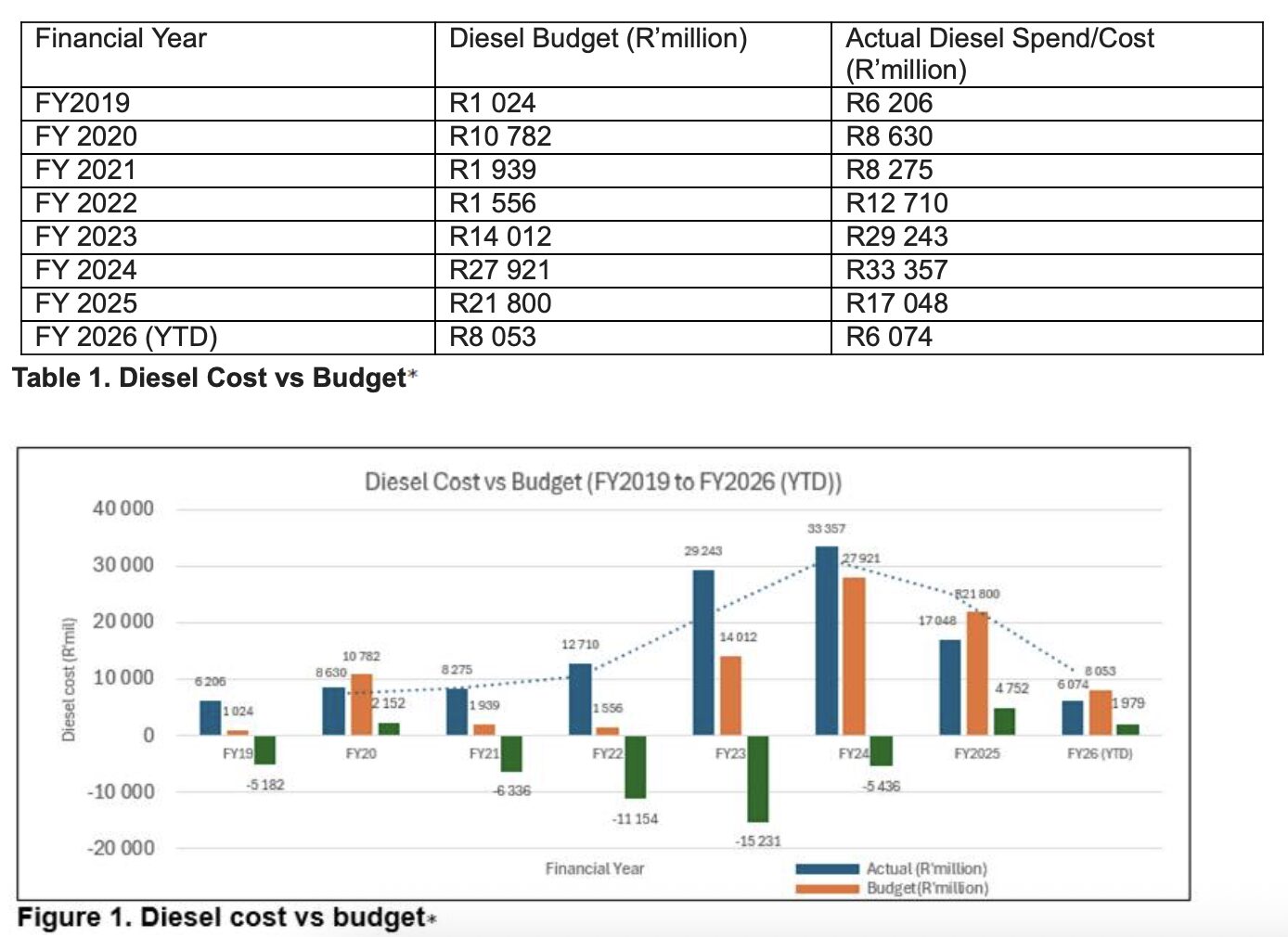
This demonstrates Eskom’s strategic shift away from diesel reliance, driven by stronger 24/7 baseload generation.
Eskom affirms its committed to transparency, providing South Africans with accurate and timely information. Improvements in generation performance, a significant reduction in diesel usage, and the effective execution of the Generation Recovery Plan have strengthened the stability of the national grid.
Author: Bryan Groenendaal