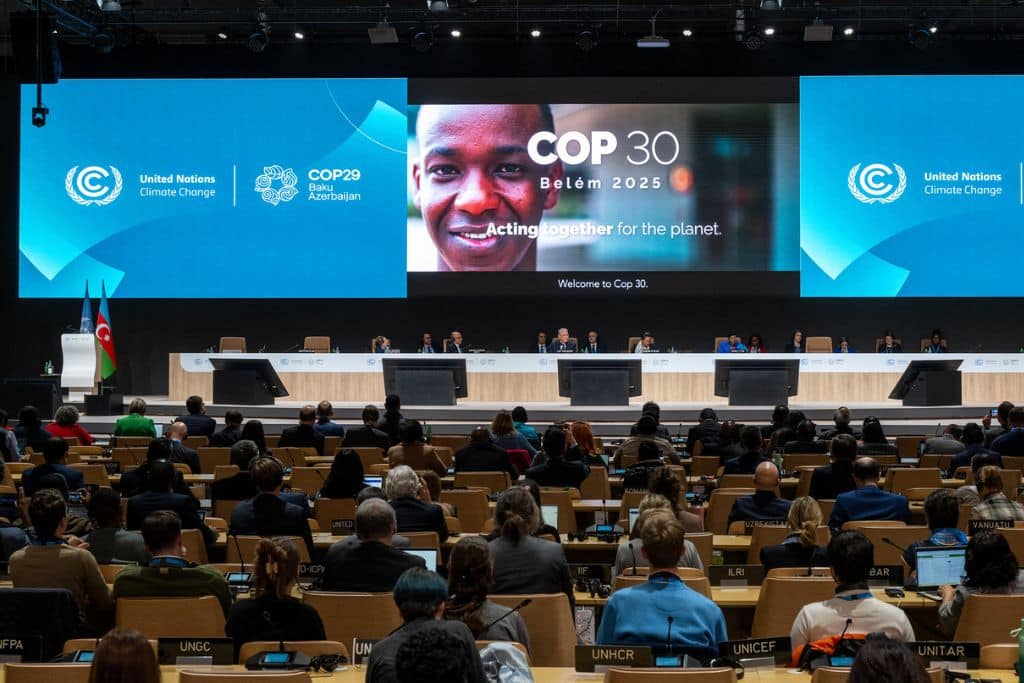
- After two weeks of tense negotiations, the UNFCCC COP30 climate summit concluded Friday with widespread frustration, as governments failed to advance what had been billed as the “implementation COP.”
- Despite escalating climate threats and mounting pressure from vulnerable nations, negotiators left major work streams paralysed by a lack of funding and political will.
The failures, observers warn, pose serious consequences for Africa, the broader Global South and Indigenous Peoples, communities already facing the most severe climate impacts.
Finance deadlock from COP29 casts long shadow
Much of the paralysis stemmed from unresolved issues dating back to COP29 in Baku. The inability there to agree on a New Collective Quantified Goal (NCQG) for climate finance left this year’s core negotiating tracks, Adaptation, Just Transition, and the Gender Action Plan (GAP), without the resources required for implementation.
“Implementation is impossible without finance,” said multiple Global South delegates, noting that developing countries remain unable to meet their Paris Agreement obligations without scaled-up and predictable funding from wealthy nations.
Gender action plan: a step forward, but rights language weakens
Ahead of the negotiations, Natural Justice released a report documenting the escalating violence faced by African Women Environmental Human Rights Defenders (WEHRDs), including gender-based and sexual violence used to silence their activism.
However, gender issues did not feature among the COP30 Presidency’s priorities, and negotiations saw several governments attempt to roll back previously agreed language on gender equality and human rights.
The final Belém Gender Action Plan includes, for the first time, explicit reference to women environmental defenders — a milestone that advocates celebrated even as they criticised the erosion of broader rights-based language.
“The explicit mention…is a small but progressive step,” said Tawonga Chihana, Head of Natural Justice’s African Environmental Defenders Initiative. “But we hope this does not become a tokenistic exercise. It must lead to stronger protections, gender-responsive climate finance, and meaningful participation for defenders.”
Just transition: progress undermined by diluted language
Developing countries and civil society groups had pushed for a Belém Action Mechanism under the Just Transition Work Programme to operationalise support for equitable transitions. Wealthy states resisted, leading to a weakened compromise.
“The mechanism for just transitions is a positive aspect,” said Lauren Nel, Natural Justice’s Just Energy Transition Lead. “But critical language on fossil fuel subsidies and socio-economic opportunities of transitioning away from fossil fuels has been watered down or removed.”
Nel welcomed references to free, prior and informed consent for Indigenous Peoples, but warned that without real implementation, governments will continue advancing fossil fuel projects or “clean energy” supply chains that replicate environmental and human rights abuses.
Adaptation talks stall over financing
The Global Goal on Adaptation (GGA) began with optimism but quickly faltered as developing countries called for tripling adaptation finance by 2030, a demand that wealthy states refused to meet.
“It is disappointing to see that no clear financial commitments have been made,” said Sokhna Die Ka, Director of Natural Justice’s Dakar Hub. She stressed that achieving adaptation targets requires large-scale financial and technological support and that African countries “should not have to bear the costs” through national budgets.
Indigenous rights marginalised despite amazon venue
Despite COP30 being held in the Amazon, Indigenous Peoples reported being sidelined from negotiations. President Lula had hailed the summit as the “COP of Truth,” but the event saw a record presence of agribusiness, fossil fuel and carbon-capture lobbyists, who advocates say diluted human rights safeguards, particularly in Article 6 rules governing carbon markets.
“It has been a difficult and spatially contested COP,” said Claire Martens, Natural Justice’s Communications and Media Coordinator. She noted that Indigenous leaders had to breach venue barriers to make their concerns heard, prompting a heavy security response.
Martens highlighted ongoing crises facing frontline communities: from devastating storms in the Philippines and Caribbean to the environmental and human rights toll of critical mineral mining across Africa, a key blind spot in COP30’s outcome texts.
“Again, the space was dominated by fossil fuel and agricultural interests,” she said. “Some progress was made, but not enough.”
Growing calls to reform the COP process
Civil society groups say COP30’s failures underscore the need for fundamental reform of the UNFCCC system, including measures to curb corporate influence and ensure meaningful participation for affected communities.
“We need a peoples’ multilateralism built on equity, equality and solidarity,” said Katherine Robinson, Natural Justice’s Head of Policy and Advocacy. “Without human rights, there is no climate justice.”
As COP30 closed without the finance or ambition needed to meet global climate goals, activists warned that the world is running out of time, and patience for incremental progress.
Author: Bryan Groenendaal