- According to the OPIS Solar Weekly Report released on October 21, The Chinese Module Marker (CMM), OPIS’s benchmark for TOPCon modules above 600W, rose 1.14% to $0.089/W Free-On-Board (FOB) China, with indications between $0.086-0.093/W.
Forward curve indications strengthened this week, with H2 2026 loading cargoes rising to $0.091/W for both Q3 and Q4, while H1 2026 held steady at $0.089/W for Q1 and $0.090/W for Q2.
Q4 2025 loading climbed 1.14% at $0.088/W, tracking firmer spot indications, with higher market prices ranging $0.086-0.091/W.
The polysilicon platform company – jointly established by several leading producers to absorb excess capacity – is nearing completion, according to recent industry discussions. Market sources say this development suggests a step forward in the long-anticipated industry consolidation plan, though its scale and timeline still await official confirmation.
Downstream solar producers noted that the consolidation talks have had limited immediate impact on the cell and module markets, as downstream clients haven’t shown strong price acceptance yet.
A module manufacturer source said that if the polysilicon consolidation plan is implemented, it could ease the supply-demand imbalance across the solar value chain, adding that major downstream manufacturers are already operating under production quotas while new capacity approvals are becoming harder to obtain.
However, even if implemented, a market analyst expects any short-term effect will likely be limited to sentiment support for the downstream market, as the initial phase of the consolidation is expected to be small. Yet the analyst remains skeptical of the plan’s execution, citing multiple previous delays.
Meanwhile, recent prices in China’s tender markets remained above the China’s Photovoltaic Industry Association (CPIA) N-type cost price guidance of CNY 0.701 ($0.098)/W. Henan’s tender for N-type 635W modules averaged CNY 0.711/W (~$0.092/W FOB equivalent without VAT), while a 130MW state-owned tender in Shanxi by Jiaokong Technology saw average offers between CNY 0.715/W and CNY 0.719/W.
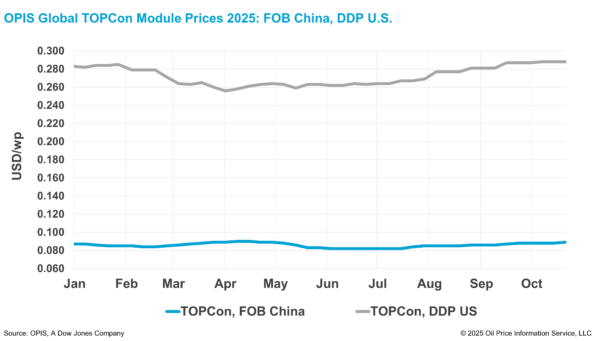
In the U.S., the spot price assessment for TOPCon modules over 600W DDP U.S. remained at $0.288/W this week. Quotes for cargoes from India held at $0.331/W while quotes for cargoes from Southeast Asia fell 0.37% to $0.271/W.
US-assembled TOPCon modules with imported cells were quoted at an average price of $0.326/W, stable week-over-week. Domestic content modules – Mono PERC panels with American cells – are generally quoted above $0.45/W, though availability remains limited.
The U.S. solar industry continues to wait for critical developments on multiple policy fronts, including two tariff investigations (AD/CVD and Section 232 into polysilicon) and forthcoming “foreign entity of concern” (FEOC) rules, amid a federal government shutdown.
Official information on timing for the Section 232 investigation remains scarce, with much of the industry resorting to speculation, according to a large developer source.
The lingering question is whether the federal government will target Chinese polysilicon producers specifically or impose measures that affect the broader solar industry. However, the source noted the stalemate in D.C. could delay the probe’s conclusion until 2026.
Meanwhile, a developer source suggested the AD/CVD investigation could end up being more consequential than the changes to IRA tax credits over the summer as it could threaten a cell shortage in the US. Combined with new FEOC guidance, the probe could spell price hikes in 2026, as the source doesn’t expect many facilities will be able to comply with FEOC “material assistance” provisions.
Source: OPIS
OPIS, a Dow Jones company, provides energy prices, news, data, and analysis on gasoline, diesel, jet fuel, LPG/NGL, coal, metals, and chemicals, as well as renewable fuels and environmental commodities. It acquired pricing data assets from Singapore Solar Exchange in 2022 and now publishes the OPIS APAC Solar Weekly Report.
This article was originally published in pv magazine and is republished with permission.