Watch the video below to learn more about the renewable ammonia process
- Yara, a global crop nutrition company based in Norway, has officially opened its renewable hydrogen plant at Herøya, Norway.
- The hydrogen is produced with electrolysis of water and renewable energy, replacing natural gas as feedstock and annually cutting 41,000 tonnes of CO2 emissions from the site.
- Hydrogen is used to produce ammonia, which in turn is used to produce fertilizers and can also be used as shipping fuel.
- Ammonia is also an efficient energy- and hydrogen carrier.
Yara has already delivered the first tonnes of fertilizers made from renewable ammonia produced at the plant. The low-carbon footprint fertilizers produced and delivered will be part of a new portfolio called Yara Climate Choice. In addition to fertilizers produced with electrolysis of water and renewable energy, fertilizers based on low-carbon ammonia produced using carbon capture storage (CCS) will be a large part of Yara’s portfolio going forward.
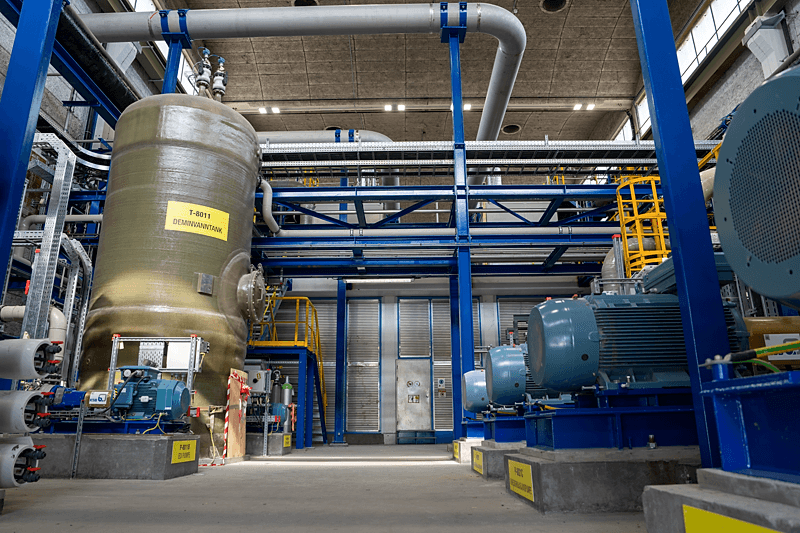
Interior shot of water circulation pumps to the right, and pure feed-water tank to the left. Image credit: Yara
Low emission ammonia, both produced with renewable energy and with carbon capture and storage, is essential to reach the goals of the Paris Agreement, and CCS is a critical step to decarbonize rapidly and profitably. While Yara is uniquely positioned to deliver decarbonized solutions quickly and at scale, the green transition will require investments, predictable framework conditions, funding, affordable renewable energy and a maturing market where demand and supply are developed simultaneously.

The stream of oxygen and water from the electrolyser is sent to the oxygen and water seperator. Water is recirculated and oxygen is vented on the top. Image credit: Yara
The low-carbon footprint fertilizers produced and delivered will be part of a new portfolio called Yara Climate Choice. These solutions will benefit crops while at the same time contributing to decarbonizing the food value chain and reducing climate impact. In addition to fertilizers produced with electrolysis of water and renewable energy, fertilizers based on low-carbon ammonia produced using carbon capture storage (CCS) will be a large part of Yara’s portfolio going forward.
Author: Bryan Groenendaal