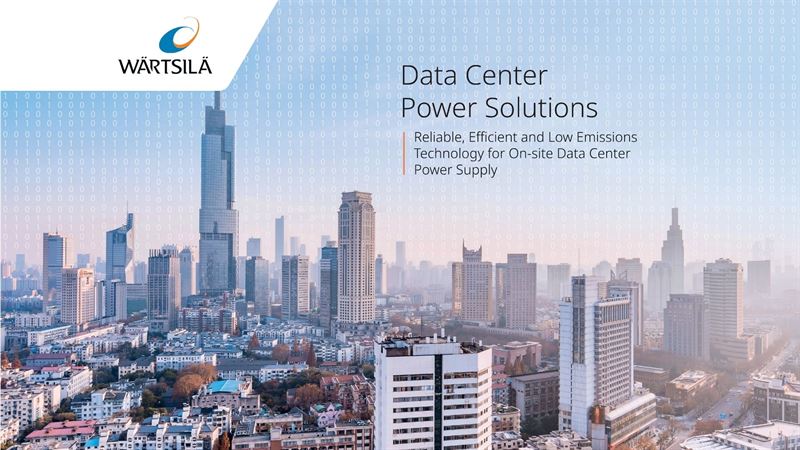

- Wärtsilä has announced a major step in its expansion into the data-center power market with a new U.S. order for 27 natural-gas-fueled engines capable of delivering 507 MW of primary power.
- The deal, booked in the company’s Q4 2025 order intake, will support a large data center currently under construction, with equipment delivery scheduled for 2027.
The installation will feature Wärtsilä 50SG engines, which the company says can later be converted to run on sustainable fuels. The facility will operate independently from the local grid, reflecting a growing trend among data-center developers to secure their own power sources amid concerns about capacity constraints, grid instability, and long connection timelines.
As the digital economy expands, data centers are becoming increasingly power-hungry, with strict requirements for uptime. Developers are therefore turning to off-grid primary power solutions such as engine-based power plants to maintain reliability and speed up project timelines.
According to the company, its technology was selected over competing options due to its ability to maintain full output in temperatures above 100°F (37.8°C), combined with low emissions and high fuel efficiency. These features, Wärtsilä says, will help the customer meet sustainability targets while ensuring consistent operations.
“Our off-grid solutions eliminate lengthy grid connection delays and offer a range of advantages,” said Anders Lindberg, President of Wärtsilä Energy and Executive Vice President of Wärtsilä. “Our modular engine power plants deliver high availability even during maintenance, ramp up quickly to meet fluctuating loads, and scale rapidly as data-center demand grows. They also perform efficiently in demanding environments, using significantly less fuel and water than other technologies.”
Wärtsilä currently has 79 GW of installed capacity globally, including 6 GW across roughly 80 power plants in the United States. The company identified data centers as a key growth area in its Q3 2025 report. By 2030, the U.S. is expected to lead global data-center expansion, with rising energy demand prompting customers to adopt flexible generation technologies, including engine systems and energy storage to achieve reliable, affordable, and low-emission power.
Author: Bryan Groenendaal