- Small scale embedded solar remains significantly more expensive than grid electricity for homeowners.
- Around half of household solar generation capacity is unused and could be sold back to the grid.
- Municipal funded bidirectional metering could unlock new revenue and reduce future tariff increases.
A new study by David R. Walwyn from the Graduate School of Technology Management, University of Pretoria, titled ‘An alternative to higher energy tariffs: Extracting unused capacity from small-scale embedded solar,’ suggests that South Africa electricity distributors are missing a major opportunity to tap into unused rooftop solar capacity that could strengthen the grid and ease pressure on future tariff increases.
The research examines the techno economic performance of small scale embedded solar systems using real time data from a residential installation combining rooftop photovoltaic panels and battery storage. While adoption of household solar has accelerated due to rising electricity tariffs, grid instability and falling equipment costs, the study finds that solar remains a premium option for consumers.
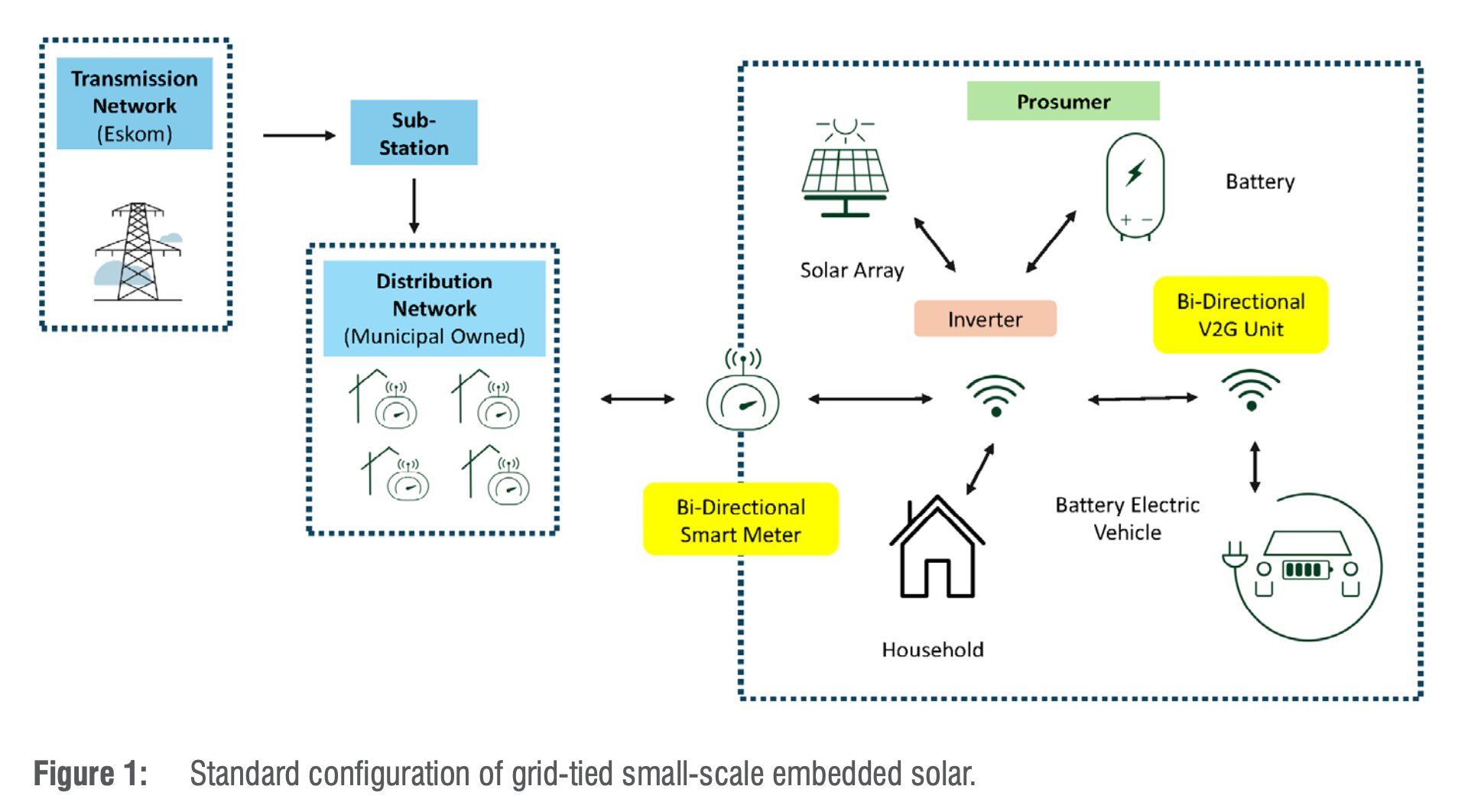
Image credit: David R. Walwyn
According to the analysis, the levelised cost of electricity from small scale embedded solar is around 75 percent higher than grid based electricity. This confirms that most homeowners are investing in solar primarily for energy security rather than cost savings, particularly in response to load shedding and supply uncertainty.
However, the study highlights a significant inefficiency in how these systems are currently used. Household solar installations are typically sized to meet winter demand, which means that during sunnier months around 50 percent of generation capacity is left unused. This excess energy represents a largely untapped resource that could be fed into municipal or Eskom networks.
Using the City of Cape Town as a case study, the research estimates that as much as 153 gigawatt hours of surplus solar energy could be made available annually. If fully traded, this could generate a net profit of approximately ZAR144 million for the municipality. Despite this potential, participation in energy trading remains limited.
The main barrier is the cost and administrative burden placed on homeowners. To sell electricity back to the grid, households are required to install bidirectional meters and complete a formal registration and certification process. As a result, fewer than half of existing small scale embedded solar systems are properly registered.
The study argues that this is a missed opportunity for distributors. A cost benefit analysis shows that if municipalities or Eskom were to fund the installation of bidirectional meters, the benefits would outweigh the costs by more than five to one. In addition to new revenue streams, distributors would gain access to low carbon energy, improved system resilience and reduced transmission losses.
Importantly, the research challenges the concern that encouraging rooftop solar will undermine municipal revenues by pushing customers off the grid. Achieving near total energy independence would require uneconomical levels of investment by households. Instead, the optimal level of self-supply still leaves prosumers dependent on the grid, making grid connected solar the most practical and sustainable model.
The findings suggest that enabling prosumer participation through distributor funded metering could support affordability, reliability and decarbonisation goals. By unlocking unused solar capacity already installed on rooftops, South Africa electricity sector could reduce emissions, improve resilience and limit the need for further above inflation tariff increases.
While the study is based on a single residential system, it points to a scalable opportunity across urban centres with high rooftop solar penetration. Further research across different regions and system configurations could help refine the business case, but the message is clear: the energy transition may be accelerated not only by building new capacity, but by making better use of what is already there.
Link to the full paper HERE
Author: Bryan Groenendaal