- ESG performance service quality and innovation emerge as key differentiators.
- Regional manufacturing strategies gain importance amid trade uncertainty
Huawei and Sungrow have been ranked as the world’s leading solar inverter manufacturers for the first half of 2025, according to the latest Global Solar Inverter Manufacturer Rankings report published by Wood Mackenzie. SMA, GoodWe Solis and Fronius are the other four listed in the top six. Huawei achieved a score of 93.9, narrowly ahead of Sungrow at 93.7, underscoring the tight competition at the top of the global market.
The report assesses 23 leading inverter manufacturers from seven countries, representing around 90 percent of global shipment volumes in 2024. Together, the top 10 suppliers accounted for 71 percent of the global market, highlighting continued concentration among a small group of dominant players.
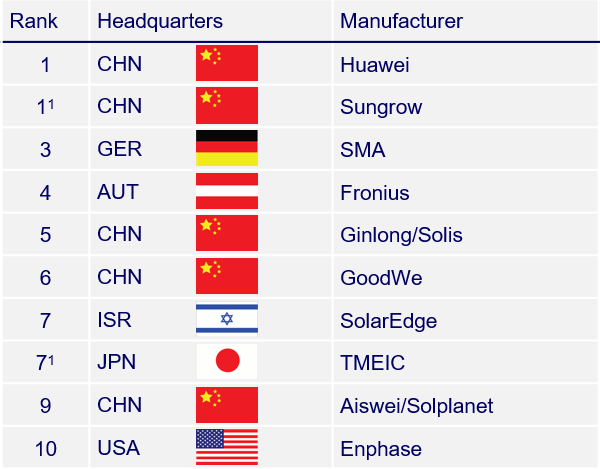
Global top ten solar inverter manufacturers. Source: Woodmac
According to Timothy Shen, Senior Research Analyst at Wood Mackenzie, the current market landscape reflects more than just scale. He noted that competitive advantage is increasingly defined by strong Environmental Social and Governance practices, reliable service offerings and resilient supply chains, alongside shipment volumes.
One of the key findings from the ranking is the growing maturity of ESG practices across the sector. Six of the top 10 manufacturers achieved an EcoVadis silver rating or higher, placing them among the top 15 percent of companies globally for sustainability performance. In parallel, all top 10 suppliers now offer warranty extensions of 20 years or more, aligning inverter lifespans more closely with those of solar modules and reducing long term risk for developers and asset owners.
Innovation remains a central focus despite ongoing pricing pressure. Eight of the top 10 manufacturers reinvest more than 6 percent of their revenue into research and development. This investment is driving advances in digitalisation, power conversion technologies, faster product refresh cycles and expanding patent portfolios.
Manufacturing strategies are also evolving in response to global trade dynamics. Four of the top 10 inverter suppliers now operate truly global production footprints, with facilities across regions including China, Europe, India, the United States, Southeast Asia and Israel. Shen said that regionalised assembly strategies are becoming critical, enabling manufacturers to meet local content requirements, manage import barriers and maintain supply reliability.
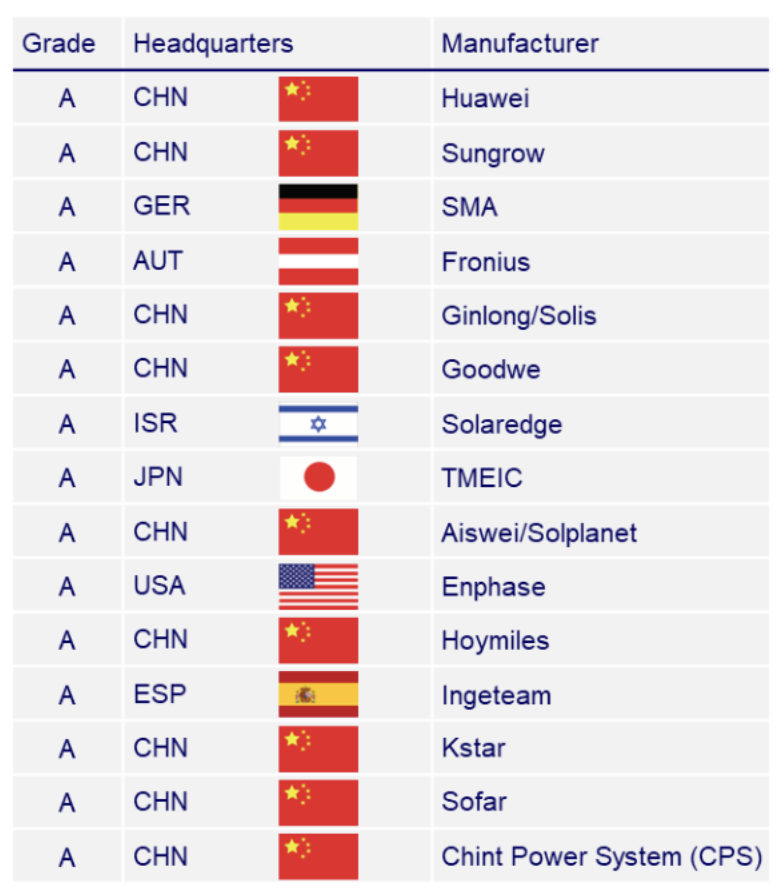
Grade A inverter manufacturers. Source: Woodmac
The report also highlights the importance of Wood Mackenzie’s Grade A designation, which is awarded to manufacturers that meet at least five industry benchmarks across the assessed criteria. Grade A suppliers demonstrate consistent and verifiable performance, helping to reduce execution and operational risk for developers, engineering procurement and construction contractors, and asset owners. The designation is widely viewed as a signal of alignment with global procurement standards, including ESG and corporate social responsibility, research and development investment and capacity utilisation.
Wood Mackenzie’s inverter manufacturer rankings are published twice a year and are based on eight weighted criteria, with ESG and CSR accounting for the largest share. The assessment draws on vendor surveys, public disclosures, proprietary databases and extensive engagement with manufacturers across the global solar value chain.
Author: Bryan Groenendaal