- Solar PV in combination with Windenergy and dispatchable Renewable Energy Sources are becoming globally the most important energy sources for the future electricity supply and the share of fossil fuelled bulk power plants with rotating generators will decrease strongly.
- Thus, solar PV systems as well as other inverter coupled generators (e.g. Windturbines) and storage units must take over additional grid supporting tasks of conventional power plants in order to allow for secure and stable operation of electrical power systems at all times.
A new IEA-PVPS report aims to present the status and the potential of distributed solar PV and PV hybrid systems with respect to provision of frequency related services. Very large PV systems, which must be connected directly to bulk power systems (e.g. to EHV level) and its specific requirements are not considered in this report.
Due to a wide range of technical and economic advantages, Alternating Current (AC) technology has become established worldwide for public electrical power supply over the past 150 years. In order to keep the grid frequency in such AC power systems stable, it is mandatory to assure an electrical active power balance in the entire supply area, i.e. to adjust at any time the active power generation to its demand. PV systems with its capability to adapt its active power generation can thereto contribute very well to frequency stabilisation, although they have certain limitations such as dependency on solar irradiation, response speed or fast frequency measurement.
Depending on the legal background of the electricity supply and especially the power system market design in the various countries, the frequency control / balancing energy products specifications and designations are different, but the physical principles in the background are equivalent. In the European Union five different power balancing / frequency control services/products have been defined and traded on the power balancing markets:
- Operating or Spinning Reserve
- Frequency Containment Reserve (FCR) or primary control reserve
- Automatic Frequency Restoration Reserve (aFFR) or secondary control reserve
- Manual Frequency Restoration Reserve (mFFR) or tertiary control reserve
- Replacement Reserve (RR)
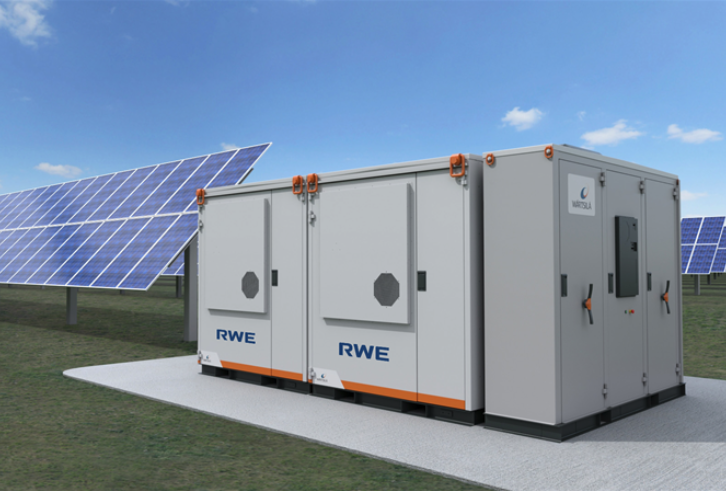
PV Systems already today have the technical capabilities to provide various frequency related grid services: Reduction of active power generation in case of overfrequency and – in combination with BESS – automatic increase of their output in case of underfrequency.
Furthermore, Frequency Containment Reserve (FCR) is an important frequency support service. Although this feature is procured on balancing markets, its specification has been introduced in some network codes, for instance like in the German HV network code for connection of generators.
The transition from grid-following to grid-forming operation – already foreseen in upcoming revisions of selected grid-codes – will enable PV systems to provide the full set of frequency services, analogue to services today provided by rotating generators.
Power system stability studies from Transmission System Operators have clearly shown, that during the next years and decades the probability for the provision of pre-defined inertia constant is decreasing and the time periods with less than this inertia value are strongly increasing. Thereto, it is especially in low inertia and inverter dominated power systems absolutely necessary, that any active power imbalance would be reduced as soon as possible by means of activating very fast active power reserves, such as Synthetic Inertia (SI) or Fast Frequency Response (FFR). They are currently not mandatory requested in Grid codes, but in the current draft of the lately revised European grid code Requirements for Generators (RfG) from 2023 both requirements are foreseen for inverter coupled power stations with rated capacities exceeding certain limits.
The case studies presented in this report successfully demonstrate the capabilities of Solar PV to provide a wide range of frequency related services in real-world power systems environments.
Link to the full report HERE
Author: Bryan Groenendaal