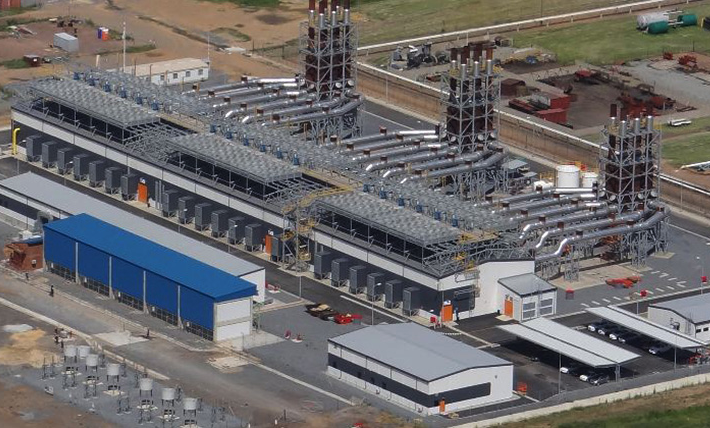
- A group of opposition activists has cut off gas supplies to neighbouring South Africa after seizing a plant owned by South African company Sasol in Inhambane Province in south-east Mozambique.
- More than 90% of South Africa gas imports come from Mozambique.
Sasol has been operating in Mozambique since 2004 and operates the Pande and Temane onshore gas fields in Inhambane. It has a gas processing plant at Temane from which gas is transported via the 865 km Rompco pipeline to Sasol’s Secunda industrial complex in Mpumalanga province, South Africa. Sasol relies on the gas supply to fire its 140MW gas-to-power plant at its Sasolburg operations plus a 280MW plant at its Secunda operations. The gas imported from Mozambique is also distributed to local users.
“We have informed various gas users and our customers that we are not able to supply gas at full production rates to maintain stability of the gas value chain infrastructure and pipeline network,” said Alex Anderson – head of Group External communication at Sasol.
Related news: South Africa’s massive Sasol petrochemical plant faces serious challenges
Demonstrations began at the end of October in Maputo after Daniel Chapo, the Frelimo candidate, was officially declared the winner of the elections with over 71% of the vote. Protesters are contesting the results of the 9 October elections, which allowed the ruling Frelimo party to extend its 49-year rule. The protests, primarily led by young people, have resulted in violent clashes with the police, mass prison breaks, and at least 248 deaths.
Political protests in Mozambique has also disrupted power supply to Zambia. Read more
Paula Cristina Roque writes that Mozambique is not experiencing a coup – “it’s a people’s revolution of unprecedented proportions demanding electoral truth and justice for assassinated activists. It’s a march against poverty, exclusion, violence, and the arrogance of a ruling party that decides, without consent, the fate of 33 million people, denying them a voice, a platform, a role in the democracy that camouflages Frelimo with a mantle of credibility.
Mozambique’s ruling party has lost legitimacy, it’s in disarray and without a political solution to the post-election crisis sparked by mass fraud. It’s time for Frelimo to step down and begin a transition of power where opposition parties led by Podemos, and civil society can recalibrate governance and open the way for a new political order based on the rule of law, socioeconomic justice, and accountability.” Read more
Last week South Africa’s International Relations and Cooperation Minister, Ronald Lamola, and his Mozambican counterpart, Pascoal Ronda, held a joint media briefing after the inter-ministerial meeting in Mpumalanga.
At the meeting Lamola acknowledged that the crisis in Mozambique was putting South Africa’s national security at risk. “In terms of energy security, this corridor is very important for South Africa … for petroleum products and for gas through the pipeline,” said Lamola. He added that South Africa was looking into measures to mitigate the risk to energy security.
Author: Bryan Groenendaal