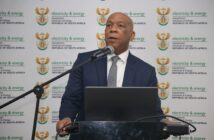
Watch the video: Portfolio Committee on Electricity and Energy, (National Assembly), briefing by the Eskom on their Strategic Corporate Plan for 2025-2030. Note, it takes a while to feed through.

- Parliaments Portfolio Committee on Electricity and Energy hosted South Africa’s Department of Electricity and Energy (DEE) headed by its minister, Dr Kgosientsho Ramokgopa, and Eskom Group Chief Executive Dan Marokane, separately this past week.
- Both submitted updates on the country’s energy sector plans leading up to 2030
Ramokgopa and his team confirmed that the DEE wanted to increase the current 11 GW renewables capacity y to 33 GW by 2030 and raise local content in these projects to 60%. He also confirmed that with the participation of the private sector, the DEE will implement the Transmission Development Plan to compliment the National Transmission Company South Africa’s programme.
Related news: Ramokgopa invites comments on the draft Electricity Transmission Infrastructure Regulations
On nuclear energy, DEE acting Director-General Subesh Pillay revealed that a strategic priority is to “reset the role and place of nuclear” which appears to be focussed on the South Africa Nuclear Energy Corporation (NECSA) and the replacement build for the ageing Safari reactor which is a global leader in the supply of industrial applications, medical diagnostics and therapy. An increased budget allocation will see investment in nuclear regulation and management, including oversight of existing facilities, nuclear safety and feasibility planning for future builds.
The DEE did not update the committee on the progress of the IPP Office which is responsible for much needed new generation energy procurement in the country. The IPP Office has lagged the pace of procurement needed for the country to meet energy demand and avoid costly blackouts. Controversially, a job position for a new IPP Office head was recently advertised by the Development Bank of South Africa. Read more
The following vision was laid out by the DEE leading to 2030:
- increase in private-sector investment in energy infrastructure from R80-billion to R400-billion by 2030.
- increase the proportion of electricity generated by independent power producers to 40% from 14% currently
- allocation of 500 000 t of green-hydrogen capacity.
- creation of 200 000 new energy sector jobs aligned to the country’s just energy transition.
- market code in place for electricity trading, alongside a fully operational wholesale electricity market.
- Finalisation of a new Integrated Resource Plan (IRP2025) this year.
- Implementation of Gas Masterplan, which is currently still in draft form.
- R4-billion of R6 billion 2025 budget is directed to Eskom and municipalities in support for the Integrated National Electrification Programme.
- proportion of electricity traded within the Southern African Power Pool to rise from 5% to 15%.
Eskom
The Eskom team headed by Dan Marokane informed the committee that R133-billion, or 41.2%, of its capital budget for the 2026 to 2030 financial years would be spent by the National Transmission Company (NTCSA) ramping up from R9.96-billion in the current financial year to R38.72-billion in the 2030 financial year.
The corporate plan indicated that about 6 600 km of powerlines and 67 000 MVA of transformer capacity would be constructed by 2030.
Echoing the DEE, the Eskom team confirmed that the NTCSA’s capex will be complimented with private grid investment.
New regulations for public-private partnerships (PPPs) in South Africa have been finalised and will take effect on 1 June 2025. The regulations reduce the procedural complexity of undertaking PPPs, create capacity to support and manage PPPs, create clear rules for managing unsolicited bids, and strengthen fiscal risk governance.
The regulations also make provision for national departments to establish sector-specific PPP units. These units will drive private sector participation (PSP), creating opportunities to optimise the balance sheets of financially distressed state-owned companies.
The Independent Transmission Programme will be launched later this year. A request for information for a multi-line transmission package will also be issued by the Independent Power Producers Office in July this year, followed by a request for proposals in November.
About R18.50-billion of the generation unit’s capex would be allocated for renewables and a 3000MW gas-to-power project in Richards Bay. Read more
Renewable energy business
Marokane confirmed that Eskom intends to establish renewable energy business. He explained that Eskom had decided that a separate renewables entity was required, owing to the partnership model being pursued, which would involve leveraging the balance sheets of its private partners.
Earlier this year, Eskom appointed a Group Executive for renewables to drive 20GW of clean generation projects. Read more
More recently, Eskom issued an invitation to tender for firms with a proven track record in establishing renewable energy businesses to assist Eskom in accelerating the deployment of renewable energy solutions. Eskom will evaluate applicants on criteria that includes the requirement for a proven track record in establishing a renewable energy company, the number of Public-Private Partnerships (PPPs) and Special Purpose Vehicles (SPVs) created that have delivered projects, IPP Business Model & Financial Structuring Expertise and technical capability and sector knowledge. Read more
Author: Bryan Groenendaal