Opinion
Eskom is edging closer to a year without load shedding, recently surpassing the 300-day mark- the longest stretch of uninterrupted power supply in years. Eskom Generation’s recovery plan, support from National Treasury’s debt relief for the utility and wider power sector reforms that have unlocked private generation capacity have all helped reduce power cuts.
The clearest sign of progress is in Eskom’s generation fleet. The energy availability factor – the share of installed capacity available to produce power at any given time – has recovered from its crisis lows, reaching 65.38% for the financial year to date as of 19 March 2026. The fleet exceeded 70% on 78 occasions over the same period. The main driver has been a declining trend in unplanned outages. which averaged 10,739 MW in the week to 19 March, down from 12,968MW during the same week last year – a reduction of 17-%.
Structural reforms have reinforced these gains. Progress on electricity wheeling – the transmission of privately generated power across the grid to end-users – has broadened market access beyond large industrial customers.
The outlook for the next two to three years is broadly positive. Projections published in a recent report by the South African Electricity Traders Association (SAETA) forecast no load shedding through 2026 to 2028, supported by continued fleet improvements and new private generation capacity coming online.
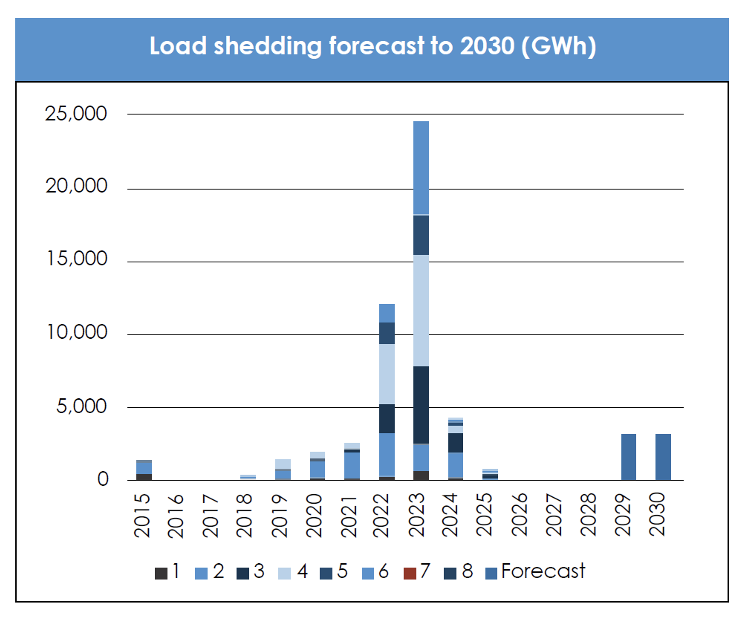
Image credit: SAETA
However, looking ahead to 2029, there is a real risk of load shedding re-emerging if renewable energy build stalls and market failures delay private investment amid increasing power demand given a projected economic growth rebound.
Another concern is system stability flagged in the Eskom medium-term system adequacy outlook report for the years 2026-2030. The report notes the risk of system instability caused by excess power from solar PV during day-time hours that would have to be curtailed or pulled back which is an inefficient use of generation capacity. The report points to the need for storage solutions and dispatchable generation capacity (such as gas-to-power) to balance out renewable energy output and ensure the reliability of the electricity system.
Cross-border electricity trading to manage the costs of grid stabilisation
With gas-to-power public procurement seeing material delays, cross-border electricity trading is a more realistic option to provide flexible power needed to ensure grid stability. For example, hydropower in Zimbabwe and Zambia could be imported via the Southern African Power Pool (SAPP) to provide flexible, dispatchable energy to balance variable renewable generation such as solar and wind in South Africa. This reduces the need for curtailment, lowers the need for expensive domestic peaking capacity such as gas-to-power plants, and improves the use of existing generation assets across the system.
Eskom already exports surplus supply across South African borders through the SAPP and imports hydropower from Mozambique’s Cahora Bassa plant. But there is scope to expand regional trade to include more private sector players with the aim to reduce exposure to domestic supply constraints and create more options to manage periods of tight system conditions that would warrant load shedding.
To this effect, in 2025 the National Energy Regulator of South Africa (Nersa) issued its first import and export trading licence to Africa GreenCo, creating a legal pathway for South African companies to buy and sell power across the region and participate in the SAPP. However, a Nersa-issued import and export licences is only the first step in deepening cross-border electricity trade. While a licence authorises a trader to buy and sell electricity, it does not provide automatic access to the transmission system or the ability to move power across borders.
Before any electricity can flow, operational and contractual arrangements between the trader and the National Transmission Company South Africa (NTCSA) must be put in place to govern the scheduling and balancing of cross-border transactions and associated costs. The framework being developed by the NTCSA needs to move rapidly from concept to implementation to enable licensed traders to participate effectively in regional power markets and ultimately deliver additional benefits to South Africa.
Saving on system costs
Applying a regional lens will also improve the investment case for new generation and transmission capacity in South Africa, as use of system charges can be levied on regional market participants who use the South African network for cross-border electricity flows. But without adequate interconnection, regional trade remains constrained, and system costs remain higher than necessary.
For South Africa, expanded regional transmission means the lowering of long-term electricity costs, strengthening competition, improving energy security and reducing fiscal pressure by limiting the need for costly, purely domestic capacity being added.
Cross-border trade essentially delivers large system-wide savings through economies of scale and the optimal use of resources.
Regional benefits translate into national benefits
Importantly, during South Africa’s G20 presidency in 2025, regional integration and cross-border energy flows were among the important focus areas of the “Solidarity, Equality and Sustainability” agenda, aimed at addressing Africa’s energy poverty and strengthening its energy infrastructure. Practical steps toward achieving these objectives included the launch of the “Powering Regional Integration” best practices booklet to provide tools for governments, regulators, and utilities to strengthen regional cooperation and implement cross-border power projects. Another important milestone was the launch of the Africa Ten-Year Infrastructure Investment Plan, to advance energy security through continental integration, optimising resource management, and increasing private sector participation.
South Africa also used its G20 presidency to highlighted the crucial role of regional power pools in reducing costs, integrating renewables, and improving reliability. This included support for the implementation of key initiatives such as the Programme for Infrastructure Development in Africa (PIDA), the Continental Power Systems Master Plan, and the African Single Electricity Market (AfSEM). South Africa’s stated policy objectives are therefore fully aligned with accelerating and deepening regional power sector integration.
Given the regional benefits cross-border power flows achieve, further steps are being taken to grow and strengthen the regional electricity market within the SAPP with the launch of the World Bank Approved RETRADE SAPP project in November 2025.
The project provides $12m in technical assistance to increase cross-border trading, improve market liquidity, crowd in private capital for transmission, and accelerate renewable energy integration across SAPP’s 12 member countries. As part of the wider Regional Energy Transmission, Trade and Decarbonisation multi-phase programme, RETRADE SAPP also supports the preparation and implementation of World Bank-financed interconnector projects.
Many priority interconnectors remain stalled by financing constraints. To close this gap, the Southern African Development Community and SAPP have launched the Regional Transmission Infrastructure Financing Facility (RTIFF), a blended finance platform managed by Climate Fund Managers and initially targeting $1.3bn to de-risk and mobilise private investment in regional transmission corridors.
South Africa’s policy and operational framework now need to keep pace with this regional momentum. Especially as cross-border electricity transactions can help create a more flexible and resilient electricity ecosystem in South Africa that affordability, reliability and long-term supply.
Author: Cathy Oxby
Cathy Oxby is co-founder and chief commercial officer at Africa GreenCo. The company is a member of the South Africa Energy Traders Association (SAETA), which commissioned Krutham to produce a report titled Policy to Power – 10 actions to deliver green, accessible and secure electricity.
Disclaimer: The articles and videos expressed in this publication are those of the authors. They do not purport to reflect the opinions or views of Green Building Africa, our staff or our advertisers. The designations employed in this publication and the presentation of material therein do not imply the expression of any opinion whatsoever on the part Green Building Africa concerning the legal status of any country, area or territory or of its authorities.