- A research group from China’s Shanghai Jiao Tong University has developed a novel optimisation strategy for an electric vehicle (EV) charging station relying on a PV system and storage solutions.
“This study introduces a vehicle-to-grid (V2G)-enhanced operation optimisation strategy for EV charging stations with PV and energy storage (ES) integration,” said the team. “A day-ahead power purchase planning model based on two-stage distributionally robust optimisation (TDRO) is established, demonstrating advantages in balancing economic efficiency with uncertainty risks. To address intra-day stochasticity, a model predictive control (MPC) based real-time optimisation scheduling method for the EV charging station is proposed.”
The strategy was tested on a case study in Shanghai. It considers the uncertainty of PV generation and the randomness of the EV load, while applying both day-ahead and intra-day optimisation.
The TDRO is used as a day-ahead power procurement planning model that incorporates two decision-making stages within the context of the electricity market.
In the first phase, the model determines the amount of electricity it needs to purchase. It uses PV forecasts and estimated time-of-use electricity pricing, while also estimating state of charge (SOC) for the batteries. In the second phase, the model considers the forecast errors of the PV system to finalize the day-ahead power procurement plan. The results are then refined on an intra-day basis.
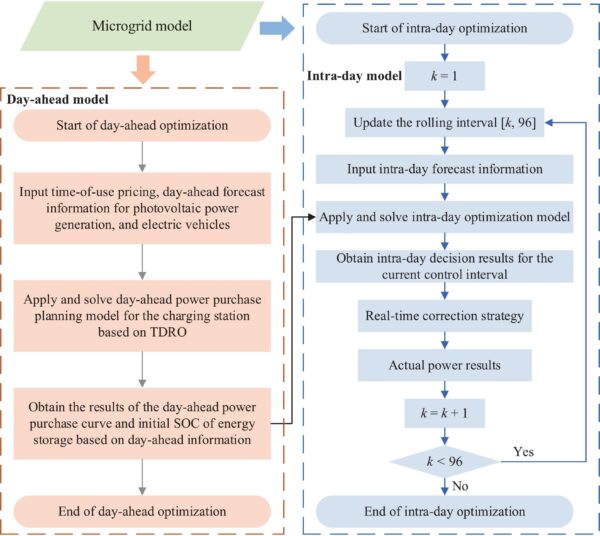
“The MPC rolling optimisation interval is divided into two parts: one is the control interval based on short-term forecasting information, and the other is the interval based on day-ahead forecasting information,” the group explained. “Considering the balance between computational efficiency and real-time performance, and combining the practical scheduling operations of charging stations, the time scale for intra-day rolling optimisation is set to 15 min. The rolling optimisation interval length corresponds to the remaining time of the day. Within the MPC rolling optimisation interval, decisions are made based on a combination of short-term and day-ahead forecasting information.”
A simulation of the optimisation strategy was then carried out based on data from an EV charging station located in Shanghai, China. The station is equipped with 80 DC fast charging piles, each with a charging power of approximately 100 kW. The parking canopies feature PV panels with a total capacity of 500 kW, while two six-slot battery containers with a total capacity of 1,080 kWh are also connected on site. The EV load data was collected from July to August 2024, with a sample size of 19,570 vehicle trips.
The analysis showed that, compared to the original “disordered” charging, the operational costs of two typical days analyzed were reduced by 17.80% and 13.51%, respectively.
“Joint optimisation through V2G and ES can better reduce peak loads compared to using ES alone,” the scientists concluded. “For example, with a peak load of 2,608.96 kW during the evening peak on weekdays, PV-ES optimisation can reduce 11.57% of the peak load, while PV-ES-EVs optimisation can achieve a 23.81% reduction.”
Their findings were presented in “V2G-enhanced operation optimization strategy for EV charging station with photovoltaic and energy storage integration,” published in the International Journal of Electrical Power & Energy Systems. Academics from China’s State Grid Shanghai Municipal Electric Power Company and Nari Technology have contributed to the study
Author: Lior Kahana
This article was originally published in pv magazine and is republished with permission.