


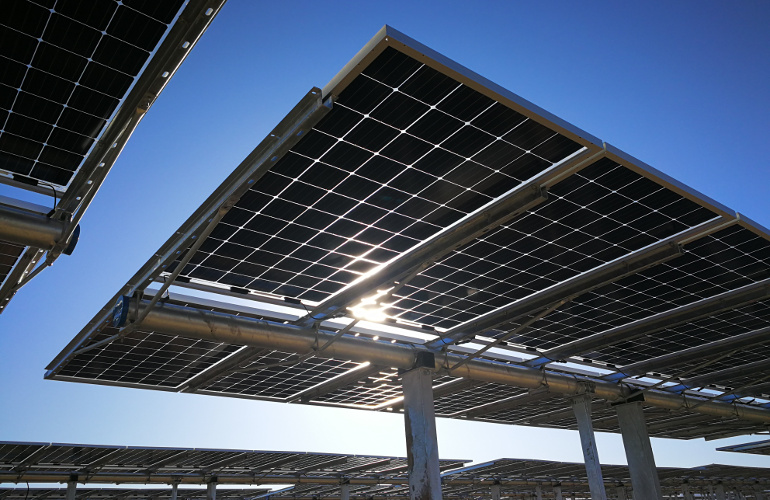

- Researchers in the United Arab Emirates (UAE) have developed a new bifacial PV module cooling technique based on a mist cooler placed between the two sides of the panel.
- They tested it under the extremely hot climate of the UAE and achieved some significant gains.
“The novelty of our research lies in the development of a new type of solar panel called a sandwich bifacial photovoltaic panel (sbPV),” corresponding author Zafar Said told pv magazine. “Unlike traditional solar panels that suffer efficiency losses in extremely hot conditions, our mist-cooled design maintains a cooler temperature, significantly boosting efficiency and energy production.”
To form the sbPV, the team took two mono-facial monocrystalline 60 W panels and installed them in a back-to-back configuration. In between, a mist cooling system was modified to fit the installation: 16 mist nozzles were installed behind the front panel and 16 behind the rear. PVC tubes channeled water from a water tank using a water pump, with a collection tray being used to collect used water. The working pressure is 0.7 MPa with a maximum flow rate of 8 L/min.
The system was then installed on the roof of the UAE’s University of Sharjah, at a fixed tilt angle and a height of 30 cm from the surface. A white paint coating is applied on the lower surface to increase the reflection. An additional mono-facial reference system, also of 60 W, was installed on the same roof. The systems were then tested under three scenarios: Sunny days without a mist cooler; sunny days with a mist cooler; and cloudy days with a mist cooler.
“One of the most remarkable results was the considerable increase in energy output we observed,” Said said. “In extremely hot conditions typical of the UAE climate, our sandwich bifacial panels with mist cooling generated up to 37% more electricity on sunny days and up to 46% more on cloudy days than standard single-sided solar panels. Additionally, the panel temperatures were dramatically reduced—by up to 34% on the front side—which significantly contributes to this improved performance.”
According to the research team, the novel system demonstrated an annual energy output of 45.34 kWh/m2 more than mono-facial systems, corresponding to an annual economic gain of $5.48/m2. Specifically, the expected generation of the sbPV panel over a year was calculated at 167.38 kWh/m2, compared to 122.04 kWh/m2 of the reference module.
“We are planning to explore further enhancements of this technology. Future research will focus on incorporating second-life solar panels into the sandwich design to improve sustainability and reduce environmental impact,” Said added, noting that the proposed technique was patented. “Additionally, we’ll investigate optimising the mist-cooling mechanism to further reduce water consumption and energy use, making it even more practical and environmentally friendly.”
The system was presented in “Maximizing solar photovoltaic efficiency with Mist Cooled sandwich bifacial panels under extreme hot climate conditions,” published in Energy Conversion and Management. Researchers from the UAE’s United Arab Emirates University and the University of Sharjah participated to the research
This article was originally published in pv magazine and is republished with permission.




1 Comment
Interesting development, it’s long known that PV panels work better actually when they aren’t too hot. That’s why they work brilliantly at high altitudes, where it’s cooler, and where the sunlight is more intense. Or in floatovoltaics, floating PV on lakes, dams, as the water cools down the panels.
What’s happening with the floating PV project as planned on Lake Kariba ?