
- New modelling shows seasonal shutdowns of coal units deliver greater cost savings than running plants at minimum levels.
- Solar and wind already reducing load shedding risk and easing pressure on Eskom operations.
- Economics, not ideology, now driving South Africa energy transition.
Meridian Economics has reinforced the case for renewable energy and greater coal flexibility in South Africa power system, arguing that seasonal shutdowns of coal plants could deliver substantial cost, emissions and operational benefits.
In comments on Eskom technical report on coal operational flexibility, the energy economics consultancy said repeated analysis of the power sector shows that the probability and severity of load shedding remain highly sensitive to coal plant availability. At the same time, the rapid addition of solar and wind generation has already reduced the residual load Eskom must supply.
According to Meridian Economics, this reduction has created valuable space for Eskom to replenish pumped storage and diesel reserves during periods of severe load shedding, while also enabling improved maintenance of the coal fleet.
The consultancy rejected claims that coal alone can solve South Africa power challenges or that renewable energy is unrealistic. It noted that new coal power projects can no longer secure funding in South Africa and that existing coal stations must increasingly operate flexibly as least cost solar, wind and storage are added to the grid. The shift, it said, is inexorable and driven by economics.
Meridian Economics welcomed Eskom effort to assess the operational limits of the coal fleet, describing the technical study as a useful baseline, particularly its assessment of minimum stable operating levels at selected power stations. However, it argued that the report focus is too narrow and overlooks more impactful flexibility options.
In particular, Eskom analysis does not examine seasonal shutdowns, where coal units are taken offline for extended periods during times of low demand and high renewable generation. Recent modelling by Meridian Economics found that this approach can deliver significantly greater system wide cost savings than incremental improvements in minimum stable levels.
This finding challenges Eskom view that it is preferable to keep units running at minimum levels rather than cycling them on and off when excess capacity is available. Eskom example from Majuba Power Station suggests higher returns from avoiding cold reserve operation, but Meridian Economics said the calculation assumes frequent short shutdowns that result in high start up costs.
By contrast, seasonal shutdowns would require only one additional cold start per year, with plants remaining offline for several months. While this still incurs fuel oil costs, these are more than offset by reduced coal burn and lower operating expenses during the shutdown period.
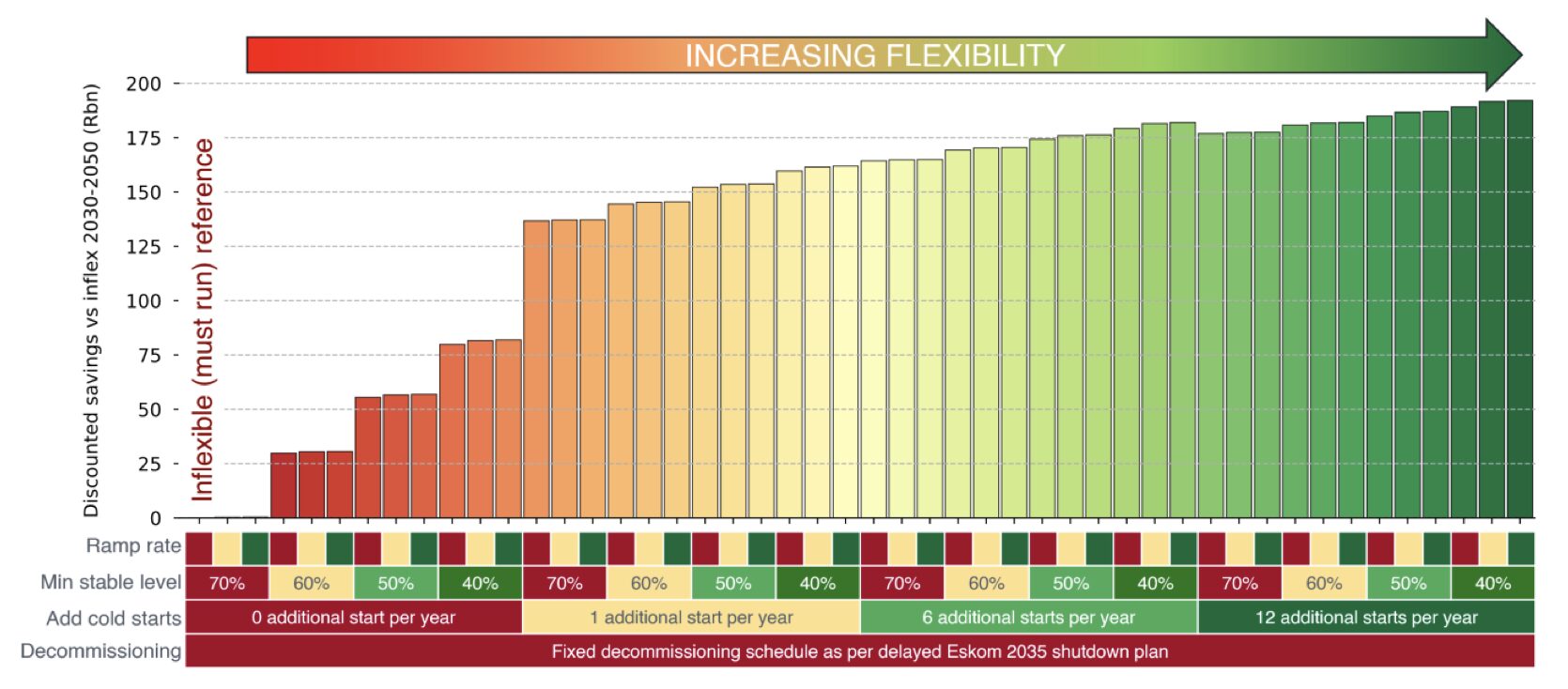
Discounted cost savings of various flexibility interventions relative to a must-run reference. Image credit: Meridian Economics
Meridian Economics modelling shows that during summer months, when solar output is high and electricity demand is lower, it is cost effective to take surplus coal capacity offline and return it in autumn to support winter demand. As renewable energy penetration increases after 2030, the duration and scale of these shutdowns grow, with coal plants operating mainly between March and August by 2045.
Beyond cost savings, the consultancy estimates that seasonal shutdowns could reduce cumulative carbon dioxide emissions to 2050 by up to one gigaton and cut annual sulphur oxide emissions by around fifty percent.
Given these findings, Meridian Economics has called on Eskom to expand its coal flexibility analysis to include seasonal shutdowns as an explicit option. It said this should be accompanied by a detailed assessment of feasibility, operational risks, cost implications and the contribution such measures could make to overall system flexibility and stability.
Link to the full report HERE
Author: Bryan Groenendaal