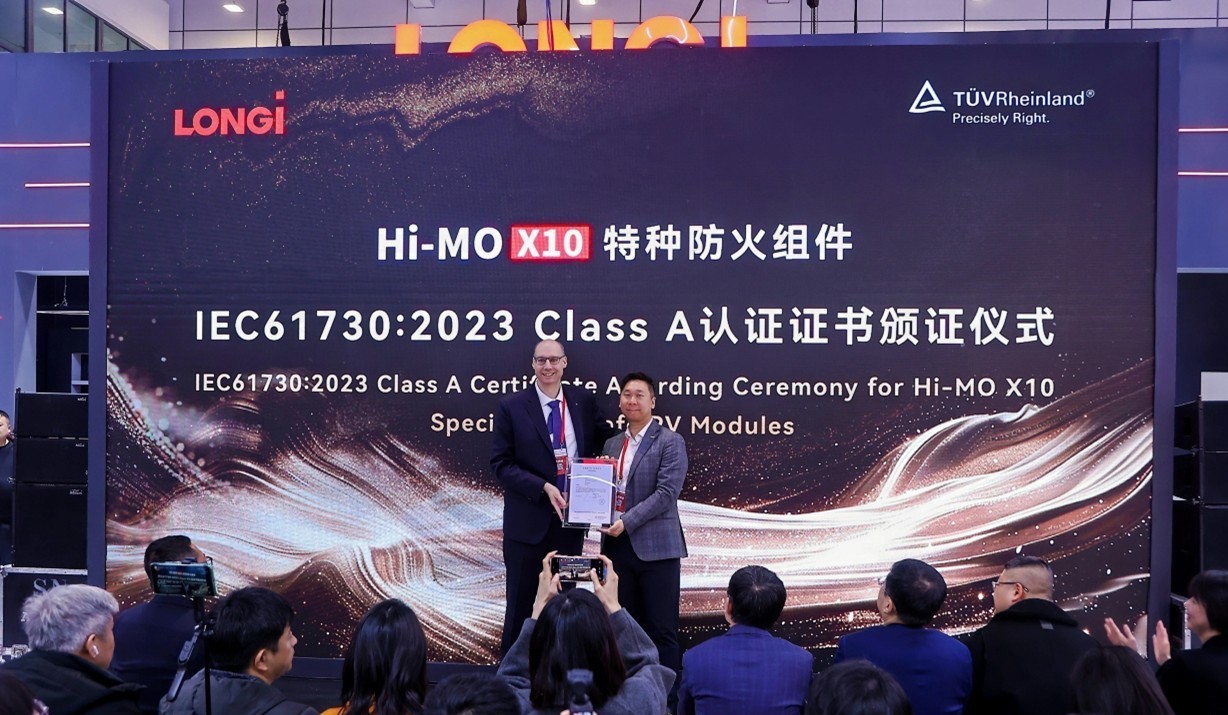

- New fire resistant module targets rising rooftop PV fire risk linked to hot spots and DC arcing.
- Based on HPBC 2.0 cell technology with peak module efficiency of 24.8%.
- Designed for distributed solar with enhanced safety architecture and 30 year warranty.
LONGi has introduced a fire resistant version of its Hi-MO X10 solar module, expanding its product portfolio to address safety concerns in the fast growing rooftop solar segment. The launch took place on March 9 during the China International Solar Utilization Conference and Exhibition.
The new module is built on the Hi-MO X10 platform, which uses the company’s second generation hybrid passivated back contact cell technology known as HPBC 2.0. The Hi-MO X10 series delivers peak module efficiency of 24.8% with a power temperature coefficient of -0.26% per degree Celsius and includes a 30-year product and power warranty. The portfolio is primarily designed for distributed photovoltaic applications.
According to the manufacturer, the fire resistant model was developed in response to increasing concerns in rooftop solar market around module driven fire risks. These risks are typically associated with hot spots and DC arcing in PV systems.
The company said the new design aims to reduce the probability of ignition and also limit flame spread if an external fire occurs. The module maintains the Hi-MO X10 family’s three defense positioning, which includes protection against ignition, shading and dust accumulation. The series previously obtained Class A certification for shadow resistance from TÜV Rheinland, reflecting efforts to reduce localized overheating caused by partial shading.
The fire resistant module uses 108 half cells and supports a 1,500 V DC system architecture. It is available in power ratings ranging from 580 W to 630 W. LONGi reports a maximum conversion efficiency of 24.8% with average mass production efficiency exceeding 24.5%. The module is designed to operate in temperatures between -40 C and +85 C.
Safety features are integrated at cell, string and module level. The design includes a honeycomb style current diversion structure to reduce hot spot formation, reinforced sealing and welding in the junction box to lower the risk of electrical arcing, and flame retardant materials used in encapsulation and junction box components. The module also incorporates high temperature resistant front glass designed to withstand extended exposure to flames.
The product has received Class A fire certification from TÜV Rheinland at the full module mass production level. It has also undergone safety and performance verification at the China National Center of Supervision and Inspection on Solar Photovoltaic Products Quality, in addition to international testing under IEC 61215 and IEC 61730.
Author: Bryan Groenendaal