
- The utility scale fire test confirms containment of thermal runaway within a single container.
- The adjacent units maintained safe temperatures and full functionality after 13 hour fire event.
- The results provide data to support emerging global battery storage safety standards.
Jinko ESS, a subsidiary of Jinko Solar, has completed a large scale fire test for its SunTera 5 MWh liquid cooling energy storage system, demonstrating the system’s ability to contain thermal runaway within a single enclosure under extreme conditions.
The test was conducted at a specialised facility in Suzhou City in Anhui Province, China and followed the CSA C800 standard as well as the November 2025 draft of UL 9540A. Representatives from CSA Group and fire protection engineers from North America observed the test.
The evaluation simulated fire conditions under utility scale deployment scenarios. It assessed fire behaviour, the potential for thermal runaway propagation, enclosure integrity and the impact on nearby battery units. The test framework aligns with large scale fire testing guidelines referenced in the forthcoming 2026 update of NFPA 855.
The SunTera system is built on a 314 Ah battery cell platform and offers a nominal energy capacity of 5.015 MWh. The containerised system supports 0.5P continuous charge and discharge and incorporates liquid cooling thermal management. It carries an IP55 protection rating, C4 and C5 corrosion resistance and is designed for an operational life of 20 years.
Related news: JinkoSolar launches mass production of Tiger Neo 3 as global pre-orders exceed 15GW
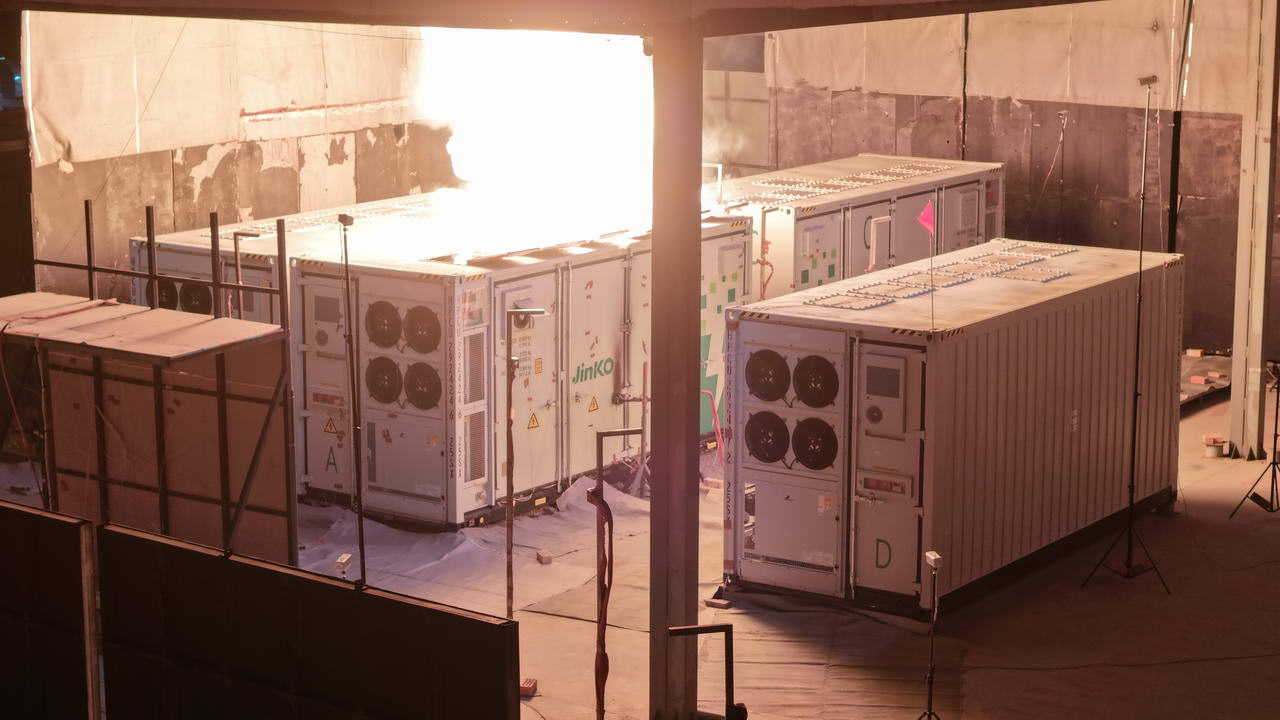
To simulate real world project layouts, four SunTera containers were deployed in a dense configuration. One container served as the initiating unit for forced ignition. A second unit was placed back to back at a spacing of 15 cm, a third unit was positioned side by side at 1 m, and a fourth unit was placed face to face at 3.5 m.
All units were charged to 100% state of charge to create conservative testing conditions. Active fire suppression systems were disabled and no manual intervention was allowed during the test.
Forced heating of the initiating unit began at 17:00 on 10 February 2026. Battery cells reached ignition conditions at about 18:10 and the internal temperature of the initiating unit peaked at 1296°C.
Despite the intensity of the fire, adjacent units remained stable. Maximum internal cell temperatures recorded in the neighbouring units were well below thermal runaway thresholds, with readings of 51.3°C, 38.3°C and 41.2°C.
External enclosure temperatures did increase significantly. One unit recorded surface temperatures of up to 404°C due to direct flame exposure. However, internal battery module temperatures remained within safe limits, indicating effective thermal insulation and fire containment at the enclosure level.
The fire self-extinguished at 07:50 on 11 February after burning for about 13 hours and 40 minutes.
Post test inspections confirmed that the initiating unit retained structural integrity with surface soot but no enclosure collapse. The three adjacent units remained structurally intact and retained full electrical functionality. Functional testing showed no impact on charge and discharge performance.
The test also incorporated controlled flue gas capture and treatment systems to minimise environmental impact during the burn event.
Carl Yang, product general manager at Jinko ESS, said the results provide measurable insight into fire propagation limits. He noted that the SunTera system demonstrated containment of thermal runaway within a single enclosure even under challenging test conditions, which can help inform installation spacing and reduce multi-unit propagation risks.
Dora Zhao, senior product management engineer, said the system’s safety architecture is based on three design layers covering cell stability, pack level insulation with engineered pressure relief and system level fire barriers.
Patrick Rimel, North America product manager, said empirical data from large scale fire testing is becoming increasingly important as regulatory frameworks shift toward risk quantification. He said the results can support permitting decisions and risk evaluation for insurers, project developers and authorities having jurisdiction.
Independent validation was provided by Todd LaBerge, fire protection engineer at ATAR FIRE. According to LaBerge, the test complied with CSA C800 and the latest UL 9540A draft and incorporated deflagration protection principles aligned with NFPA 68 and NFPA 69.
With enclosure doors closed and venting mechanisms active, the initiating fire remained contained within the original container throughout the test, confirming the effectiveness of the system’s safety design.
Link to the list of JinkoSolar distributors in Africa HERE
Author: Bryan Groenendaal