
- Commercial TOPCon module reaches 24.1% efficiency and 650 W output.
- Integrated cell and solar panel (module) innovations deliver 20 to 25 W power gain.
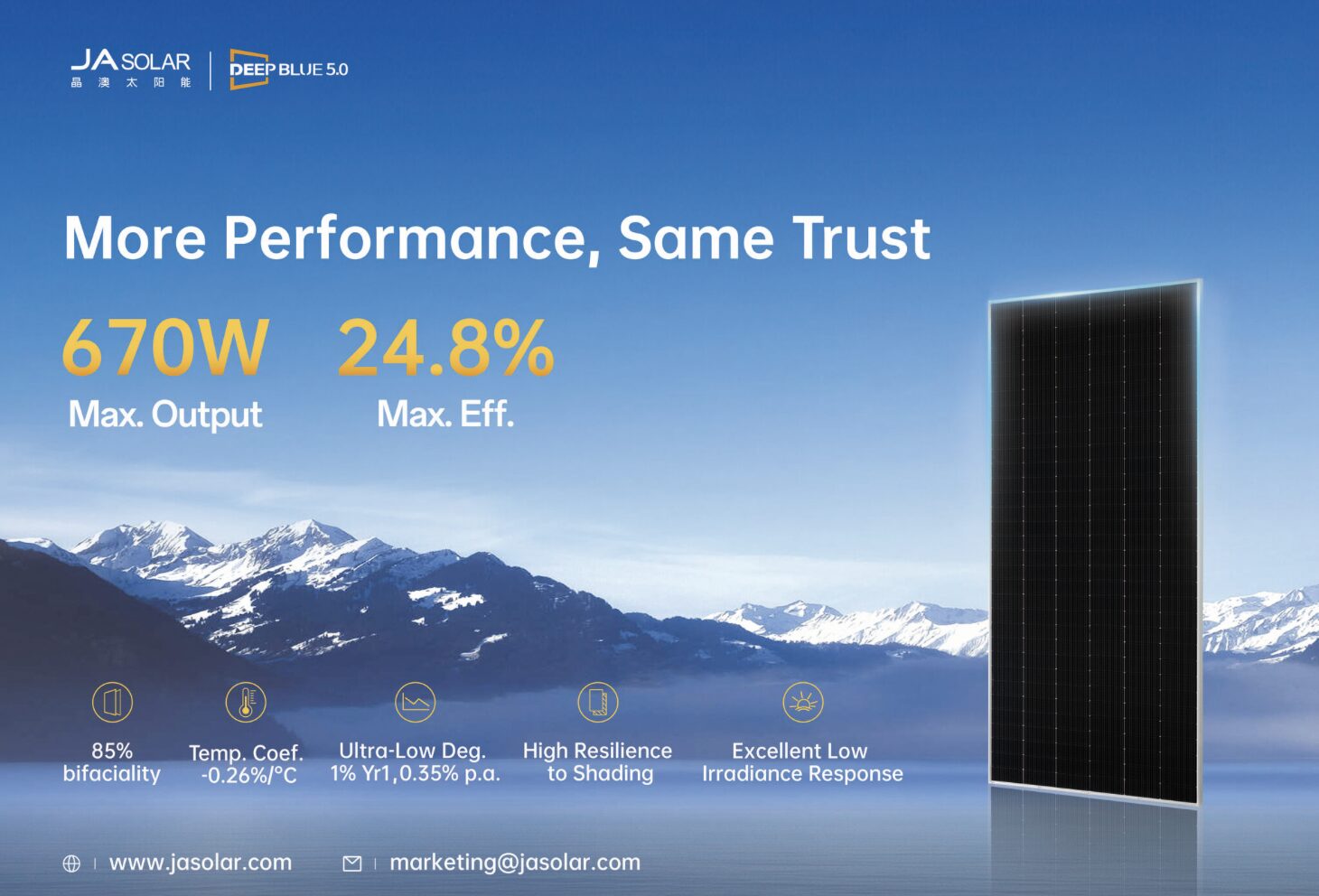
- Technology roadmap targets 670 W and 24.8% efficiency within the year.
JA Solar has announced a major milestone in photovoltaic technology, with its DeepBlue 5.0 module series achieving 24.1% efficiency, becoming one of the first commercially available TOPCon modules to exceed the 24% threshold.
The new series delivers a rated output of 650 W and is already being deployed at scale, signalling a shift in how incremental innovation at both cell and module level is being combined to unlock higher performance. The company has also outlined plans to increase module power to 670 W and efficiency to 24.8% within the year.
Advances in TOPCon technology are increasingly driven by integrated design approaches rather than isolated improvements. Several innovations introduced in DeepBlue 5.0, including rear side polyfinger metallisation and edge passivation, originate at the cell level but deliver significant gains at the module level.
DeepBlue 5.0 is built on a combination of polyfinger technology, advanced edge passivation, multi cut cell architecture, gapless flexible interconnection, and a full screen module layout. Together, these innovations contribute an additional 20 to 25 W of power output compared to previous designs.
Related news: TOPCon takes centre stage JA Solar and UNSW experts chart the future of solar PV
At the cell level, the use of rear polyfingers limits the TOPCon structure to metallised regions, reducing parasitic light absorption and improving bifacial performance. The module achieves bifaciality of 85%, representing a 5% increase, and delivers an additional 3 W of output.
A key advancement is the transition from half cut to multi cut cells. By dividing cells into smaller segments, current is reduced and resistive losses are lowered, while module voltage increases. This configuration delivers an additional 7 to 8 W compared to conventional half-cell designs. Recent improvements in edge passivation have addressed historical recombination losses, enabling large scale deployment of this architecture.
Further gains are achieved through gapless flexible interconnection, where overlapping cells increase active surface area, and a full screen layout that eliminates inactive margins along module edges. For a module size of 2,382 by 1,134 mm, these design changes increase active area by about 1.82%, adding another 7 to 8 W of output.
Related news: JA Solar introduces integrated BESS solutions for commercial and industrial applications in Africa
The module also introduces a redesigned circuit architecture based on a 66 cell, three substring configuration. This eliminates the central junction box and redistributes electrical connections, reducing mechanical stress on the rear glass by 14 to 16%, particularly in tracker mounted systems.
Additional structural improvements are delivered through a specialised encapsulation approach that enhances thickness uniformity and edge sealing, improving durability and load distribution.
Operational performance has also been enhanced. Under partial shading conditions, the module can deliver up to 34% higher output than conventional designs due to its three substring layout, which limits inactive areas. The improved bifaciality further boosts energy yield, while a lower temperature coefficient of 0.26% per °C contributes nearly 1% additional power gain compared to the previous generation.
With commercial shipments of DeepBlue 5.0 now underway, JA Solar is positioning the platform as a scalable solution for utility scale solar projects, demonstrating how cumulative innovation can push module efficiency beyond established limits.
Author: Bryan Groenendaal