
- The intermittent nature of variable renewable energy sources (VREs) remains a primary challenge for grid integration and stability.
- However, research funded by the UVA Environmental Institute investigating wind and solar complementarity confirms that hybridisation is an optimal engineering solution to this volatility.
By leveraging the inherent inverse timing of wind and solar generation peaks, hybrid systems can effectively double generation capacity and produce a stable source of generation critical for system operators, said the report.
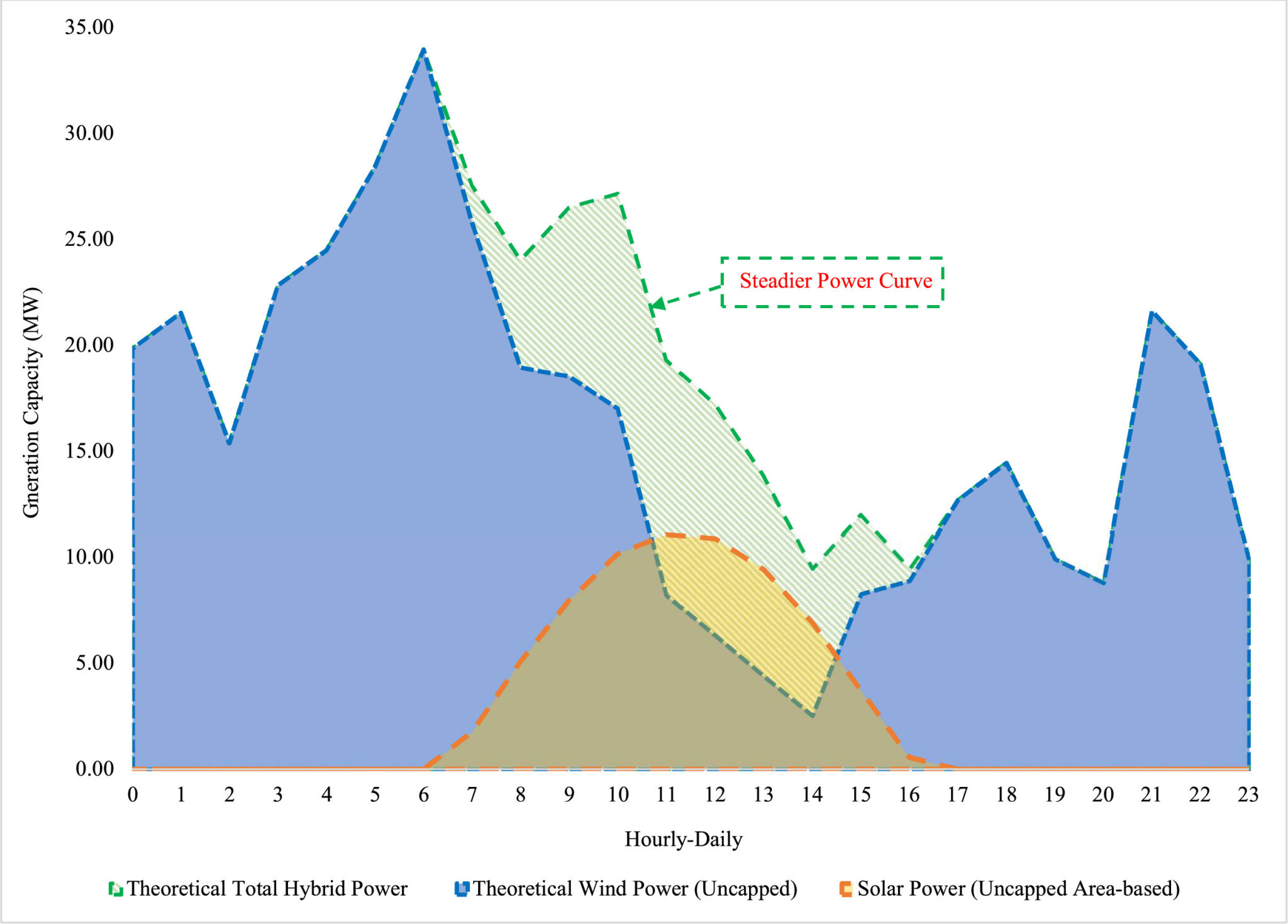
The modeling examined theoretical systems, showing that wind power in a simulated Lubbock, Texas location peaked at 6 AM with an instantaneous capacity of approximately 33.9 MW, while solar power in Imperial, California peaked later in the day, specifically at 11 AM with 11.1 MW. This alternating peak behaviour with wind excelling during night and early morning hours while solar dominates midday is the fundamental premise for improved operational stability.
The theoretical instantaneous output for both the independent and hybrid systems were simulated to measure the complementary effects. Total theoretical power by the hybrid system reached 449 MW, nearly doubling the capacity compared to when the wind (381 MW) and solar (68 MW) systems operated as independent generators.
The hybrid system output as shown in the analysis showed how generation increased and optimised when wind and solar were combined.
The system generated a total cumulative theoretical energy of 6.3 GWh. The cumulative generation showed a constant and smoothened supply curve without a drop when integrated into the grid, said the study. This optimisation makes it easier for grid operators to predict and balance the grid and minimise the overall need for storage.
This co-operation can help reduce the overall need for energy storage as when solar generation drops in the late afternoon, wind ramps up generation to fill the gap until the morning. Similarly, back-up batteries do not need to store excess wind power for midday to meet demand as solar can directly offset midday supply by the wind system.
The study did not consider colocation of the resources because the focus was to investigate how the resources respond with time. However, it noted it is imperative to collocate the system for real world validation. The co-location of wind and solar hybrid system can improve grid stability by optimising infrastructure due to shared grid infrastructure like substation, transmission and distribution lines as well as shared inverter and converter systems, said the study.
Link to the full study HERE
Author: Ryan Kennedy
This article was originally published in pv magazine and is republished with permission.