- Solar is set to remain the backbone of global power capacity growth as electricity demand accelerates across major regions.
- Balcony solar is emerging as a policy catalyst in the United States, following rapid uptake in Europe.
- A large scale solar and storage project in the UAE could reshape how baseload power is defined.
Despite a difficult trading environment in 2025, global solar is expected to reassert its central role in meeting rising electricity demand in 2026 and beyond. According to Wood Mackenzie’s latest report, Global solar: three key things to look for in 2026, the technology remains the foundation for near term power growth, while new deployment models and landmark projects signal structural change across the sector.
The report highlights three developments that will shape the global solar market over the coming year: solar’s expanding contribution to power demand growth, the emergence of balcony solar as a policy issue in the United States, and a mega scale solar and storage project in the United Arab Emirates designed to deliver continuous baseload power.
Solar to underpin near term power demand growth
Electricity demand is accelerating across multiple regions as economies electrify, and solar is expected to play a leading role in meeting this growth. Wood Mackenzie forecasts that cumulative global solar capacity will nearly triple from close to 3 terawatts direct current today to almost 8 terawatts by 2034.
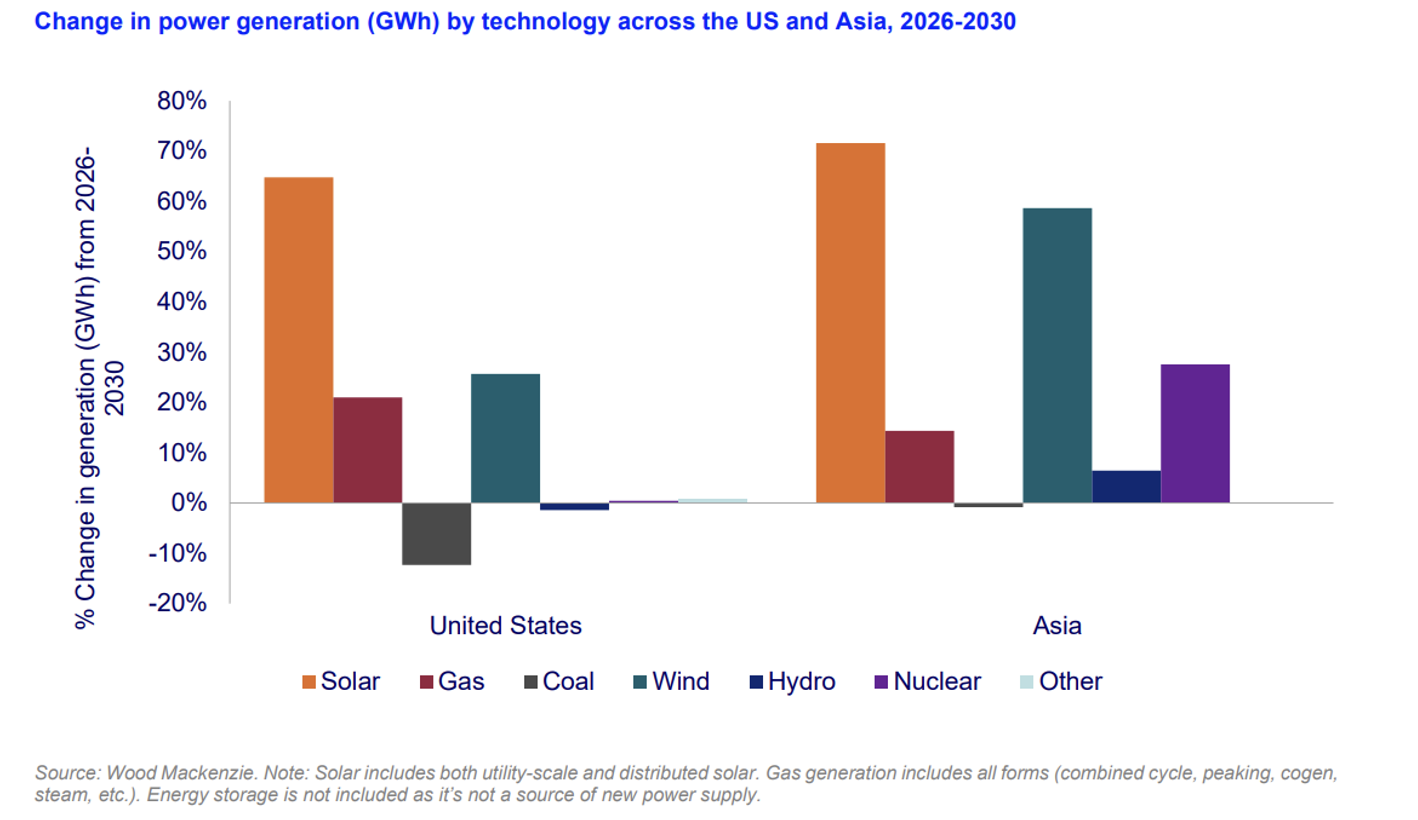
In the United States, natural gas currently dominates electricity generation, but solar is closing the gap in terms of new supply. Between 2026 and 2030, annual solar generation is expected to increase by 232 gigawatt hours, representing growth of 65 percent when distributed solar is included. Over the same period, annual gas generation grows by around 340 gigawatt hours, or 21 percent, across combustion turbine, steam turbine and cogeneration plants.
In the Asia Pacific region, investment in new power capacity is increasingly concentrated in solar, alongside wind and energy storage, driven primarily by cost competitiveness. Solar accounted for 11 percent of the regional power generation mix in 2025 and is forecast to reach 17 percent by 2030. Combined, solar, wind and storage are expected to make up one third of the power generation mix by the end of the decade, up from less than 10 percent in 2020.
Balcony solar triggers new policy debate in the United States
Balcony solar, also known as plug in solar, is gaining momentum in Europe and is beginning to attract policy attention in the United States. These systems typically consist of a small number of panels and an inverter that can be plugged directly into a standard wall outlet, allowing households to generate some of their own electricity without complex permitting or utility approvals.
“The appeal of balcony solar is that a few solar panels and an inverter can be plugged directly into a wall outlet and supply a home with some electricity, with no need for an electrician, utility interconnection approval or time-consuming permits,” said Michelle Davis, global head of solar at Wood Mackenzie.
Germany has been at the forefront of this trend, with balcony solar accounting for 25 percent of registered solar installations in 2023 and rising to 40 percent in 2024, according to SolarPower Europe. Uptake is also accelerating in several other European markets.
In the United States, balcony solar had little presence until early 2025. In March, Utah became the first state to allow residential customers to use portable solar generation devices of up to 1.2 kilowatts without a utility interconnection agreement. Since then, more than a dozen states have introduced similar legislation.
However, Wood Mackenzie notes that widespread adoption in the United States is far from guaranteed. Barriers include fragmented electrical standards, lower household voltage and a housing stock dominated by single family homes with limited balcony space.
UAE mega project points to a new baseload model
One of the most closely watched solar developments globally is underway in Abu Dhabi, where Masdar and the Emirates Water and Electricity Company are constructing a 5.2 gigawatt direct current solar photovoltaic plant paired with 19 gigawatt hours of battery storage. The project is designed to deliver 1 gigawatt of continuous, around the clock power, making it the first gigawatt scale renewable facility engineered to provide baseload supply.
“There are lots of large solar plus storage projects in development around the world, especially in the Middle East, but this one represents a structural shift in hybrid project development in the region,” said Davis.
At an estimated cost of US$6 billion, the project remains significantly more expensive than a new gas fired combined cycle plant and is not yet easily replicable. However, Wood Mackenzie suggests that successful execution and continued cost reductions could position similar projects as viable alternatives for baseload generation in the future.
“Despite the challenging events of 2025, solar market fundamentals and demand will remain strong in 2026, especially as the global economy continues to electrify,” Davis said.
Link to the full report HERE
Author: Bryan Groenendaal