- 290 MW of renewable capacity targeted by early 2027 to enable daytime green processing.
- 24 hour fossil free mining operations planned by late 2027.
- Full 1.8 GW renewable system with up to 5 GWh storage scheduled for completion by 2028.
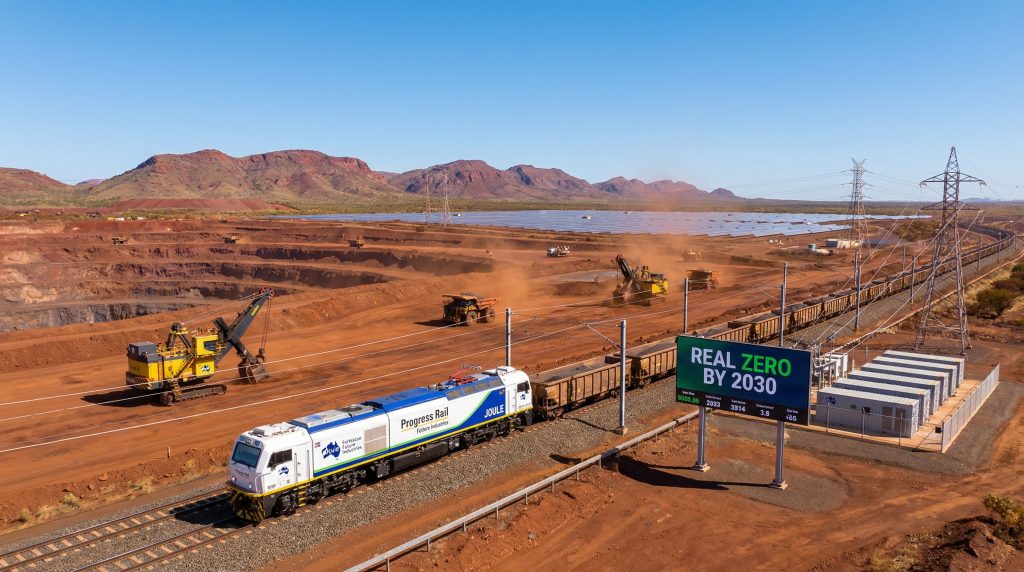
Australian mining major Fortescue has announced an accelerated rollout of its Pilbara green energy grid, positioning the project as a world first fully integrated industrial renewable network designed to eliminate fossil fuel use across its iron ore operations.
The company confirmed that the system will remove reliance on imported diesel well ahead of its 2030 Real Zero target, under which Fortescue aims to eliminate fossil fuels entirely from its operations.
The first phase of the project is expected to deliver 290 MW of renewable energy capacity by early 2027, enabling daytime green processing across ore facilities. By late 2027, Fortescue plans to run its Pilbara mining operations continuously for 24 hours without fossil fuels.
Full completion is scheduled for the end of 2028, with the grid set to include 1.2 GW of solar, more than 600 MW of wind generation and between 4 GWh and 5 GWh of battery storage.
Unlike conventional renewable hubs, the Pilbara system will operate as a standalone high voltage network, independent of the national grid. The infrastructure will also support the electrification of Fortescue’s mining fleet, including haul trucks and light vehicles, with deployment beginning later this year and scaling over the next two to three years.
Fortescue expects the transition to deliver immediate and long term cost benefits. The company anticipates savings of US$100 million in fossil fuel costs by next year and a reduction in C1 unit costs of between US$2 and US$4 per wet metric tonne over time.
Chairman Andrew Forrest said the strategy is driven by the volatility of global fossil fuel supply chains, particularly amid ongoing geopolitical tensions. He added that the project will demonstrate how large scale industrial operations can be powered reliably and at lower cost using renewable energy, supported by proprietary artificial intelligence optimisation systems and in house technologies.
Fortescue also plans to commercialise the model globally, offering green energy as a service to hyperscalers and sovereign clients. The company estimates potential project values of around US$2.5 billion per 2 GW deployment.
The accelerated rollout further differentiates Fortescue from peers Rio Tinto and BHP, both of which have adopted more conservative decarbonisation pathways.
Fortescue is targeting Real Zero by 2030 for operational emissions, with a broader net zero ambition covering Scope 3 emissions by 2040. In comparison, Rio Tinto is targeting a 50 % reduction in Scope 1 and 2 emissions by 2030 and net zero by 2050, while BHP is aiming for at least a 30 % reduction by 2030 and net zero across Scope 1, 2 and 3 emissions by 2050.
In terms of renewable deployment, Fortescue plans to install more than 1.8 GW of solar and wind capacity supported by up to 5 GWh of storage by 2028. Rio Tinto has outlined plans for around 1 GW of renewable capacity in the Pilbara by 2030, while BHP is progressing a 500 MW programme for its Western Australia iron ore operations.
Fortescue’s execution timeline also stands out, with continuous fossil free operations targeted as early as 2027. Rio Tinto is expected to commission its first major 100 MW solar facilities in the Pilbara by 2026.
The companies also diverge in technology strategy. Fortescue maintains that renewable solutions are already viable for heavy industry and is investing in both electrification and green hydrogen. By contrast, BHP and Rio Tinto remain more cautious, focusing primarily on battery electric fleet transitions, with BHP recently prioritising external power purchase agreements over some internal renewable projects.
Fortescue’s islanded grid approach represents another key distinction, as competitors continue to rely on hybrid systems combining captive power generation and grid based supply arrangements.
With the accelerated Pilbara rollout, Fortescue is positioning itself at the forefront of industrial decarbonisation, signalling a potential shift in how large scale mining operations approach energy security, cost management and emissions reduction.
Author: Bryan Groenendaal