- Eskom reports that its month-to-date Energy Availability Factor (EAF) stands at 70.45%, reflecting consistent gains in plant reliability and a reduction in unplanned outages. However, respected energy analyst, Chris Yelland confirms that Eskom’s EAF dropped to 67% in week 39.
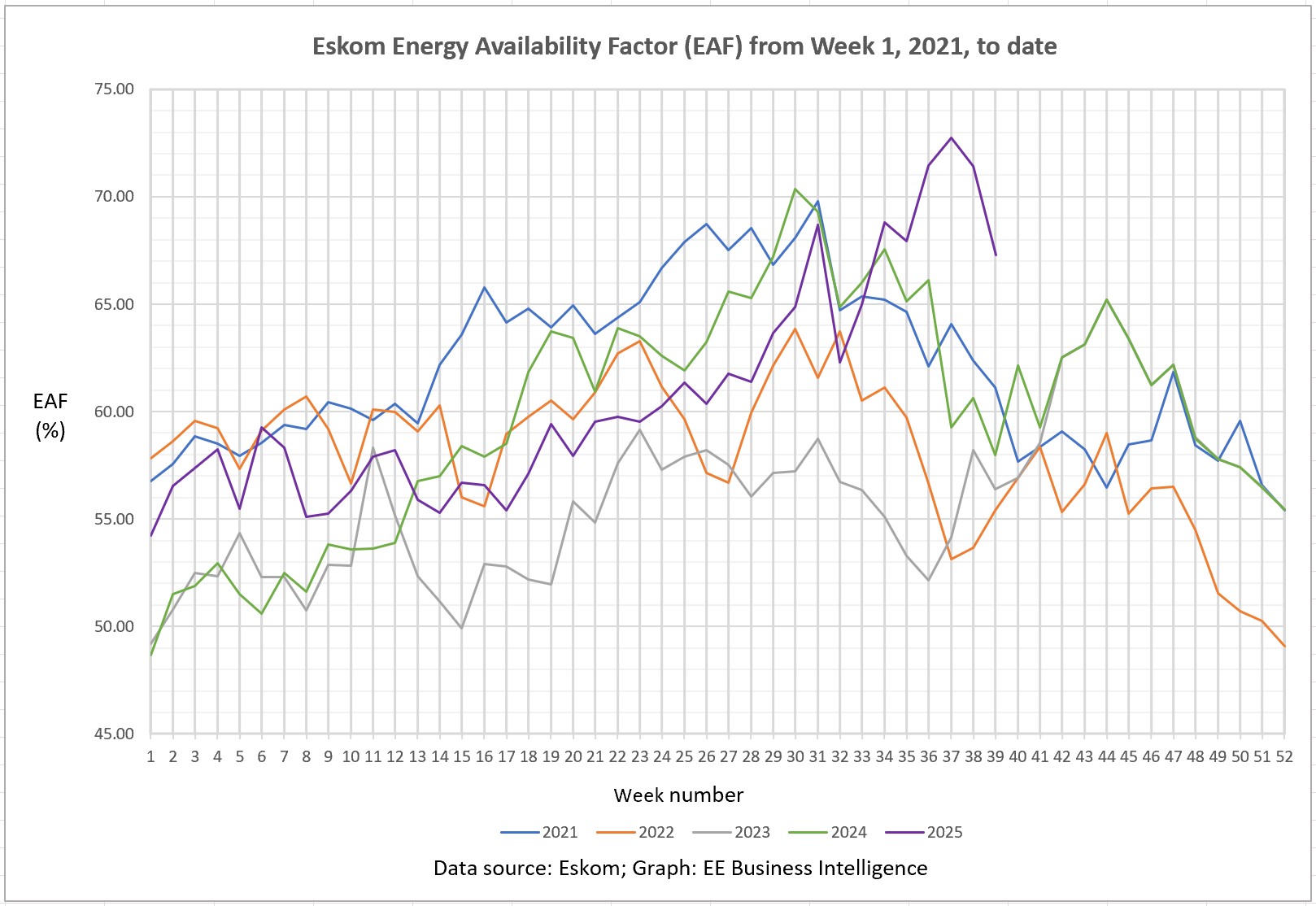
The latest Eskom week-on-week energy availability factor EAF for 2025. Data source: Eskom. Image credit: Chris Yelland. Chris is an energy analyst, consultant, electrical engineer, public speaker, writer and MD at EE Business Intelligence (Pty) Ltd. Follow Chris on X – @chrisyelland
From 1 April to 2 October 2025, diesel expenditure remained consistently below budget, reflecting reduced reliance on the diesel-powered Open Cycle Gas Turbine (OCGT) fleet, with the year-to-date load factor for OCGTs decreasing to 6.63%. This trend highlights ongoing efficiency improvements, a significant reduction in dependence on diesel generation and a sustained shift toward more cost-effective primary generation sources.
The demand for Eskom’s electricity is in decline. The cost of Eskom electricity is increasing at a rate higher than the country’s annual inflation rate, making it less affordable for consumers while renewable energy is becoming a cheaper option. Large corporates are increasingly producing their own power at point of use or procuring renewable energy from independent power producers through wheeling arrangements.

Eskom’s weakly peak demand. Source: Eskom Data Portal
On 29 September 2025, Unit 6 at Kusile Power Station entered commercial operation, marking the completion of Eskom’s New-Build Programme. This milestone concludes the construction of South Africa’s two supercritical coal-fired power stations—Medupi and Kusile. Together, they can deliver up to 9 600MW at full capacity, strengthening the country’s continuous (24/7) electricity supply—commonly referred to as baseload capacity. The unit’s output will be included in the EAF calculations, further contributing to Eskom’s overall performance metrics.
Between 26 September and 2 October 2025, Eskom recorded an average of 9 534MW in unplanned outages, a significant improvement compared to 11 505MW during the same period last year. This represents a year-on-year reduction of 1 971MW in breakdowns — nearly equivalent to the entire output capacity of Koeberg Power Station. This trend demonstrates increasing stability and improved reliability across Eskom’s generation fleet. The country has gone 140 consecutive days without loadshedding, with only 26 hours recorded between 1 April and 2 October 2025.
To further strengthen grid stability, Eskom is planning to return a total of 4 200MW of generation capacity to service ahead of the evening peak on Monday, 6 October 2025 and throughout the coming week.
Eskom published the Summer Outlook on 5 September 2025, covering the period 1 September 2025 to 31 March 2026, which forecasts no loadshedding due to the structural progress in plant performance as a result of the ongoing implementation of the Generation Recovery Plan.
Key Performance Highlights:
- Between 1 April and 2 October 2025, the Unplanned Capability Loss Factor (UCLF), which reflects the percentage of generation capacity lost due to unplanned outages, further decreased to 25.63%. This represents a week-on-week improvement of approximately 0.21% and remains about 0.15% higher than the 25.48% recorded during the same period last year.
- Year-to-date, planned maintenance has averaged 5 263MW, accounting for 11.22% of total generation capacity. This reflects a slight increase from the previous week and a 0.3% rise compared to the same period last year.
- The year-to-date EAF further increased to 62.66%, however, this figure is slightly below the 63.14% recorded during the same period last year.
- From 1 April to 2 October 2025, Eskom generated 1,004.70GWh from its OCGT plants, with diesel expenditure totalling R5.9532 billion—an increase from last year’s 883.01GWh. In the past week, diesel spending dropped to just R0.09 million at a load factor of 0.003%, highlighting sustained efficiency improvements and a significant reduction in reliance on diesel generation.
- The year-to-date load factor for OCGTs has decreased to 6.63%, reflecting a 0.26% decrease compared to the previous week. This figure remains higher than the 5.83% recorded during the same period last year.
Author: Bryan Groenendaal
Data source: Eskom