- South Africa’s state owned energy utility, Eskom, reports that the power system remains stable, supported by sustained technical improvements.
- A total of 2 350MW is scheduled to return to service by Monday, while unplanned outages are currently being managed within acceptable levels.
The power system remains stable and continues to show resilience in meeting the winter demand. While occasional system constraints do arise, they are effectively managed, with sufficient emergency reserves available and strategically deployed during morning and evening peak periods. Eskom remains committed to strengthening grid reliability through the ongoing implementation of the Generation Recovery Plan, aimed at improving performance and ensuring long-term energy security.
Since 15 May 2025, no loadshedding has been implemented and only 26 hours of loadshedding were recorded in Eskom’s first quarter of its Financial Year 2026 (1 April to 30 June 2025).
During the week of 27 June to 3 July, planned maintenance averaged 3 528MW, reflecting a continued decline in planned outages.
Over the same period, the Energy Availability Factor (EAF) ranged between 61% and 64%, with a month-to-date average increase to 63.29%.
The Unplanned Capability Loss Factor (UCLF), which reflects the percentage of generation capacity lost due to unplanned outages, has reached 29.74% for the current financial year-to-date (1 April to 3 July 2025). This represents an increase of approximately 2.6% compared to 27.17% recorded during the same period last year.
As of today, unplanned outages amount to 13 167MW. This figure is influenced by two key factors. Medupi Unit 4, with a capacity of 800MW, was added to the unplanned outages calculation on 1 June 2025. Although the unit has been offline since 2021, it was previously excluded due to its extended inoperability, which resulted in its capacity being removed from the nominal base. Additionally, Kusile Unit 6, which has been contributing 720MW to the grid since March 2025, has not yet been commercially declared. Consequently, it is not included in any performance metrics, including the Energy Availability Factor (EAF).
The year-to-date load factor for open-cycle gas turbines (OCGTs) has further declined to 10.70%, reflecting a 0.67% decline compared to the previous week. Despite the decrease, this figure remains higher than the 6.12% recorded during the same period last year.

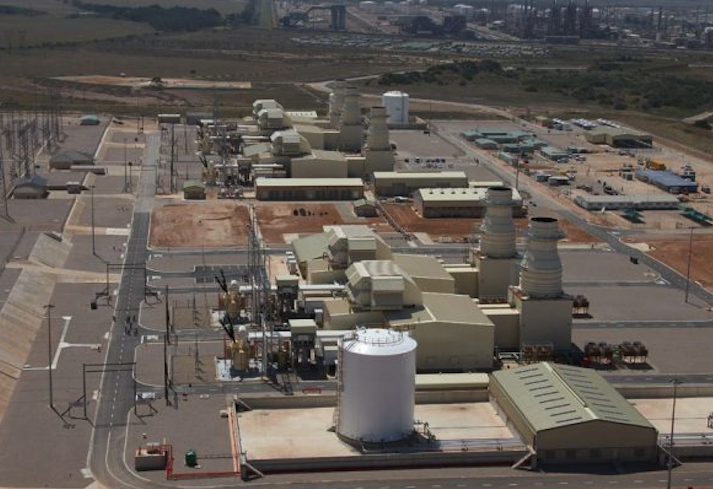
There are 9 X 148MW generation units totalling 1327 MW at Ankerlig power station currently running on diesel. Image credit: Eskom
Although diesel usage is within budget, it is expected to decline as more units return to service from long-term repairs and maintenance activities are reduced, increasing available generation capacity.
The Winter Outlook, published on 5 May 2025, covering the period ending 31 August 2025, remains valid. It indicates that loadshedding will not be necessary if unplanned outages stay below 13 000MW. If outages rise to 15 000MW, loadshedding would be limited to a maximum of 21 days out of 153 days and restricted to Stage 2.
Key Performance Highlights:
- For the week of 27 June to 3 July 2025, unplanned outages averaged 14 496MW, an increase of 1 942MW compared to the same period last year, and 1 496MW above the base case estimate of 13 000MW. The year-to-date average for unplanned outages stands at 14 091MW. This increase is primarily due to technical adjustments rather than a decline in operational performance. Medupi Unit 4, 800MW capacity, was added to the unplanned outage figures from 1 June 2025, having previously been excluded due to its long-term offline status. Additionally, Kusile Unit 6, which has been contributing 720MW to the grid since March 2025, is not yet commercially declared and therefore not reflected in the available capacity metrics. As a result of these adjustments, the actual unavailable capacity due to unplanned outages is effectively 1 520MW lower than the reported figures.
- For the financial year-to-date, planned maintenance has averaged at 5 347MW, representing 11.55% of total generation capacity. This reflects a decrease from the previous week, but a 0.7% increase compared to the same period last year.
- The year-to-date Energy Availability Factor (EAF) reached 58.21%. However, this is still lower than the 61.39% recorded during the same period last year, primarily due to a 3.2% year-on-year increase in unplanned maintenance. It is important to note that the EAF figure excludes the 720MW contribution from Kusile Unit 6, which, although not yet commercially operational, has been supplying power to the national grid since 23 March 2025.
- Year-to-date, Eskom spent R4.85 billion on fuel for the OCGT fleet, generating 824.08GWh. This is higher than the 471.18GWh generated during the same period last year.
- The open-cycle gas turbine (OCGT) load factor declined further this week, reaching 2.41%, down from 7.25% recorded during the previous week (20 June to 26 June 2025).
Link to Eskom’s real time performance data portal HERE
Author: Bryan Groenendaal
Information source: Eskom