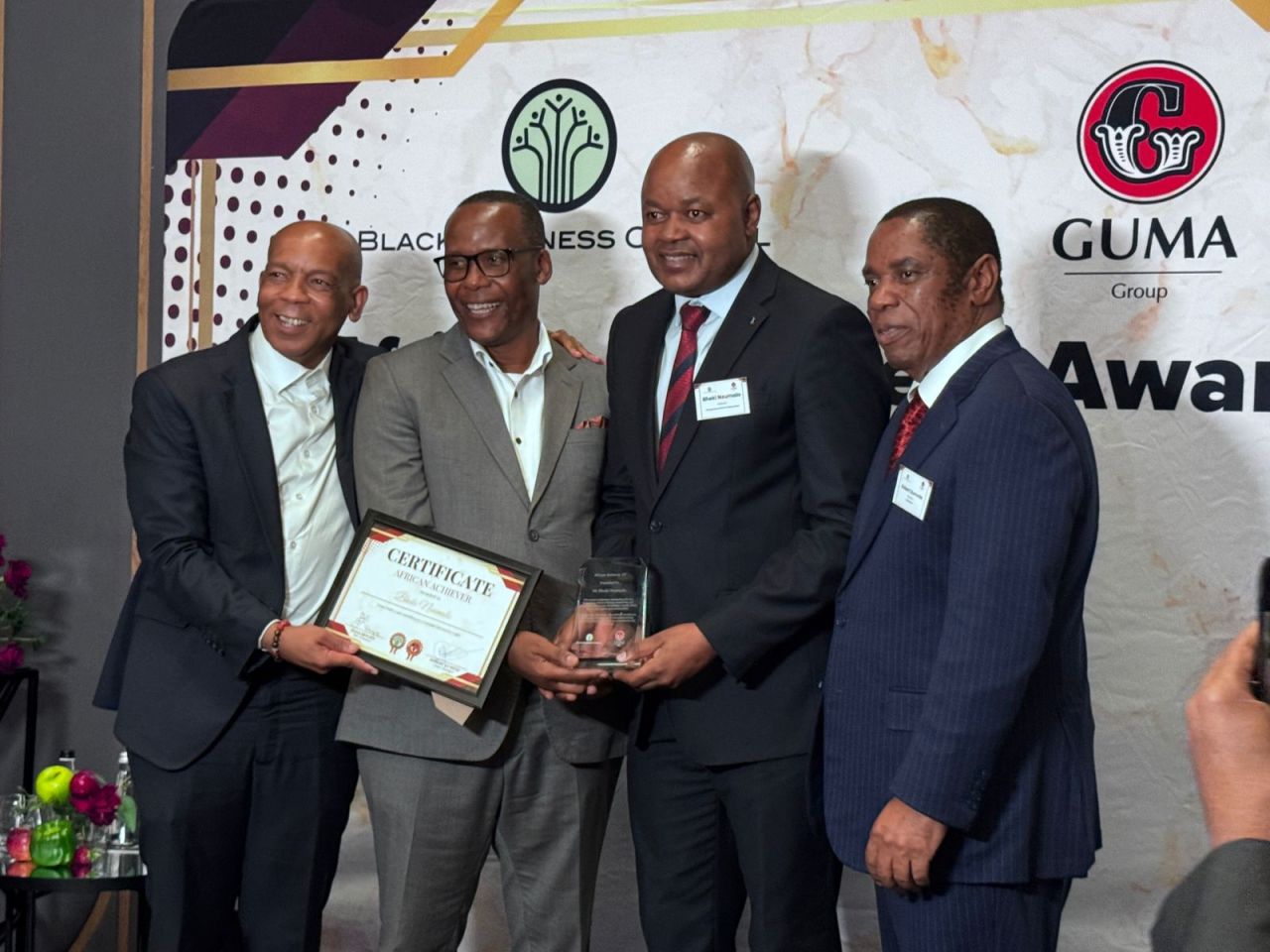
- Eskom’s leadership and employees have been awarded the African Achiever Award 2025 by the Black Business Council (BBC) and the Guma Group, recognising the utility’s accelerating turnaround.
- The award honoured Eskom Chair Mteto Nyati, Group CEO Dan Marokane, Generation Executive Bheki Nxumalo and the broader workforce for their role in stabilising South Africa’s power system.
The ceremony, attended by senior government and business leaders and the Minister of Electricity and Energy, highlighted renewed national confidence as load-shedding continues to ease.
Eskom says the generation fleet continues to improve under the Generation Recovery Plan. Month-to-date, the Energy Availability Factor (EAF) has climbed to 70.75% from 63.16% a year ago, while year-to-date EAF stands at 63.48%. The improved performance has sharply reduced diesel use: Eskom spent just R4.80 million in the past week compared with R287.64 million during the same week in 2024.
Breakdowns averaged 9 115MW over the past week—2 143MW less than last year—while both unplanned (UCLF) and planned (PCLF) losses declined. South Africa has now experienced 182 consecutive days without load-shedding, aside from 26 hours earlier in the financial year. Eskom expects to return 4 270MW to service ahead of the 17 November evening peak and continues to forecast no load-shedding through March 2026.
Eskom’s annual results for the year ended 31 March 2025 show the utility’s first profit since 2017: R23.9 billion before tax, compared with a R25.5 billion loss last year. A stronger EBITDA margin, lower primary energy costs and a 12.74% tariff increase supported the recovery. Load-shedding dropped from 6 367 hours to just 175 hours, with electricity supplied on 96% of all days in the reporting period.
A once-off recovery of previously disallowed fuel levy rebates from SARS further strengthened liquidity. Excluding this item, Eskom recorded a normalised pre-tax profit of R11.9 billion. Government debt-relief support of R64 billion enabled increased capital investment and improved planning.
Eskom executives say the organisation is now more stable and increasingly investable, though regulatory uncertainty over long-term tariffs remains a concern.
Municipal arrear debt rose sharply to R94.6 billion, despite National Treasury’s debt-relief programme. Many municipalities continue to default on current payments, posing a risk to Eskom’s future distribution company. The utility is exploring prepaid supply models and agency agreements to improve revenue collection.
Eskom received a qualified audit opinion for FY2025 due to inadequate PFMA-compliant records and unresolved historical audit issues. In response, the company has launched a three-year Audit Recovery Programme to strengthen internal controls, improve documentation and move toward an unqualified audit. Eskom says around 90% of audit findings since FY2021 have now been addressed, pending verification.
Eskom plans to invest more than R320 billion over the next five years to sustain and expand its infrastructure. While operational and financial improvements are evident, the utility acknowledges persistent risks—including municipal debt, regulatory uncertainty and the need for stronger internal controls—as it works toward long-term stability and energy security.
Author: Bryan Groenendaal