- Spending is set to rival total oil and gas and renewable generation capex this year.
- Rapid growth is driving major opportunities and constraints across global energy markets.
Rystad Energy finds that global investment in data centre’s has accelerated to unprecedented levels, reaching US$770 billion in 2025 and overtaking upstream oil and gas expenditure for the first time. The surge underscores a structural shift in energy infrastructure investment, with data centres now emerging as a dominant force across power and utilities markets.
After already surpassing solar PV investment in 2024, data centre capex is projected to match total spending across both the renewable generation sector and the full oil and gas value chain this year, including upstream, midstream and downstream segments.
A significant portion of this investment, around 40%, is directed toward IT infrastructure such as accelerator servers. However, spending on supporting infrastructure including cooling systems and power distribution units has also grown rapidly and is now approaching the scale of global solar PV capex. Beyond the facilities themselves, data centre expansion is unlocking hundreds of billions in additional investment across power generation, grid infrastructure and supply chains – according to Rystad Energy.
For energy sector players, the rise of data centres represents a generational shift. Power demand linked to these assets is reshaping markets and accelerating the need for new capacity and system upgrades.
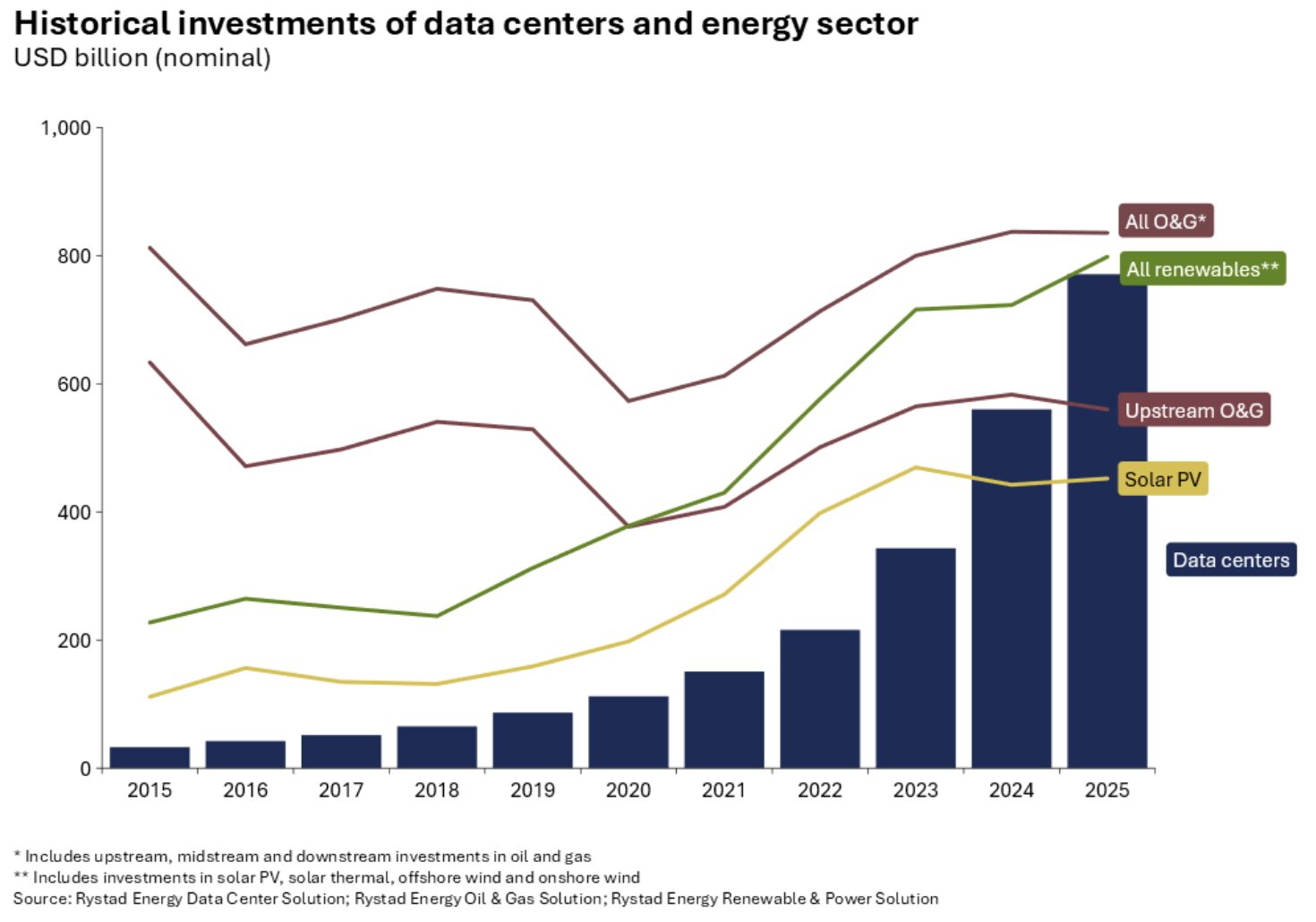
Image credit: Rystad Energy
The underlying asset class is also evolving. Large scale facilities exceeding 100 MW are becoming the dominant format, requiring infrastructure grade capital while demanding faster delivery timelines for power access. Investment is increasingly concentrated among hyperscalers and major technology firms such as Alphabet, Amazon, Microsoft and Meta, alongside emerging AI developers and global data centre operators. This concentration mirrors the oil and gas sector, where capital flows are largely driven by major producers and national oil companies.
Geographically, the United States remains the leading market, accounting for 42% of installed capacity in 2025, more than double that of mainland China. India ranks third, followed by a diverse group of markets across North America, Asia Pacific and Europe. However, future growth is expected to broaden geographically as rising power demand, often exceeding 10% of national consumption, creates constraints around electricity supply, land availability and infrastructure.
As a result, operators are increasingly targeting new markets and are expected to deploy capital accordingly. Strong capacity growth is anticipated in countries such as Finland, Portugal and Thailand by 2030.
The rapid expansion is already benefiting energy equipment manufacturers. Demand for grid upgrades and technologies including gas turbines, transformers and fuel cells has strengthened performance among original equipment manufacturers. Siemens Energy has seen its share price increase more than tenfold since January 2024, while Bloom Energy has recorded similar gains. Mitsubishi Heavy Industries shares have risen six times since early 2024, and GE Vernova has grown 2.5 times since January 2025.
Despite the strong momentum, risks remain. Supply chain bottlenecks, infrastructure constraints and delays are expected to persist in the near term, potentially driving further cost increases. While revenues across leading firms are expanding rapidly, sustaining current investment levels will require the sector to approach the revenue scale of oil and gas.
With new AI driven applications emerging at pace, the data centre boom is expected to continue, extending what is increasingly viewed as a long-term infrastructure super cycle until market conditions stabilise.
Author: Bryan Groenendaal