- Carbon Capture Utilisation and Storage (CCUS) is a crucial element in global decarbonisation, but current economics limit CO2 utilisation deployment as high costs and insufficient subsidies hinder the market, according to a recent report from Wood Mackenzie.
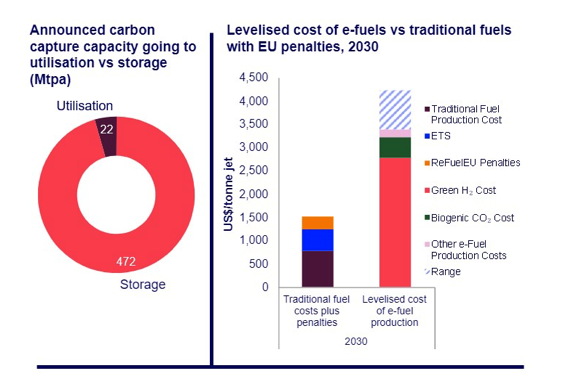
In Wood Mackenzie’s 2050 net zero scenario, more than 7 Btpa of CCUS capacity is needed. Currently, 500 Mtpa of planned carbon capture capacity has been announced worldwide, of which more than 95% is dedicated to storage and less than 5% (22.4 Mtpa) to utilisation, according to the report “To use or not to use? CO2 utilisation as a carbon capture enabler.”
“Expanded CO2 utilisation could bolster overall carbon capture economics, but current high costs, insufficient subsidies, and unsubstantial markets for green premiums are limiting appetite for utilisation growth,” said Rohan Dighe, research analyst, CCUS for Wood Mackenzie.
Credit: Woodmac
Most markets remain uncompetitive due to costs
According to the report, e-Hydrocarbons are uncompetitive and cost three times more than incumbent technology when using green H2, which comprises more than 80% of the cost of production.
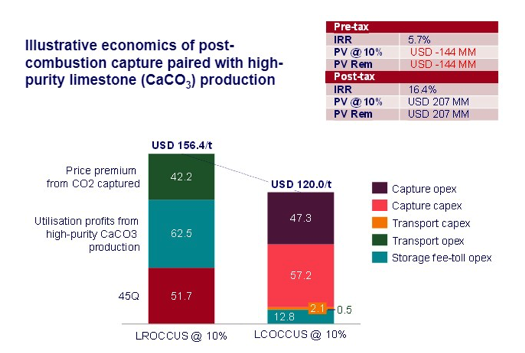
However, CO2 mineralisation to high-purity limestone is competitive with traditional manufacturing, showing double digit returns if technology is scaled economically, but the market size is limited.
“Aggregates could be more than a 500 Mtpa market, but conversion to aggregates is too expensive today to be competitive,” said Dighe.
Credit: Woodmac
More policy support and tax incentives needed
According to Dighe, tax incentives like the US 45Q and Canadian Investment Tax Credit support utilisation but are limited in scope and provide insufficient revenue to justify projects. Only the EU has a legislated CO2 utilisation mandate, which is confined to e-fuel use in aviation.
“Policy supporting demand for utilisation products is not strong enough,” said Dighe. “Without markets for these products, utilisation economics will continue to be disadvantaged. Declines in feedstock and technology costs and development of strong policy incentives are crucial for utilisation to become a legitimate, widespread enabler of carbon capture deployment.”
Source: Woodmac