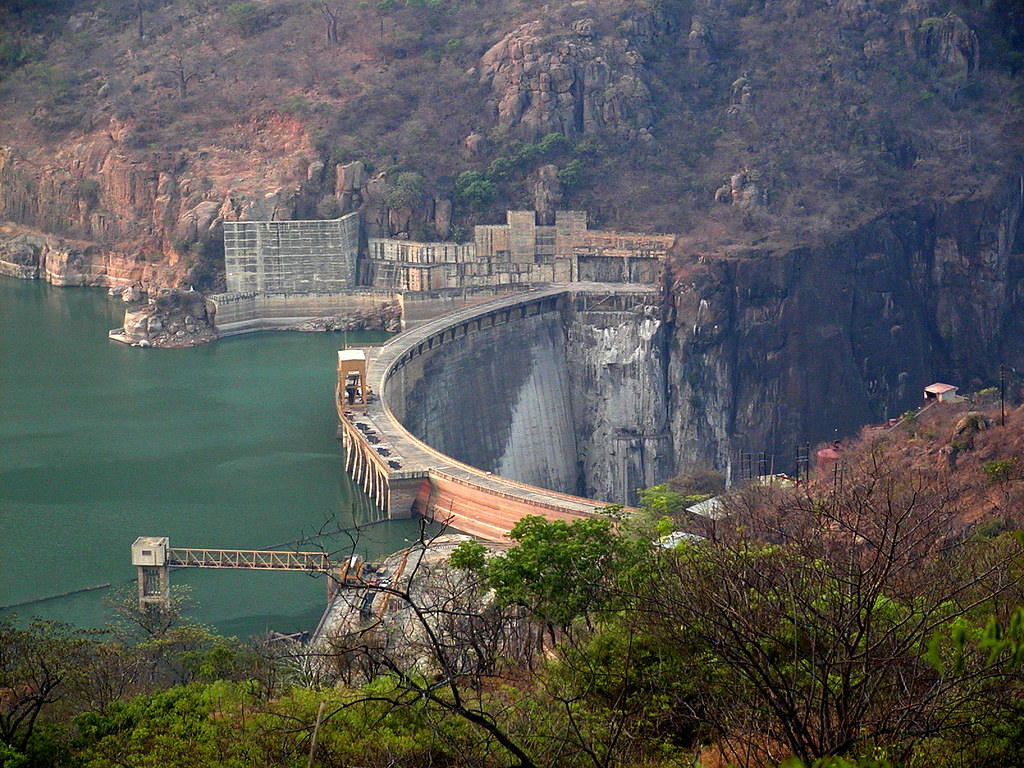
- Notícias in Maputo reports that Mozambique is in negotiations with neighbouring Zambia and Zimbabwe to allow 20 to 25 billion cubic metres of water from the Zambezi River to enter the country in order to address low water levels in the Cahora Bassa hydroelectric dam (HCB).
The possibility of negotiation was reported to Noticias by Agostinho Vilanculo, head of the Department of Basin Management at the Ministry of Public Works, Housing and Water Resources. At the moment, the storage level of the Cahora Bassa reservoir stands at 20%, whereas the normal level during the rainy season is at least 70%, corresponding to 30 to 35 billion cubic metres.
According to Agostinho Vilanculo, negotiations will be necessary because, in the event of rainfall upstream, these two countries will prioritize raising the levels of their dams.
“The water market is a possibility. It means negotiating and buying water from Zimbabwe and Zambia. Zambia was clear in saying that it will not allow more than 12 billion cubic meters to pass through, and this amount is not enough for us,” Vilanculo explained.
He emphasized that the ideal would be to allow at least 20 to 25 billion cubic meters of water to replenish the HCB reservoir.
But Zimbabwe and Zambia have their own water crisis at Lake Kariba. Kariba water allocation for electricity generation cut by almost half in 2024. The dam falls under the management of the Zambezi River Authority, a corporation jointly and equally owned by the governments of Zambia and Zimbabwe. Zimbabwe has a power station on the north bank (1050MW) while Zambia’s is on the south bank of the dam (1080MW). Zambia only produce 214MW last year and Zimbabwe was not much better.
Currently, Zambia’s energy utility, Zesco, is spending $90 million every month to import 500 MW of off peak power and annually it will be $1.08bn. By the end of a 3 year period, expenditure would reach $ 3.24bn and the problem will still be unresolved if the rainfall received does not improve.
This general outlook is highly influenced by the increasing occurrence of El Niño weather conditions, which are expected to significantly impact negatively, the rainfall season in Southern Africa. The 2024 rainfall profile outlook implies a high likelihood of below-normal Zambezi River inflows into Lake Kariba.
For Vilanculo, this negotiation alternative has the merit of considering the strong power generation capacity of HCB compared to the Kariba dam, located between Zambia and Zimbabwe, across the Zambezi River basin.
“HCB has a greater production capacity than Kariba, which is large, but with only low power. So, the alternative would be for us to fill HCB, produce and sell energy at reduced prices. I think it would be a reasonable solution, because normally the Zambezi flows until May,” he said.
The Kariba dam has a capacity of 181 billion cubic metres, but currently holds only around 6 billion. In turn, HCB has a capacity of 51 billion cubic metres, but is currently at 12 billion.
Author: Bryan Groenendaal