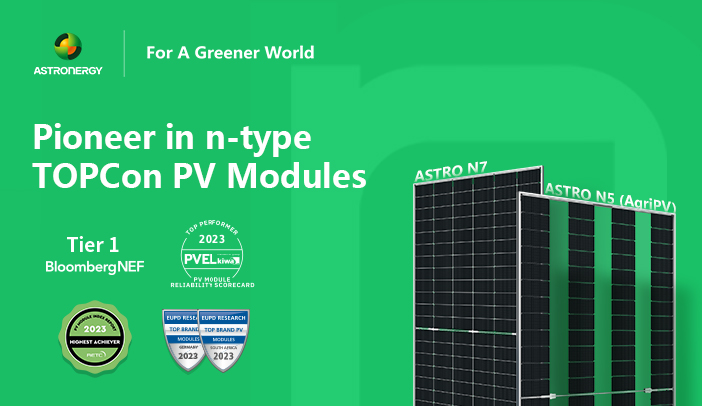
- During the World Future Energy Summit 2025 at the Abu Dhabi National Exhibition Centre from January 14-16, Astronergy showcased its ASTRO N series PV modules and their high-performance capabilities in various application scenarios.
The Middle East region’s extreme climate presents significant challenges for solar modules. Recognised with the LCOE Certificate from TÜV NORD and achieving less than 2% degradation in the UVID220 test by RETC, the ASTRO N7 demonstrates exceptional performance in diverse challenging conditions, making it a trusted choice for local applications.
During the summit, TÜV Rheinland and Astronergy signed a strategic cooperation agreement to pursue the IEC TS 63126:2020 Level 2 module testing certification. Established by the International Electrotechnical Commission (IEC), the test evaluates the performance of PV modules under high-temperature conditions over extended periods. Astronergy had previously received the world’s first IEC TS 63126:2020 (2 PfG 2971) certificate by TÜV Rheinland. By signing the Level 2 testing that includes temperature increases of up to 110°C compared to Level 1, Astronergy aims to further enhance its products’ performance in extreme environments.

With larger wafers, Astronergy ASTRO N7 products to drop PV power station costs to lower level. Image credit: Astronergy
In other news, Astronergy’s ASTRO N7s ZBB-TOPCon module products have successfully passed the rigorous tests conducted by TÜV NORD, and have been awarded three certificates, including the world’s first UVID-Free certificate, IEC TS 63126 Extended High Temperature (Level 2) certificate, and IEC 62892 Extended Thermal Cycling (TC) certificate. These awards demonstrate the high reliability of Astronergy’s ZBB-TOPCon products in extreme environmental conditions.
The UVID-Free certificate highlights the superior UVID performance of Astronergy’s ZBB-TOPCon modules. During testing, these modules were exposed to UV120 irradiation (120kWh/m²) and demonstrated ultra-low degradation with stable power output even after UV exposure for a long period.
The IEC TS 63126 extended high-temperature test includes a series of thermal cycling tests, hot spot rigorous tests, etc. Notably, among those tests under Level 2 conditions, the maximum temperature is up to 110℃. As for the average temperature increase, it is 10℃ higher than Level 1 and 20~25℃ higher than standard. This certificate proves the ability of Astronergy’s ZBB-TOPCon modules to deliver efficient, stable power in harsh environments, such as deserts and the rooftops of high-temperature industrial factories, with reduced hot spot risk and excellent reliability.
The IEC 62892 extended Thermal Cycling (TC) certificate tested the modules through 392 cycles between -40℃~110℃. Featuring higher temperatures, a broader temperature range, and more cycles than conventional TC test, this stringent certificate further showcases the ZBB-TOPCon modules’ capability to maintain long-term stability in demanding conditions.
Astronergy is the first manufacturer in the industry to realise the mass production of ZBB-TOPCon PV modules. The company believes that ZBB-TOPCon technology will drive the next innovation trend in the industry and become mainstream in the future. With continuously upgrading ZBB-TOPCon technology, Astronergy is not just providing customers with first-rate solutions but creating a greener world for all!
Author: Bryan Groenendaal