
- Combined energy availability factor rises to 62 percent in 2025, but coal fleet lags at 58 percent.
- Forty percent of coal stations operated at 50 percent availability or less during the year.
- Investigative analysis by amaBhungane highlights persistent breakdown risks and cost pressures
South Africa marked a turning point in April 2024 when loadshedding was suspended after six years of rolling power cuts. For the first time in years, households and businesses operated without daily alerts and emergency diesel generation.
However, new analysis by the amaBhungane Centre for Investigative Journalism shows that while Eskom’s performance has improved, structural weaknesses remain embedded within its coal fleet.
Using station level performance data provided by Eskom, amaBhungane assessed trends in energy availability, planned maintenance and unplanned breakdowns across the utility’s generation portfolio. The data, which is not publicly available but has been shared with amaBhungane since 2022 in the spirit of transparency, covers the period from January 2015 to December 2025.
Headline improvement masks coal constraints
Eskom achieved a combined energy availability factor of 62 percent in 2025, up from 59 percent in 2024 and 55 percent in 2023. While this remains below the official 80 percent target, the upward trajectory represents a notable recovery from crisis levels.
However, as amaBhungane’s analysis highlights, aggregating all technologies into a single figure obscures the performance of coal, which accounts for 84 percent of installed capacity. Nuclear contributes 4 percent, pumped storage and hydro 7 percent, and diesel fired open cycle gas turbines 6 percent. These technologies generally deliver higher availability and lift the overall average.
When coal is considered in isolation, the energy availability factor drops to 58 percent in 2025. This means coal fired stations were unavailable 42 percent of the time, either due to planned maintenance or unplanned failures.

Image credit: amaBhungane
Breakdown rates remain elevated
To assess operational health more accurately, amaBhungane focused on the unplanned capacity loss factor, which measures time lost to unexpected breakdowns.
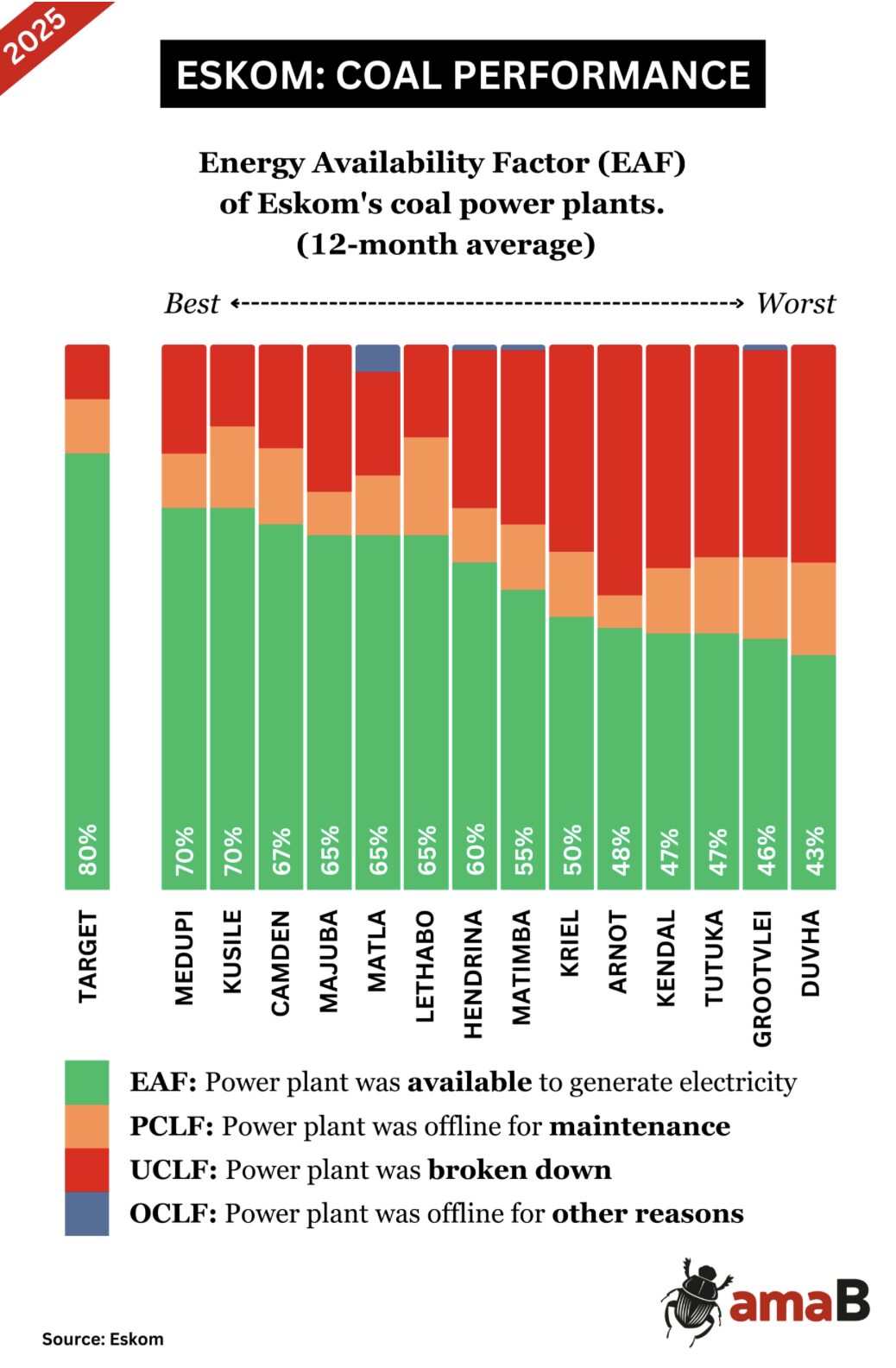
In 2025, half of Eskom’s coal fleet spent more than 30 percent of the year offline for unplanned repairs. The official target is 10 percent. Only Kusile, one of Eskom’s newer power stations, approached acceptable levels at 15 percent.
The situation has improved compared with 2022, when coal fleet energy availability stood at 53 percent and breakdowns accounted for 35 percent of operating time. By 2025, breakdowns had declined to 29 percent. Despite the gains, amaBhungane’s findings indicate that the fleet remains fragile.
High breakdown rates carry a double cost. They increase the risk of renewed loadshedding and inflate the price of electricity, as repair costs must be recovered over fewer megawatt hours generated.
To bridge supply gaps, Eskom continues to rely on diesel fired open cycle gas turbines. Diesel expenditure has fallen sharply from R33 billion in the 2022 to 2023 financial year to R5 billion year to date. Nevertheless, ongoing diesel use underscores continuing strain within the system.

Uneven recovery across stations
According to amaBhungane’s analysis, most coal stations improved between 2024 and 2025. Tutuka power station, once associated with severe operational and governance challenges, nearly doubled its energy availability factor over the past year.
Despite this improvement, six stations, Arnot, Duvha, Grootvlei, Kendal, Kriel and Tutuka, representing 40 percent of the coal fleet, recorded energy availability factors of 50 percent or lower.
Duvha, located near Emalahleni, was the weakest performer at 43 percent. This places its output performance close to wind energy capacity factors, which averaged 35 percent according to Eskom data. While capacity factor and energy availability factor are not identical metrics, the comparison illustrates the declining competitiveness of certain ageing coal assets.

Retirement plans and market reform
Five coal fired power stations, representing 20 percent of the fleet, are scheduled for retirement by 2030. Eskom’s medium term outlook assumes their continued operation, despite rising maintenance costs and safety concerns linked to ageing equipment.
Historical cost data cited by amaBhungane underscores the financial burden. In 2019, a routine outage for a single unit at Tutuka was budgeted at R523 million, while replacing unsafe switchgear was estimated at R1.2 billion. Such investments materially increase the cost of coal generation.
The findings come against the backdrop of electricity sector reform. Government initiated Eskom’s unbundling in 2019, with plans for the transmission business to operate as a standalone entity alongside an independent system operator by 2030.
Recent proposals to revise aspects of the unbundling framework have triggered concern within the private sector. Stakeholders fear that control over transmission assets could enable Eskom Generation to shield underperforming coal stations from full market competition.
Transparency and accountability
amaBhungane argues that transparent, station level data is essential to ensure fair pricing, informed investment and long term energy security.
While Eskom has succeeded in lifting overall energy availability and reducing breakdown rates, the investigative analysis makes clear that the ageing coal fleet is not a guaranteed safeguard against future supply disruptions.
In the context of a liberalising power market, granular performance data will be critical in determining which assets remain viable and which should make way for more competitive and lower cost generation technologies.
Author: Bryan Groenendaal
Link to Susan Comrie’s original article HERE
The amaBhungane Centre for Investigative Journalism, an independent non-profit, produced this story. Like it? Be an amaB Supporter to help them do more. Sign up for their newsletter to get more.