
- Africa installed at least 2.4 GW of new solar capacity in 2025, with cumulative operational capacity now officially tracked at 23.4 GW.
- New analysis suggests total installed solar capacity could be as high as 63.9 GW when accounting for module imports from China.
- Africa emerges as the fastest growing solar region globally, drawing increased attention from international manufacturers.
Africa installed a minimum of 2.4 GW of solar capacity in 2025, according to the Africa Solar Industry Association Africa Solar Outlook 2026 report, underscoring continued momentum across the continent’s renewable energy market.
Using a bottom up project tracking methodology, AFSIA identified and monitored more than 42,000 individual solar projects by the end of 2025. The association describes this as the most comprehensive project database in the African solar industry to date. The number of identified projects increased by around 40% compared to the end of 2024, with projects across all development stages representing a combined capacity of 296 GW. Of this total, 23.4 GW is now operational, reflecting a 26% increase in operating capacity year on year.
AFSIA’s revised figures also show that solar deployment in 2024 was higher than previously reported. While the association initially recorded 2.5 GW installed during that year, a further 1.2 GW of projects that came online in 2024 has since been added to its database, bringing the revised total for the year to 3.7 GW.
Despite this growth, the report argues that official statistics may still significantly underestimate the true scale of solar in Africa. Chinese export data indicates that 58.1 GW of solar modules have been shipped to African countries since 2017, including 16.1 GW in 2025 alone. By extrapolating exports prior to 2017, AFSIA estimates that total installed solar capacity across the continent could reach 63.9 GW. This suggests solar may be up to 2.75 times more prevalent in Africa than previously assumed.
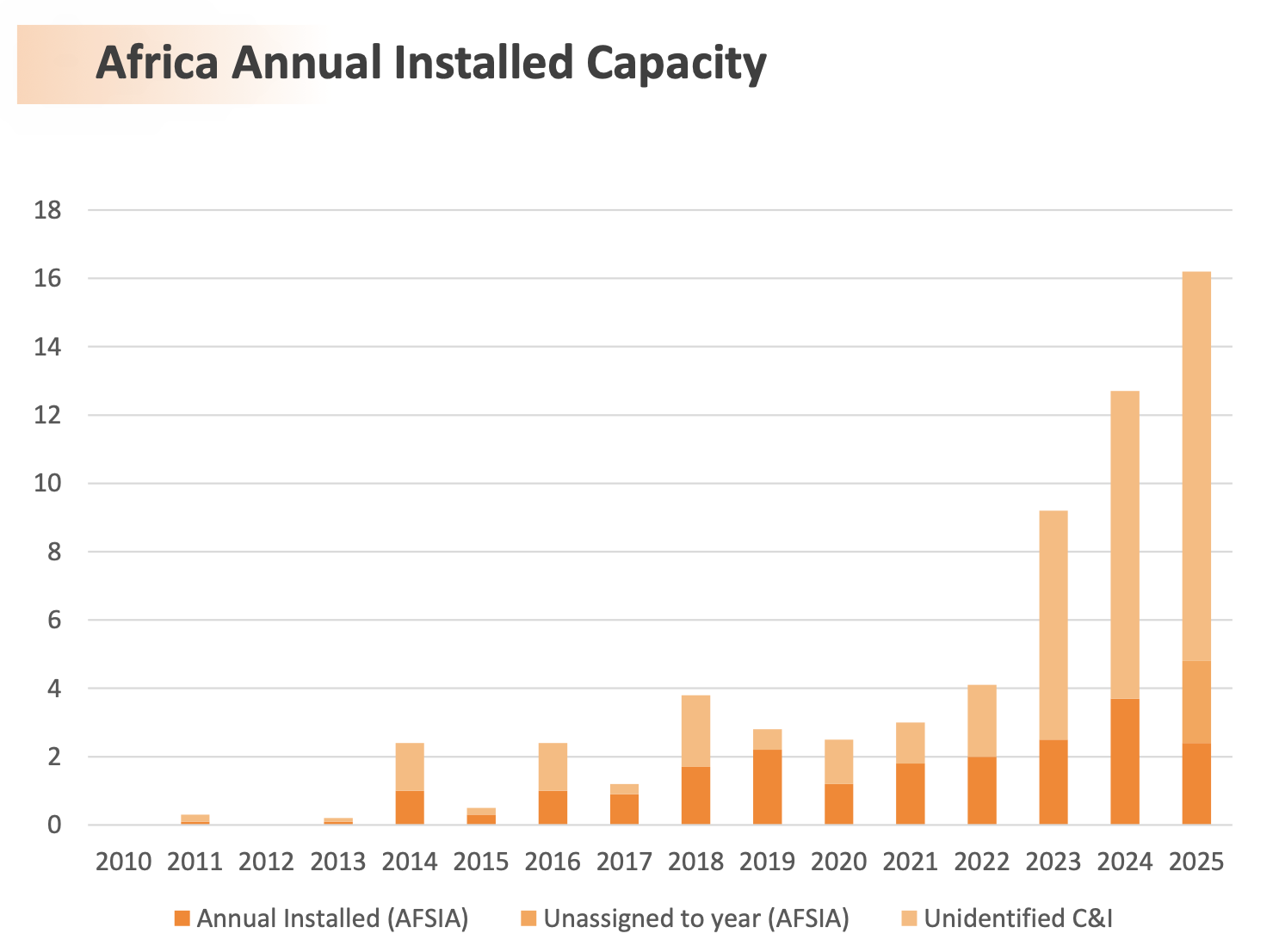
Image credit: AFSIA
These findings indicate that while Africa still represents a relatively small share of the global solar market, its importance has been understated. The continent’s share of global installed capacity may be closer to 2.6% rather than the commonly cited figure of below 1%, according to the report.
When Chinese export data is taken into account, Africa was the fastest growing solar region globally in 2025, with a compound annual growth rate of 17%, compared to a global average of 2%. AFSIA notes that this rapid growth has already prompted several major international manufacturers to target Africa as a strategic growth market, with some establishing local manufacturing facilities.
In his commentary, AFSIA chief executive officer John van Zuylen said the new data challenges long held perceptions that Africa is one of the least attractive solar markets worldwide.
“Africa now appears to be experiencing one of the fastest growths on the globe and therefore becoming a key market to tap into for all types of industry stakeholders,” he wrote. “The next few years will show if this growth is only temporary or is based on strong foundations that make solar the unavoidable way forward to electrify the African continent.”
The association believes most of the currently unidentified solar capacity is concentrated in commercial and industrial as well as residential installations. Utility scale projects are typically well documented, while off grid systems, minigrids and government led programmes are more consistently reported. Based on industry interviews, AFSIA estimates that 85% of untracked capacity sits in the commercial and industrial segment, with the remaining 15% in the residential market.
Author: Bryan Groenendaal
es on the African continent, email: africa@jasolar.com