- The Zambezi River Authority (ZRA) has allocated 30 billion cubic metres of water for power generation at Lake Kariba for the 2025/26 operational year, 15 billion cubic metres each to Zambia’s ZESCO Limited and the Zimbabwe Power Company (ZPC).
The increase from 28 billion cubic metres last year follows forecasts of normal to above-normal rainfall for the coming season by the Southern Africa Climate Outlook Forum (SARCOF-31) and the meteorological agencies of Zambia and Zimbabwe.
While rainfall across the Zambezi Basin during the 2024/25 season was within the normal range, lake levels remained below historical averages but above those recorded during the 2023/24 drought. The ZRA emphasised that it allocates water only and does not manage electricity generation or distribution, advising consumers to seek power-supply updates from ZESCO and ZPC.
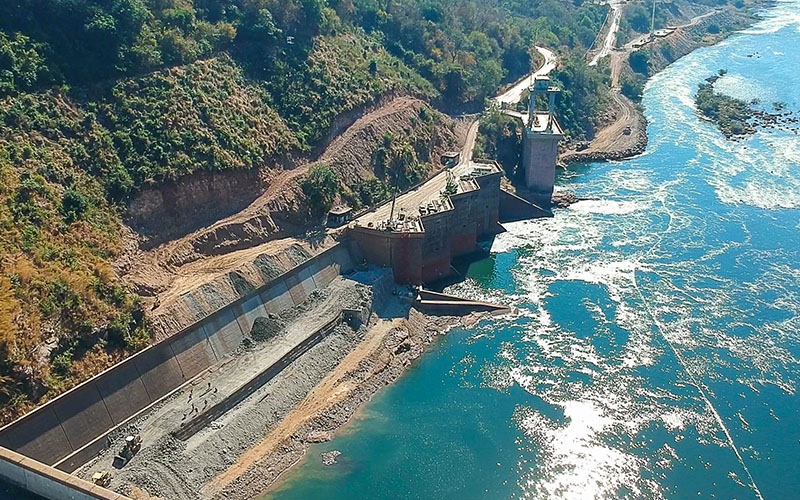
Image credit: Kariba Dam Rehabilitation Project (KDRP).
Meanwhile, the $294-million Kariba Dam Rehabilitation Project, launched in 2017, is nearing completion. The reshaping of the dam’s plunge pool was finalised in 2024, and refurbishment of the spillway’s six sluices is 99% complete, with overall works expected to finish by September 2026.
ZRA acting chief executive Christopher Chisense said the upgrades address erosion and operational risks, securing the dam’s future “as a cornerstone of regional energy security.” Supported by the World Bank, African Development Bank, EU and other partners, the project is expected to extend the dam’s lifespan by at least 50 years and enhance flood-management capacity.
Despite earlier delays linked to geological challenges, Covid-19 disruptions and design revisions, progress is now steady. The works have proceeded without interrupting electricity generation and have incorporated robust environmental, safety and community-protection measures.
Chisense noted that the project also strengthens the foundation for future regional hydropower schemes, including the proposed 2 400 MW Batoka Gorge project, while building technical and institutional capacity within the ZRA.
Author: Bryan Groenendaal