- Sasol expects a steep drop in earnings for the six months ended 31 December 2025 driven by lower oil and chemical prices and higher impairments.
- Headline earnings remain more resilient, supported by stronger refining margins, higher sales volumes and disciplined cost control.
- Civil society group Just Share renews criticism of Sasol’s climate transition strategy, urging investors to oppose the company’s say on climate resolution
Sasol has issued a trading statement warning of a significant decline in earnings for the six months ended 31 December 2025, reflecting a challenging operating and macroeconomic environment alongside substantial asset impairments.
The company expects earnings per share to be between R0,10 and R0,80, down sharply from R7,22 in the prior period. This represents a decrease of between 89 percent and 99 percent. Headline earnings per share are expected to range between R8,50 and R10,00, compared to R14,13 previously, a decline of 29 percent to 40 percent. Adjusted earnings before interest, tax, depreciation and amortisation are forecast at between R19 billion and R23 billion, down from R24 billion in the prior period.
According to Sasol, the weaker earnings outcome was mainly driven by a 17 percent decline in the average rand per barrel Brent crude oil price, a 3 percent decrease in the average United States dollar per ton chemicals basket price, and impairments of R7,8 billion before tax, compared to R5,7 billion in the prior period.
These pressures were partially offset by a more than 100 percent increase in refining margins following improved fuel differentials, a 3 percent increase in sales volumes supported by improved operational performance, and continued cost reductions driven by disciplined cost management.
Despite the lower earnings, Sasol expects overall free cash flow generation to improve compared to the prior period, largely due to reduced capital expenditure.
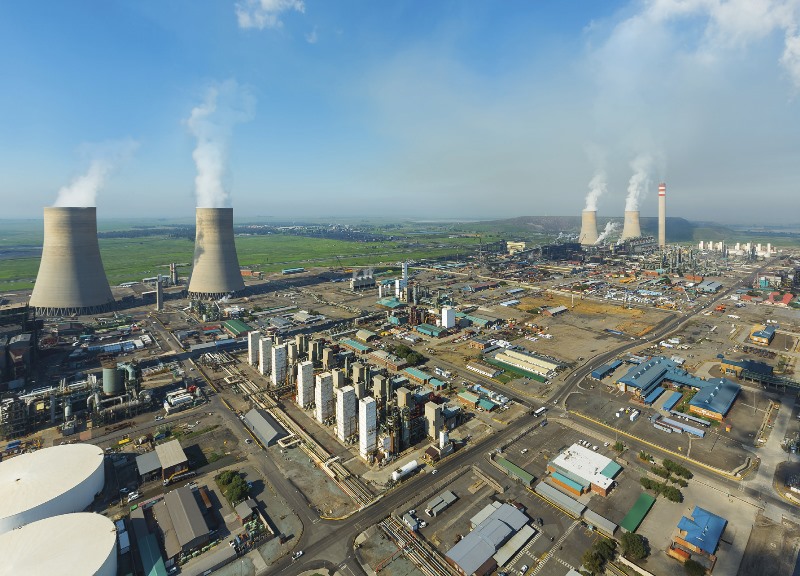
The company highlighted two major impairments during the period. The Secunda liquid fuels refinery cash generating unit remains fully impaired, with the full R3 billion of costs capitalised during the period written off. In addition, Sasol impaired its production sharing agreement development in Mozambique by R3,9 billion. While total gas resources remain unchanged, a revision to the expected production profile has delayed gas monetisation, with the strengthening of the rand against the United States dollar also contributing to the impairment.
Sasol noted that the financial information underpinning the trading statement has not been reviewed or reported on by its external auditors. The group will present its interim financial results on 23 February 2026, followed by a market call hosted by president and chief executive officer Simon Baloyi and chief financial officer Walt Bruns.

Simon Baloyi is Chief Executive Officer of Sasol. Image credit: Sasol
Alongside the financial update, Sasol continues to face growing scrutiny over its climate strategy. Shareholder advocacy organisation Just Share has renewed its call for investors to vote against Sasol’s latest non-binding say on climate resolution, arguing that the company’s updated emissions reduction roadmap lacks transparency, credibility and scientific integrity.
In a recent briefing on Sasol’s 2025 climate disclosures, Just Share questioned the feasibility of the company’s plan to achieve a 30 percent emissions reduction by 2030 without replacing coal with gas in its feedstock, while increasing production levels. The organisation argues that reliance on renewable energy projects and carbon credits to offset higher emissions does not deliver real world decarbonisation, particularly given that most of Sasol’s emissions stem from its coal to liquid operations at Secunda.
Just Share has also raised concerns about Sasol’s climate governance practices, including the structure of its say on climate vote and the company’s refusal to table a shareholder resolution calling for an independent assessment of the health, environmental and economic costs of pollution from its Secunda operations.
The group warns that without incorporating the full external costs of emissions, investors are unable to assess the true financial, regulatory and reputational risks facing Sasol as the energy transition accelerates across Africa and globally.
Author: Bryan Groenendaal