

- Minister says natural gas is essential for industrialisation and a realistic energy transition in Africa.
- About 600 million Africans still lack access to electricity, creating a major social and economic challenge.
- South Africa pursues gas imports and domestic exploration to secure long term supply.
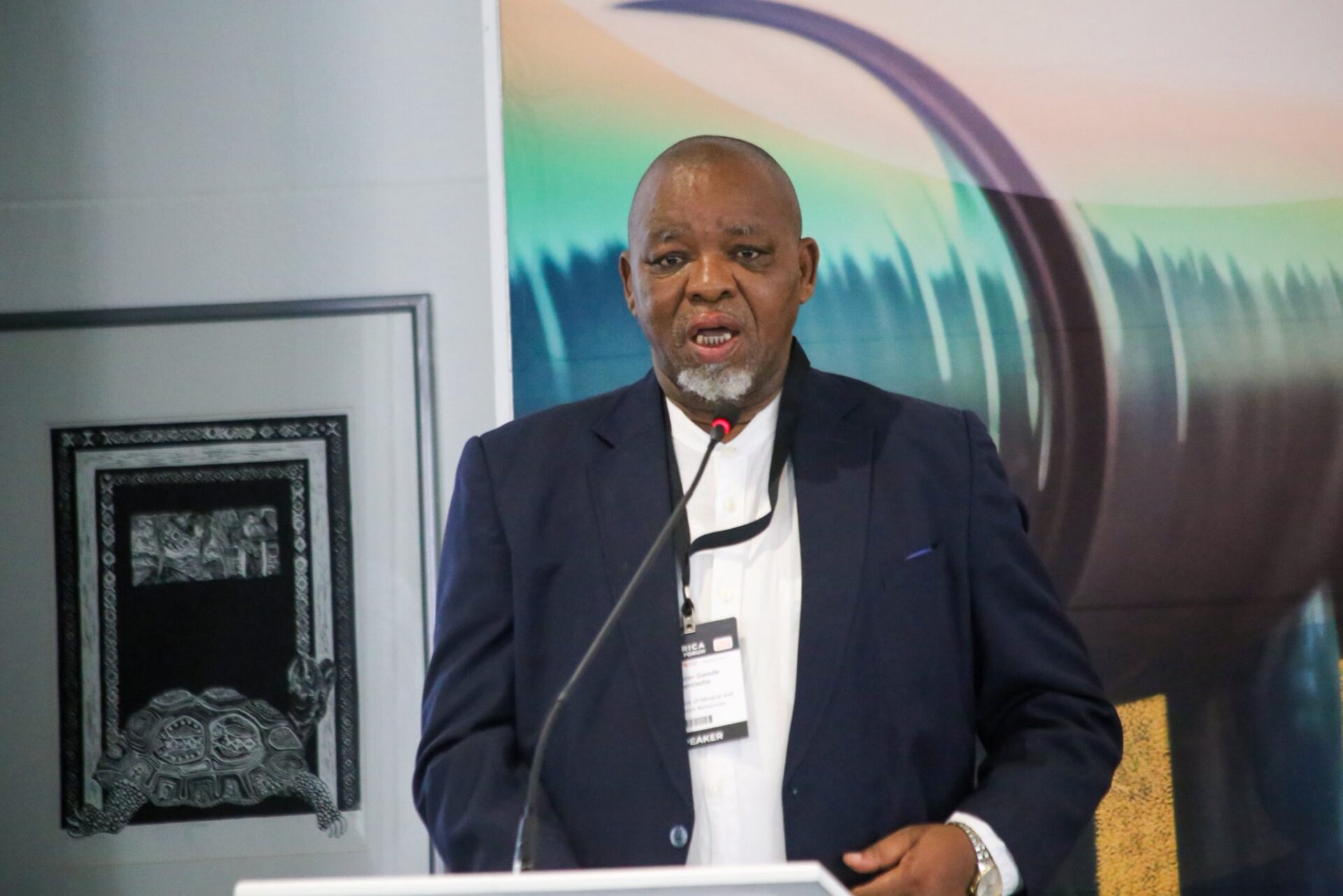
Mineral and Petroleum Resources Minister Gwede Mantashe has strongly defended the development of natural gas in Africa, describing it as critical to industrialisation and to achieving a just and realistic energy transition for the continent. Mantashe made the remarks during the 11th Africa Gas Forum, held alongside the Africa Energy Indaba in Cape Town.
According to the International Energy Agency, about 600 million Africans still lack access to electricity. Mantashe said the situation represents both a social and industrial crisis for the continent.
Without reliable energy, he said, countries cannot build a manufacturing base, expand mineral beneficiation or create meaningful employment. He argued that Africa must shift its narrative from one focused on energy shortages to one centred on industrial development supported by reliable energy resources.
Africa holds about 7% of the world’s known natural gas reserves while contributing less than 4% of global greenhouse gas emissions. In that context, Mantashe said the strategic use of domestic gas resources is essential to a fair energy transition that reflects the continent’s economic realities.
Energy analysts widely regard natural gas as the most practical transition fuel for Africa because it provides reliable baseload power with lower emissions than coal. Mantashe said gas can serve as the bridge that enables industrial expansion while reducing the carbon intensity of energy systems across the continent.
The Africa Gas Forum, he added, provides a platform for African countries to examine how gas resources can support industrial growth and economic transformation.
South Africa faces a critical moment in its gas supply outlook as production from Mozambique’s Pande and Temane gas fields begins to decline. These fields have supplied about 90% of South Africa’s gas demand for more than two decades.
Mantashe warned that the decline presents a national economic risk if replacement supply is not secured.
To avoid supply disruptions, government is pursuing a two pronged strategy that combines short term imports with accelerated domestic gas development.
A proposed methane rich gas solution from Sasol is expected to act as a bridging supply between 2028 and 2030, providing time for the country to complete its liquefied natural gas import infrastructure.
At the same time, exploration activity continues in several offshore and onshore basins.
The Orange Basin on South Africa’s west coast has attracted strong interest following major discoveries in neighbouring Namibia. Companies including TotalEnergies and Shell are advancing exploration programmes that could significantly expand the country’s resource base.
In the Outeniqua Basin, Africa Energy Corp is progressing development of the Brulpadda and Luiperd discoveries.
Onshore projects are also moving forward. The Virginia Gas Project in the Free State has reported a 60% increase in gas throughput since 2025 and maintains an 80% drilling success rate.
Thungela Resources is advancing its Lephalale coal bed methane project while Kinetiko is developing a gas project in Mpumalanga. Both companies are moving toward production following successful drilling campaigns.
Government is also progressing research into shale gas potential in the Central Karoo. A seismic survey completed last month has improved geological understanding of the basin. Mantashe said the current moratorium on shale gas development could be lifted once the required regulations are finalised.
Regulatory reforms are being introduced to support investment in the sector.
The Upstream Petroleum Resources Development Act separates petroleum regulation from mining legislation and introduces a single petroleum right covering both exploration and production. The law also provides for a 20% carried interest for the state in projects.
In addition, the proposed South African National Petroleum Company Bill aims to establish a unified state owned company to manage the country’s strategic petroleum interests.
Mantashe said these reforms signal that the period of policy uncertainty in the sector is coming to an end. He told investors that the regulatory framework is stabilising, infrastructure development is progressing and demand fundamentals remain strong. The next step, he said, is to strengthen midstream infrastructure and downstream market development so that gas resources can be converted into industrial output, employment and long term economic resilience.
Author: Bryan Groenendaal