
- FOB China: The Chinese Module Marker (CMM), the OPIS benchmark assessment for TOPCon modules from China dropped 1.15% on the week to $0.086/W Free-On-Board (FOB) China, amid lower price indications between $0.080-0.092/W.
Despite upstream price firmness, module prices remain under pressure as manufacturers continue lowering offer indications. A top-five module maker told OPIS that 2025 loading prices have not meaningfully increased, even with higher upstream costs. Current offers from leading manufacturers of utility-scale projects are in the low-$0.080/W range.
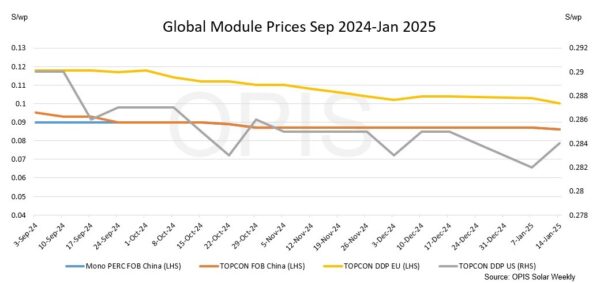
The FOB China TOPCon module price for the first-half 2025 loading was at $0.085/W, with values between $0.082-0.087/W. For second-half 2025, prices fell 1.2% at $0.084/W, with lower indications from $0.082-0.087/W. First-quarter 2026 prices were assessed at $0.083/W, with prices quoted from $0.083-0.087/W.
DDP Europe: TOPCon modules slightly dropped, while the market is waiting for price directions at the start of the new year. OPIS assessed the average price at €0.098/W, down 1.01% with indications between a low of €0.080/W and a high of €0.115/W for Tier1 panels.
European players are closely following the Chinese manufacturing industry’s efforts to rebalance supply and demand through controlled production cuts. EU sources pointed out that this might result in a small price rise after the upcoming Chinese New Year festivities, at the end of January.
But the remaining big picture for now will be low prices as inventories in Europe are still too large and distributors need cash. “That’s why we saw a lot of dumping prices in December”, sources told OPIS.
On the residential side, demand for solar panels is different from country to country, as legislations and subsidy schemes are different. While Germany promotes rooftops and balcony applications, Italy focuses on smaller projects and Eastern Europe drives on bigger size solar installations.
Average EXW prices from distributors for residential solar panels are reported between €0.125/W and €0.100/W, depending on the volumes.
US DDP: The spot price for TOPCon utility-scale modules DDP US rose this week from 0.71% to $0.284/W. On a forward-looking basis, OPIS is assessing the cost of TOPCon modules at $0.293/W in the second quarter of 2025, $0.291/W in the third quarter and $0.282/W at the end of the year and into 2026.
One developer source says they are seeing $0.29/W to $0.32/W quoted for TOPCon modules from “preferred” manufacturers in countries subject to the ongoing AD/CVD case, while American producers assembling modules with Indonesian cells are offering prices in the low 0.20s/W.
Concerns around potential changes to the Inflation Reduction Act are widespread, and companies continue to safe harbor equipment in order to secure 2025 eligibility for the Investment Tax Credit. The developer source said his company is focusing on buying high-voltage breakers and generator step-up (GSU) transformers. The consultant source said a major community solar developer is focusing their own strategy on projects sited in “energy communities,” for fear the tax credit adder might be on the chopping block.
Source: OPIS
OPIS, a Dow Jones company, provides energy prices, news, data, and analysis on gasoline, diesel, jet fuel, LPG/NGL, coal, metals, and chemicals, as well as renewable fuels and environmental commodities. It acquired pricing data assets from Singapore Solar Exchange in 2022 and now publishes the OPIS APAC Solar Weekly Report.
This article was originally published in pv magazine and is republished with permission.