- Global renewable capacity rose by 692 GW in 2025, reaching 5,149 GW, a 15.5% increase.
- Renewables accounted for 85.6% of total capacity additions, reinforcing energy security trends.
- Africa recorded a 15.9% rise, its strongest growth on record, led by key regional markets.
Global renewable energy capacity delivered another record performance in 2025, highlighting the sector’s resilience amid geopolitical uncertainty and rising energy security concerns. According to the latest report by the International Renewable Energy Agency, total installed renewable capacity reached 5,149 GW following the addition of 692 GW over the year, representing a 15.5% annual increase.
The findings confirm that renewable technologies continue to dominate global power expansion, accounting for 85.6% of all new capacity additions, while non renewable sources contributed a declining share.
The rapid growth comes at a time when geopolitical tensions, particularly in the Middle East, are intensifying concerns over fossil fuel supply security and price volatility. Renewable energy is increasingly viewed as a strategic solution, offering domestically sourced, cost effective and rapidly deployable alternatives that reduce exposure to global fuel market disruptions.
Francesco La Camera, Director General of International Renewable Energy Agency, said the consistent expansion of renewables underscores their structural resilience. He noted that countries investing in energy transition are experiencing lower economic impacts during global crises while strengthening competitiveness and energy security through more decentralised systems.
Solar energy remained the dominant driver of growth in 2025, contributing 511 GW, or around 75% of total renewable additions. Wind energy followed with 159 GW. Together, solar and wind accounted for 96.8% of net renewable capacity growth, supported by continued cost reductions across both technologies. Bioenergy ranked third, adding 3.4 GW and recording 2.3% annual growth.
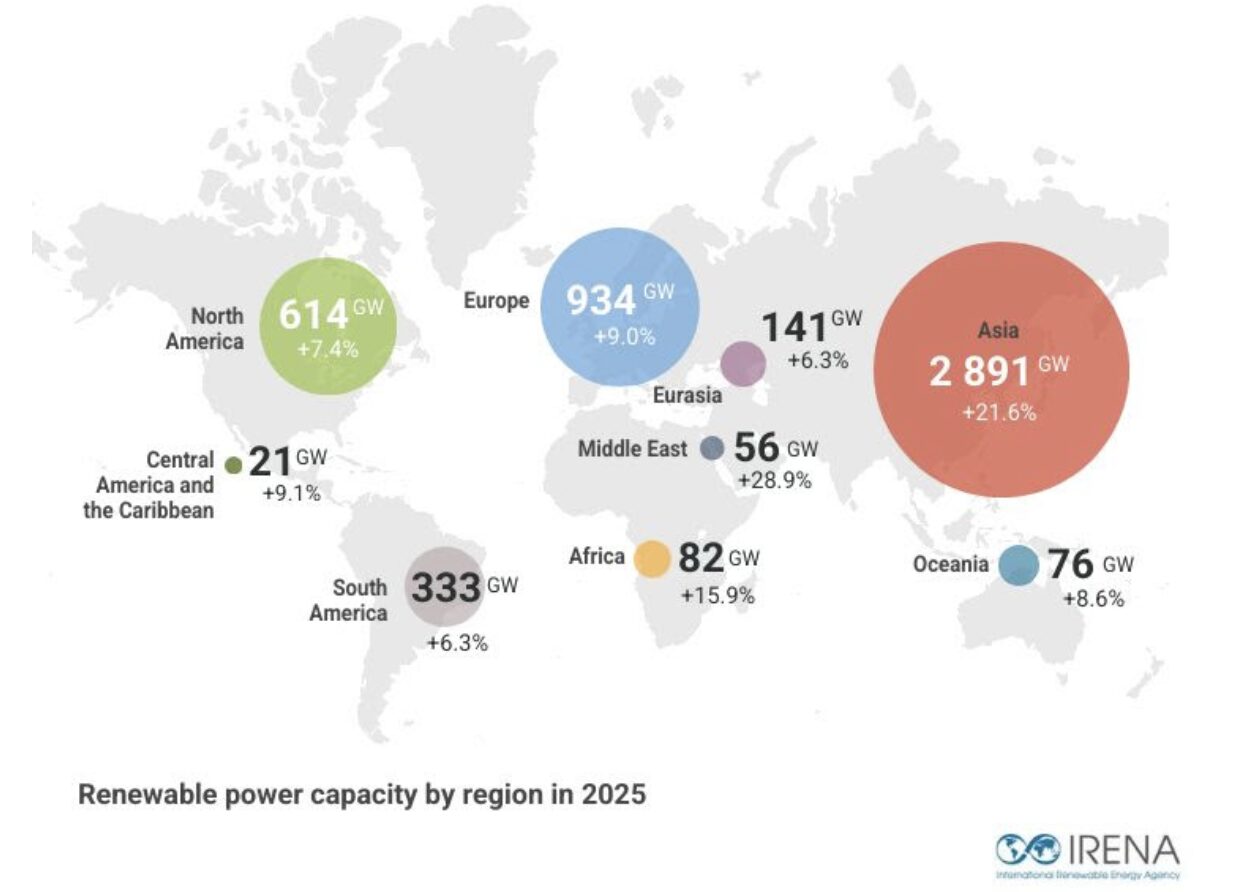
Despite the strong global performance, regional disparities remain significant. Asia led the expansion with a 74.2% share of new capacity, adding 513.3 GW and achieving a growth rate of 21.6%. Africa recorded its highest ever increase, with capacity rising by 15.9% or 11.3 GW, driven by markets such as Ethiopia, South Africa and Egypt. The Middle East also posted its fastest growth, expanding by 28.9%, led by Saudi Arabia.
In terms of total installed capacity, Asia maintained a commanding lead with 2,891 GW, followed by Europe at 934 GW. Central America and the Caribbean remained the smallest market, with just 21 GW of total renewable capacity in 2025. The imbalance highlights ongoing vulnerabilities in regions with limited renewable deployment and reinforces the urgency of scaling investments to enhance energy security.
Technology trends show solar photovoltaics accounted for virtually all solar additions, contributing 510.3 GW of the 511.2 GW total. Hydropower added 18.4 GW, with 96% of new capacity coming from China, while several countries including Ethiopia and India each contributed more than 0.5 GW.
Wind capacity grew by 14% year on year, with China responsible for nearly three quarters of the 158.7 GW added globally. Bioenergy expansion was led by Japan, which added 1.1 GW, followed by China and Brazil. Geothermal capacity increased modestly by 0.3 GW, with contributions from the Philippines, Indonesia and several European and Asian markets.
Off grid renewable solutions also continued to expand, adding 1.7 GW in 2025, largely driven by solar installations. This trend remains particularly relevant for underserved regions, including parts of Africa, where decentralised systems play a critical role in improving energy access.
The report reinforces the growing role of renewable energy as a cornerstone of resilient and secure power systems, particularly as countries seek to shield their economies from global energy shocks while accelerating the transition to low carbon development.
Link to the full report HERE
Author: Bryan Groenendaal