- The global solar market continued its growth trend in 2024, reaching new heights.
- However, several limitations such as policy uncertainty, protectionist measures and interconnection and transmission bottlenecks will bring the annual growth trend of solar buildout to a halt, according to Wood Mackenzie.
Wood Mackenzie recently released the “Global solar: four things to look for in 2025” report. Key themes to watch for include:adapting to a new, more uncertain policy paradigm, capitalizing on data centre growth, rationalisation in manufacturing, a new era of asset efficiency.
The solar industry adapts to a more uncertain policy paradigm
The global solar market reached 495 gigawatts (GW)dc of installed capacity in 2024, a 14% increase compared to 2023. However, the growth trend will likely reverse course in 2025, according to the report.
“Solar deployment will decelerate in many countries as policy changes come to fruition,” said Sylvia Leyva Martinez, principal analyst, Utility-scale solar PV, North America for Wood Mackenzie. “Post-election uncertainty, waning incentives, power sector reforms and a shift towards less ambitious climate agendas, will drive solar installations to stagnate at 493 GWdc after years of exponential growth.”
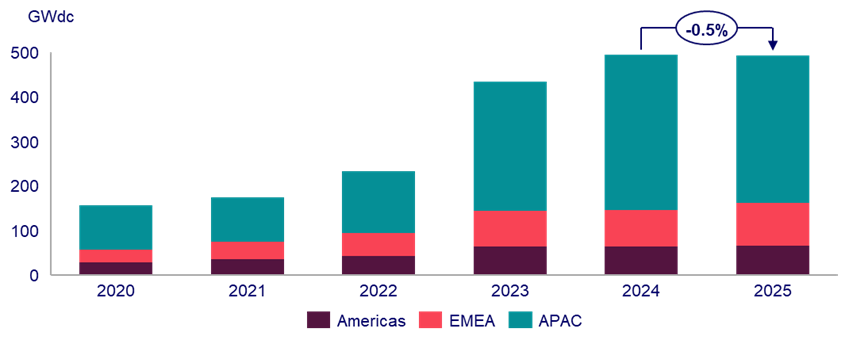
Global solar installations per region, 2020-2025 (GWdc). Source: Wood Mackenzie
Solar capitalises on data centre growth
Data centre demand will rise due to the adoption of artificial intelligence. While future demand growth from data centres is uncertain, Wood Mackenzie is tracking more than 100 GW of proposed data centres. Even if only 50 GW of this capacity is added over the next five years, demand growth over the next five years could be as high as 10-20% in many regions of the US.
“Data centre demand for firm, zero-emissions capacity will reshape solar project origination and development,” said Leyva Martinez. “A higher share of solar projects will be paired with wind, storage and/or natural gas to meet higher energy needs, and we will see innovation in contractual terms, business models, and system architectures. Data centre-driven competition for energy will increase solar Power Purchase Agreements (PPAs) prices.”
2025 will be the year of rationalisation in manufacturing
According to the report, after two years of low solar panel prices due to global overcapacity, module prices will increase to compensate for the significant losses in profits that manufacturers experienced.
“China will remain the dominant manufacturing hub, and emerging hubs in India, the US and the Middle East are expected to add at least 100 GW to the global solar manufacturing capacity,” said Yana Hryshko, managing consultant and head of global solar supply chain research for Wood Mackenzie. “Coordination by Chinese manufacturers, supported by the Chinese government, will be the key to bringing about rationalisation of the industry.”
Technology shifts in solar equipment will usher in a new era of asset efficiency
“Voltage inverter architecture will increase to 2000 Vdc lowering costs and improving scalability,” said Sagar Chopra, senior research analyst, solar for Wood Mackenzie. “AI-powered smart trackers will enhance efficiency, and robots will increasingly be used in construction and maintenance to address rising labour costs and shortages. The multi-decade path of continued solar technology improvement still has plenty of room to continue.”
Read the entire report here.
Author: Bryan Groenendaal
Source: Woodmac