- Despite tariffs targeting energy transition sectors, United States policy did not stifle overall trade growth in clean technology products.
- Persistent overcapacity driven by Chinese investment continues to compress margins across solar, batteries and electric vehicles.
- Geopolitical conflict in the Middle East underscores fossil fuel supply fragility and strengthens the case for clean energy deployment.
Global shipments of clean energy products reached US$ 479 billion in 2025, marking a 1% increase across clean technology, battery metals and grid equipment. The recovery follows a 7% decline in trade volumes between 2023 and 2024, indicating a stabilisation in global clean technology supply chains even amid rising geopolitical tension and tariff interventions.
According to BloombergNEF Energy Transition Supply Chains 2026 report, cross border clean technology trade expanded in 2025 despite the United States reinstating and revising multiple tariffs across energy transition sectors. The report highlights that global supply chains have become increasingly central to energy markets as policy volatility and geopolitical risk reshape investment and procurement strategies.
Rising conflict in the Middle East has contributed to higher global fossil fuel prices, placing additional pressure on import dependent economies in Asia and Africa. Analysts note that sustained high fuel costs are likely to accelerate imports of clean energy technologies, particularly solar equipment, batteries and electric vehicles, as countries seek to improve energy security and reduce exposure to volatile fuel markets.
BloombergNEF highlights that countries with higher dependence on fuel imports have historically recorded stronger growth in clean technology imports. Pakistan is cited as a key example, where solar module imports surged sharply in recent years, supporting rapid expansion of distributed generation capacity amid high electricity tariffs linked to liquefied natural gas imports and ongoing power shortages. Small scale solar installations reached record levels in 2025 as households and businesses sought alternatives to costly grid supply and load shedding conditions.
Antoine Vagneur Jones, head of trade and supply chains at BloombergNEF and lead author of the report, said escalating conflict is prompting many markets to accelerate clean technology deployment. He noted that energy security concerns are increasingly driving demand for imported clean energy equipment, creating significant opportunities for manufacturers across global supply chains.
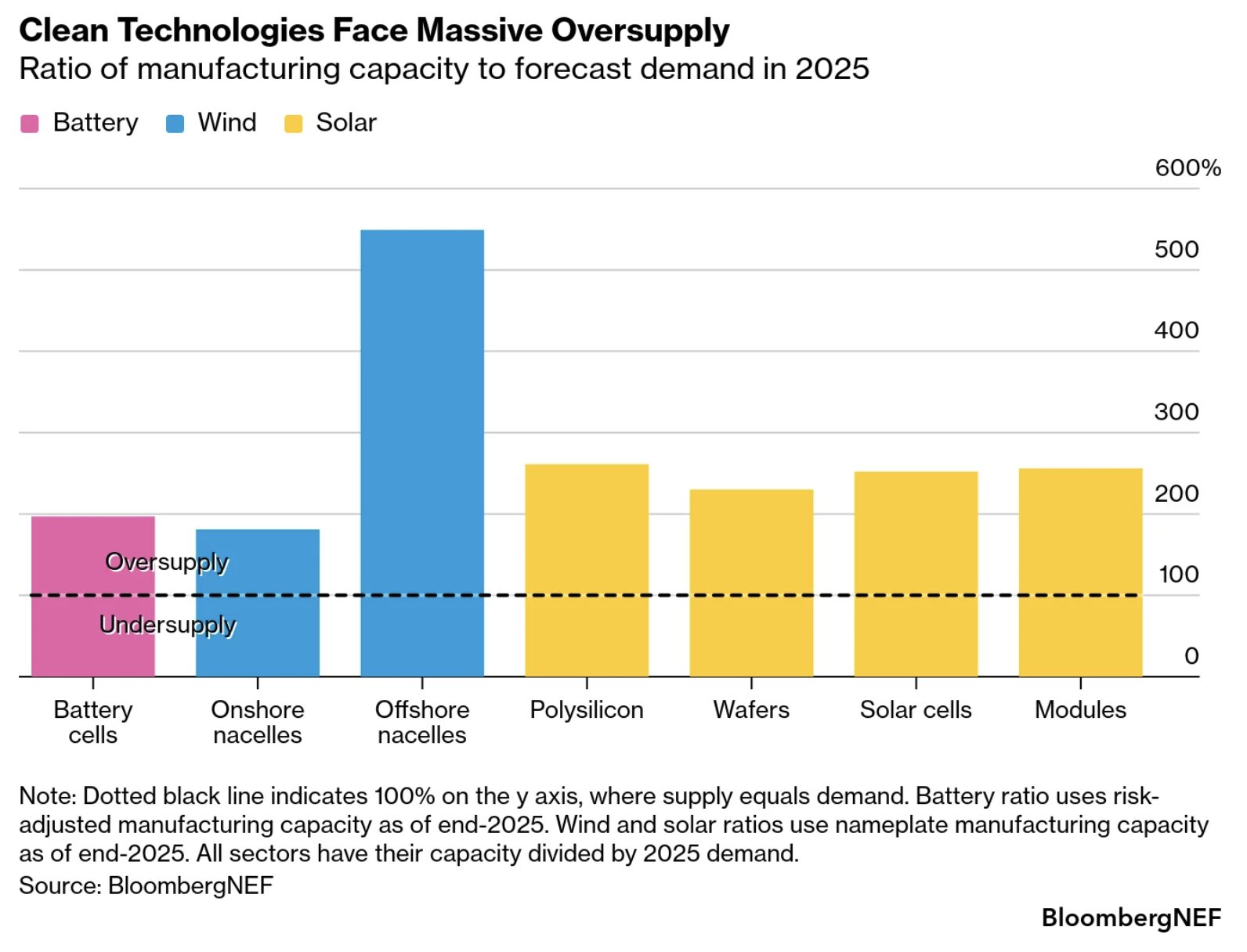
A central finding of the report is the persistence of structural overcapacity in clean technology manufacturing, largely driven by Chinese investment. Global production capacity is now estimated to exceed more than 200% of demand across the value chain, placing sustained pressure on pricing and margins. Oversupply conditions are evident across solar, wind and battery markets, with additional capacity emerging in Southeast Asia, India, Turkey, Egypt and Ethiopia.
Despite policy efforts in the United States and the European Union to onshore manufacturing, BloombergNEF finds limited prospects for these regions to become major exporters. While factory investment has increased, expansion has been concentrated in downstream assembly, with several projects delayed or cancelled due to weak demand signals and intensifying global competition.
Price trends reflect a mixed picture across technologies. Solar prices continued to decline in 2025, although at a slower pace, influenced in part by higher silver costs. Battery pack prices fell from US$ 118 per kilowatt hour in 2024 to US$ 108 per kilowatt hour in 2025, though again at a reduced rate of decline due to elevated battery metal prices. Onshore wind equipment prices edged higher as manufacturers attempted to recover margins lost in earlier periods of intense price competition.
The report also shows structural shifts in global solar trade. Solar cells now account for 44% of global solar trade, up from 25% the previous year, reflecting rapid diversification of module assembly outside China. India is emerging as a significant manufacturing hub, with growing downstream and midstream capacity positioning it as a potential exporter, alongside Turkey, which is also expanding its manufacturing footprint.
Battery trade is increasingly shaped by electric vehicle demand, although stationary energy storage systems are gaining share as deployment accelerates globally. Energy storage systems accounted for 29% of battery shipments in 2025, growing 64% year on year.
BloombergNEF concludes that economies exposed to high fossil fuel prices, particularly in Southeast Asia including Cambodia, Laos and Vietnam, are likely to continue scaling imports of clean energy technologies. Governments in these markets are simultaneously introducing policy measures to support adoption of cleaner and more resilient energy systems.
Author: Bryan Groenendaal